Applications
3D Pets Can Help Dogs Back on Their Feet With Just a 3D Printer and a Smartphone
Almost half of all canine limb amputations are either due to cancer treatment or accidents. While there have been multiple efforts focused on animal prostheses, it has often been more difficult to find an effective and widespread solution. For example,…
- 3 min read
- Applications
- Six more stories
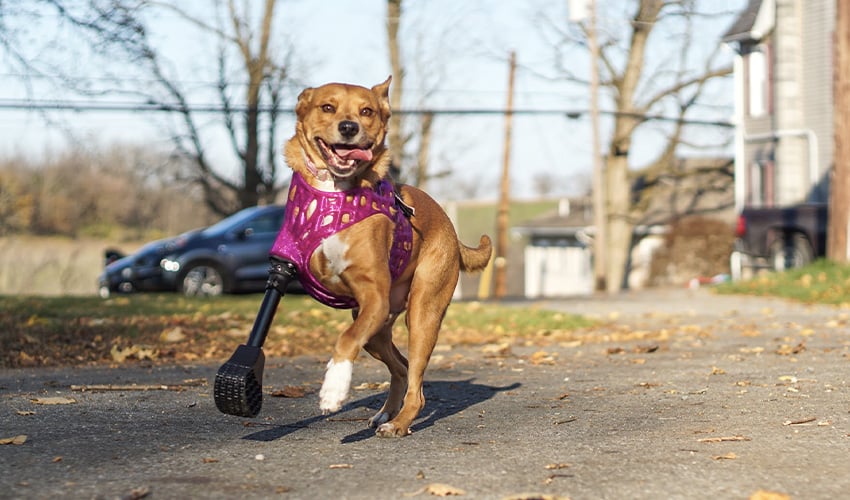
Almost half of all canine limb amputations are either due to cancer treatment or accidents. While there have been multiple efforts focused on animal prostheses, it has often been more difficult to find an effective and widespread solution. For example, dogs support 60% of their body weight on their front legs alone which is why it is so important to ensure that their weight is safely and evenly distributed. Without proper attention, a dog favoring one leg may develop more serious health conditions down the line. Fortunately, as advances in medical 3D printing have benefitted humans, so too has it helped our animal companions. To that end, New Jersey-based company 3D Pets has a simple goal, “to bring animal mobility into the 21st century”.
Formed as a subsidiary of 3D printing and design company, DiveDesign whom we have previously interviewed, the creation of 3D Pets as a separate entity gives their team the allowance to focus their resources and attention solely on the veterinary revolution. Their process involves creating custom dog prostheses for their canine clients. To do so, they have utilized FDM 3D printing and 3D scanning in order to map the accurate support and shape requirements of each animal. However unlike a large, cumbersome device used in some hospital or clinic, they use a technology much closer to home: smartphones.
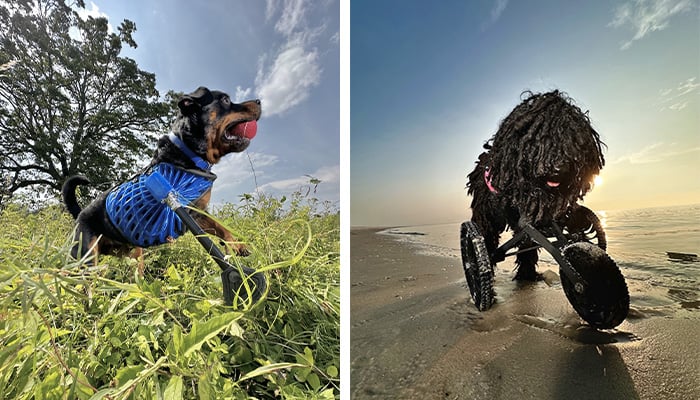
3D Pets offers a modular design that can accommodate different types of prostheses.
3D Pets Custom Solution Focused on Individual Needs
Not the first object you may think of when thinking about 3D scanning, using a smartphone makes ingenious use of modern technology and the advanced cameras that are quickly becoming run-of-the-mill on new phones. The process takes several steps: after filling out a questionnaire in order to determine the best style of device needed for the patient, the company sends the client a molding kit to create a rigid mold of the animal’s body. Once the mold is complete, the team is able to use a smartphone’s LiDAR and TrueDepth cameras to get a 360 degree scan the mold that can be uploaded as a digital file. After rendering in a modeling software application, the mold can be modified to best suit the animal’s body. This fine tuning process is an important step because it considers the dog’s unique shape, size and prosthetic need in order to maximize both their comfort and mobility.
More from the desk
Six other notes from the rest of the bench.
 MaterialsSUNLU Launches AMS Lite Heater, Marks 13th Anniversary with Global Giveaway and U.S. ExpansionFor many Fused Deposition Modeling (FDM) users, moisture is an invisible but persistent challenge. It can lead to stringing, weak layer adhesion, rough surfaces, and inconsistent print quality. Rather than requiring users to dry filament separately before every print, SUNLU’
 PrintersWhat New Products Will Formlabs Present This Year at RAPID + TCT?With the 2024 edition of RAPID + TCT just around the corner, many companies that will be present at the event are already preparing everything they need. Many of them are taking advantage of this opportunity to showcase their technology…
 NewsU.S. Navy to Use 3D Printed Components in New Nuclear SubsThe U.S. Navy stretches around the world as one of the farthest-reaching branches of the North American superpower. It demands the most cutting-edge technology to enhance its operational effectiveness as it patrols the oceans of the world. To fill that…
 ApplicationsUpcoming Trial to Use 3D Bioprinting in Improving the Treatment of Extensive BurnsBurns are the cause of death of around 180,000 people each year, according to the WHO. Severe burns, especially those affecting a large part of the body, are still a major challenge for modern medicine. Current treatments consist of skin…
 PrintersThe Top Dual Extruder 3D Printers on the MarketOften FDM 3D printers are associated with a single extrusion head, also called an extruder, which melts and then deposits the filament on the printing plate layer-by-layer. However, increasingly, it is possible to find FDM machines that come equipped with two…
 SoftwareZBrush: The CAD Software for Creating 3D-Printed SculpturesAs you may know, before starting a printing process, it is first necessary to obtain a 3D digital model of a part. Perhaps the best-known modeling method is computer-aided design (CAD). It can be used to create individual models with…