News
How 3D Printing is Transforming Water Infrastructure
You learned it in science class: water is the foundation of life. The renewable resource is often taken for granted, since for many of us, it is easily accessible with a turn of the tap. However, the infrastructure that delivers…
- 3 min read
- News
- Six more stories
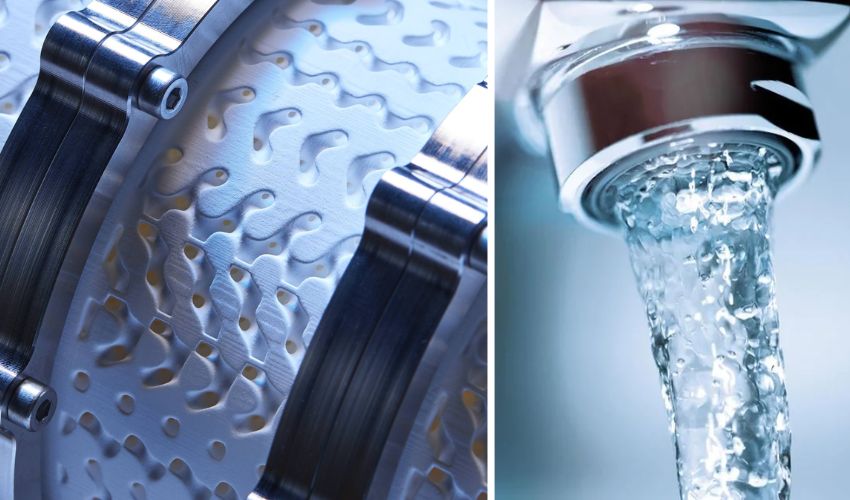
You learned it in science class: water is the foundation of life. The renewable resource is often taken for granted, since for many of us, it is easily accessible with a turn of the tap. However, the infrastructure that delivers clean drinking water, as well as the infrastructure that deals with wastewater, requires complex engineering. Globally, many water infrastructure systems face aging systems that need maintenance, or in some cases, replacement. These systems can be troubled by leaks, inefficiency, and high costs. Additionally, these systems often face a rising demand due to growing populations. Add environmental goals to the mix, and you have an elaborate question to answer: how can a community create efficient, secure, affordable, and sustainable water infrastructure?
Increasingly, engineers have been exploring 3D printing as a solution. The emerging technology is attractive for building and maintaining infrastructure because it offers faster, greener, and more customizable solutions. But before diving into 3D printing’s role here, let’s take a brief look at what water infrastructure is.
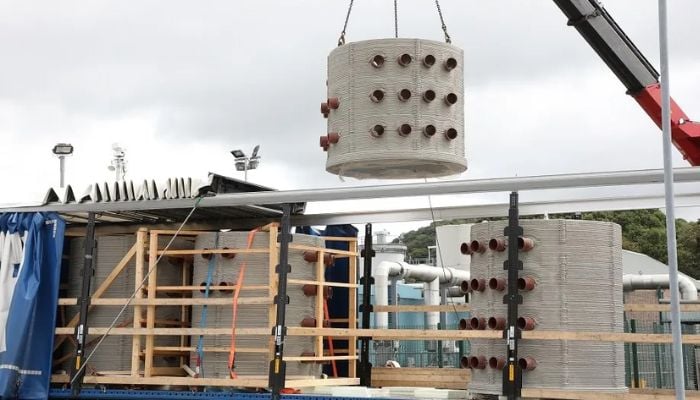
Concrete drawpit being placed into position at Esholt Waste Water Treatment Works (Photo Credits: Hyperion Robotics)
What is Water Infrastructure?
Water infrastructure is essential to the fulfillment of basic societal needs, from sustaining life to safeguarding public health. Collecting and treating wastewater is also critical for preventing disease and protecting the environment. One of the vital components of the water infrastructure framework is water treatment plants. These facilities collect water from surface sources like rivers or underground wells and treat it with various chemical and physical processes to make it potable. Once purified, the water goes through a network of distribution systems, consisting of pipes, pumps and storage tanks, that deliver water to its destination. After this water is used, it becomes wastewater, and it must be treated again. This water goes to wastewater treatment facilities, where it is subject to advanced processes to eliminate contaminants, before being safely released back into the environment. Other components in this vast network are reservoirs and dams, which store large amounts of water. These can be useful for flood control, hydroelectric power and providing a stable water supply.
More from the desk
Six other notes from the rest of the bench.
 NewsThe US Army transforms a steel alloy to 3D print ultra-resistant partsA team of researchers from the U.S. Army Combat Capabilities Development Command Research Laboratory says they have adapted a custom-made steel alloy to be compatible with 3D powder-bed fusion printing technology. This new material should be able to produce parts…
 PrintersNew Report Shows Struggling Industrial 3D Printer Sales With Hope for Better 20252024 was not the best year for the 3D printing industry. When we looked back at the trends that had marked it, turbulence was dominant throughout, with failed mergers, layoffs, leadership changes and more. This struggle has been further shown…
 MaterialsWhat is the environmental impact of metal additive manufacturing?Not so long ago, the Additive Manufacturer Green Trade Association (AMGTA) released its report on the environmental impact of metal additive manufacturing. Conducted by Jeremy Faludi of Delft University of Technology and Corrie Van Sice of Dartmouth College, the study…
 SoftwareBRL-CAD: The Design Software Created for DefenseWith so many 3D design and modeling tools available, finding the right fit can be overwhelming. Enter BRL-CAD, an open-source, cross-platform software built on constructive solid geometry (CSG)—a method that delivers highly accurate, optimized renderings. While useful for general
 GuidesFrom Prototype to Full-Rate Production at RAPID + TCT: Garrett Hawkins on Scaling Additive in AerospaceIn aerospace additive manufacturing, you expect the story to start with rockets. This one starts with an ink cartridge. Years before working on aerospace antenna systems, Garrett Hawkins was a high school student measuring a printer cartridge with calipers, recreating…
 NewsCellX Raises $4.3 Million in Funding to Expand 3D-Printed Pork BusinessWith China currently consuming 30% of the world’s meat, it’s no wonder a food tech company tackling global meat supply and sustainability has emerged from the region. After debuting its 3D printed cell-based pork meat at a tasting event for…