Applications
3D Printing Could Reduce Waste and Emissions When Retreading Tires
A team from Virginia Tech has been selected by the REMADE institute for a $1.5 million project to improve tire retreading using additive manufacturing. Tire retreading is a common part of commercial vehicle maintenance. Essentially, when a tire is worn…
- 3 min read
- Applications
- Six more stories
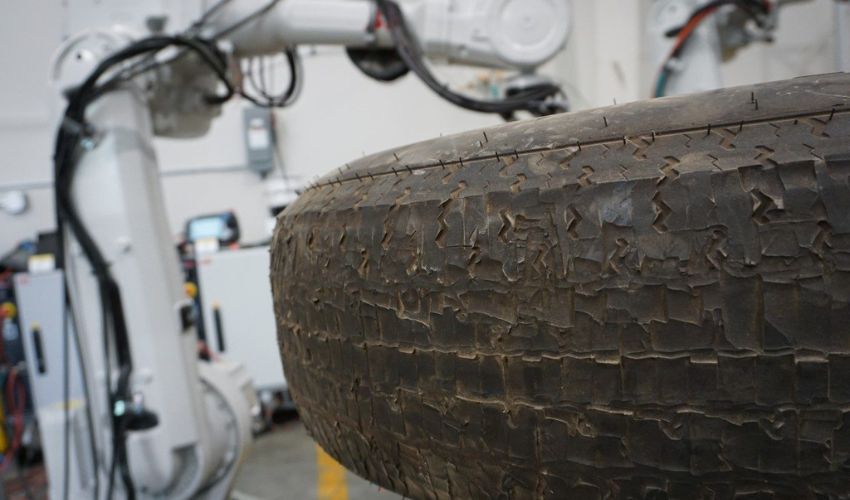
A team from Virginia Tech has been selected by the REMADE institute for a $1.5 million project to improve tire retreading using additive manufacturing. Tire retreading is a common part of commercial vehicle maintenance. Essentially, when a tire is worn out, its surface must be buffed away before a new layer of tire is adhered to it. The action is critical for the safety of tires, but the process itself is relatively inefficient. To address this, the team is turning to 3D printing and 3D scanning to improve efficiency, thereby reducing waste and emissions.
In the United States, the shipping industry in the country is almost entirely dependent on commercial vehicles notably tractor trailers, also known as semi-trailer trucks. Indeed, according to the Bureau of Transportation, there are 13 million trucks operating in the US including 2.9 million tractor trailers. Furthermore, nearly 70% of all freight in the US is transported by trucks making it one of the country’s biggest industries. As a result, about 14.5 million tires are retreaded each year in the US according to a press release from Virginia Tech. Subsequently, the waste, an estimated 9 pounds of excess material per tire, and inefficiencies really add up over time. That is why Chris Williams, the L.S. Randolph Professor in Mechanical Engineering as well as the REMADE institute believe it is so important to seek enhancement in the efficiencies of tire retreading. Including through the use of 3D printing.
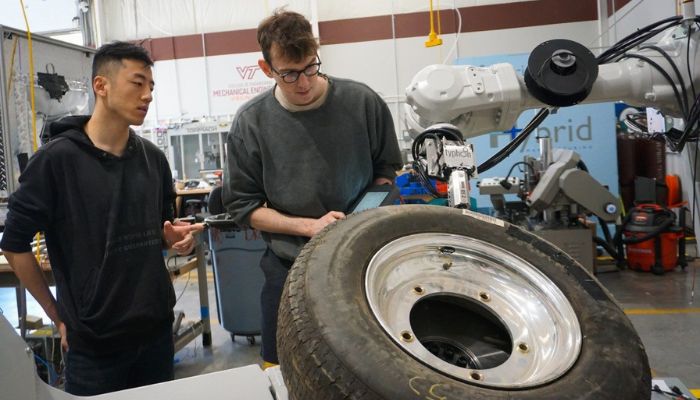
Graduate students Yigun Fu and Tadek Kosmal monitoring the 3D printing process
But how exactly will these technologies be used for tire retreading? Well according to information from Virginia Tech, the team’s approach will be to use 3D scanning, 3D printing and industrial robotics to create a new process for retreading. The combination of these different technologies and material science is critical in fact for the success of the project. Williams explains, “The only way to address this project’s grand challenge of reimagining the tire retreading process is through a team-based transdisciplinary approach focused in simultaneous considerations of materials, the additive manufacturing process, and the final tires’ performance.”
More from the desk
Six other notes from the rest of the bench.
 NewsMorphSensor, 3D design environment developed by MITToday, it is possible to 3D print a wide variety of objects from the comfort of your home: owning a desktop 3D printer allows virtually anyone to manufacture a robot dog or an anti-Covid necklace, for example. However, oftentimes, the…
 NewsThe best 2019 videos about 3D printing!2019 has been a year full of exciting developments for the additive manufacturing industry across all sectors. New machines have been introduced to the market, many applications have broken records, better performing materials have been developed, etc. Fortunately, most of&hellip
 NewsTop 5 Videos: OWA SpeakerThis week’s Top 5 Videos contain a variety of videos, from well-known brands like Makerbot and Prusa, to innovative new projects such as the OWA Speaker. Remember, a new Top 5 Videos is posted every week, so tune in next…
 PrintersSLS: The New 3D Printer from Dynamical ToolsDynamical Tools are a Spanish 3D printer manufacturer based in Zaragoza. They are rapidly expanding and have recently moved into a new, larger headquarters. Their CEO, Pablo Murillo, says “We do not want to stop growing and we work hard…
 MaterialsBridging in 3D Printing: Everything You Need to KnowUsing a 3D printer, whether for professional or hobbyist purposes, can be an exciting journey filled with surprises. However, not all surprises are positive; some may present challenges. We have previously discussed common printing issues like stringing, ghosting, and warping,&he
 NewsEquinor brings critical 3D printed part to offshore location with a droneFirst established in 1972, Equinor has been pushing the boundaries of technology to solve challenges in the oil & gas industry. Today, the company aims to be the world’s most carbon-efficient oil and gas producer, as well as driving innovation…