News
3D Knitwear: How 3D Printing Is Revolutionizing the Fashion Industry
In recent years, 3D printing has become growingly everpresent. From medicine, aerospace, to design, and construction — every day there’s news about breakthroughs, innovations, and developments in the additive manufacturing industry. However, in one particular industry, it&#
- 3 min read
- News
- Six more stories
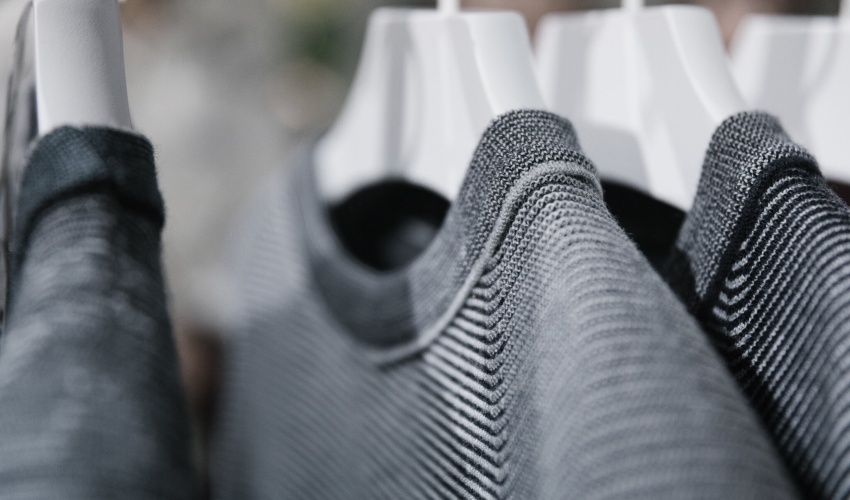
In recent years, 3D printing has become growingly everpresent. From medicine, aerospace, to design, and construction — every day there’s news about breakthroughs, innovations, and developments in the additive manufacturing industry. However, in one particular industry, it’s still pretty quiet regarding developments around 3D printing. We’re talking about the fashion industry. It cannot be denied that the first experiments and advances in 3D printed clothing have only been recorded relatively recently. Yet, if you have followed these developments in fashion a little more closely, you may have noticed that these are high-end fashion, i.e. clothing created for the runways and red carpet and not for everyday wear. The reason why the combination of 3D printing and clothing seems so difficult is quite simple: The materials used in 3D printing, mostly plastic, and metal, are not flexible enough. To counteract this problem, some fashion and 3D enthusiasts have been looking into suitable options and ultimately honed in on one solution: 3D knitwear. But, what exactly is 3D knitwear? How does its production method differ from additive manufacturing and conventional textile production? Will 3D knitwear be available as ready-to-wear for ordinary consumers in the near future? We got to the bottom of this topic in more detail and we clarify all of these questions with the help of various expert opinions from the industry.
In order to understand the principle of 3D knitwear and its differences and similarities to 3D printing, it is first necessary to take a look at the definitions. Gihan Amarasiriwardena, co-founder and CEO of the Ministry of Supply, defines 3D printing as follows: “In 3D printing, molded products (such as plastics) are produced by adding a layer of material (often plastic or synthetic) according to a given digital Design is ‘printed’.” Rosanne van der Meer, designer and founder of New Industrial Order, offers a broader definition: “3D printing is the production of a three-dimensional shape on the basis of a filament that is formed by a machine.“ In fact, 3D printing is all about computer-controlled machines creating three-dimensional objects and building them up layer by layer. The question now remains whether 3D knitwear is made according to the same principle.
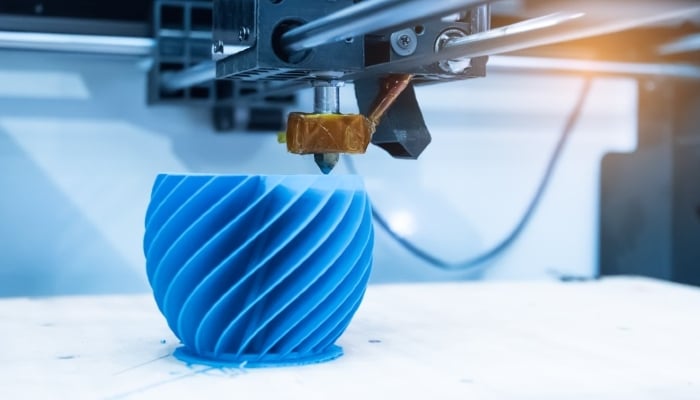
In 3D printing, the object is additively manufactured layer by layer.
Production of 3D Knitwear
The manufacturing process of 3D knitted fabrics is quite similar to other 3D objects. Both begin on a computer: CAD software is used to create the design and ultimately to obtain a programming language. The digital codes are then forwarded to the machine, which then begins the manufacturing process. However, the machine used is where knitwear and traditional 3D printing diverge. The primary difference from additive manufacturing is that the machine is not a 3D printer that processes filament or powder through extruders, rather, a knitting machine that can produce a three-dimensional garment in a single pass by uniting it thread by thread. Consequently, it should be noted that the principle is essentially the same both are based on software and are additively manufactured, but the material creates a big difference between the two methods.
More from the desk
Six other notes from the rest of the bench.
 NewsTree-Root Inspired Template-Constrained Additive Technique Creates Durable Electronic CircuitsConformal electronics are stretchable, flexible electronic devices often used for applications like smart skins and robotics. While 3D printing conformal electronics is possible, the process can come with challenges. Often, conformal electronics have significant mechanical and th
 MaterialsResearchers Succeed in 3D Printing One of the Strongest Stainless Steels on the MarketSteel is a metal prized for its resistance to corrosion and is used by many sectors in the 3D printing industry. As is stainless steel which is actually an inox, an alloy made of iron, chromium, and a little carbon.…
 Applications3D Printed Skull Played “Pivotal” Role In Murder ConvictionSherlock Holmes, Hercule Poirot, Columbo…3D printing? In a story that seems pulled straight from the latest detective novel, additive manufacturing has been used as a way to get a conviction for a murder in the United Kingdom. A 3D printed…
 PrintersFlashforge Launches New Adventurer 5M Pro 3D PrinterFlashforge, an industry leader in desktop 3D printers, recently introduced its latest Adventurer 5M 3D printer series, launched on September 1, 2023. The series, consisting of the Flashforge Adventurer 5M and 5M Pro 3D printers, follows the success of the…
 PrintersResearchers at MIT 3D Print GlassThe process of 3D printing glass can seem beyond possible, however this is what researchers at MIT have been working towards. In a paper published in 3D Printing and Additive Manufacturing in December 2018, researchers Chikara Inamura, Micheal Stern, Daniel…
 NewsnFrontier Unveils UILA, a 3D Printed Hyrbid Electric Cargo Bike and Electric VehicleOnce again, 3D printing has been used for an innovative and sustainable new solution. This time, nFrontier, a Berlin-based innovation studio, has unveiled UILA, a revolutionary vehicle that is essentially a hybrid between an electric cargo bike and a small…