Materials
Researchers Succeed in 3D Printing One of the Strongest Stainless Steels on the Market
Steel is a metal prized for its resistance to corrosion and is used by many sectors in the 3D printing industry. As is stainless steel which is actually an inox, an alloy made of iron, chromium, and a little carbon.…
- 3 min read
- Materials
- Six more stories
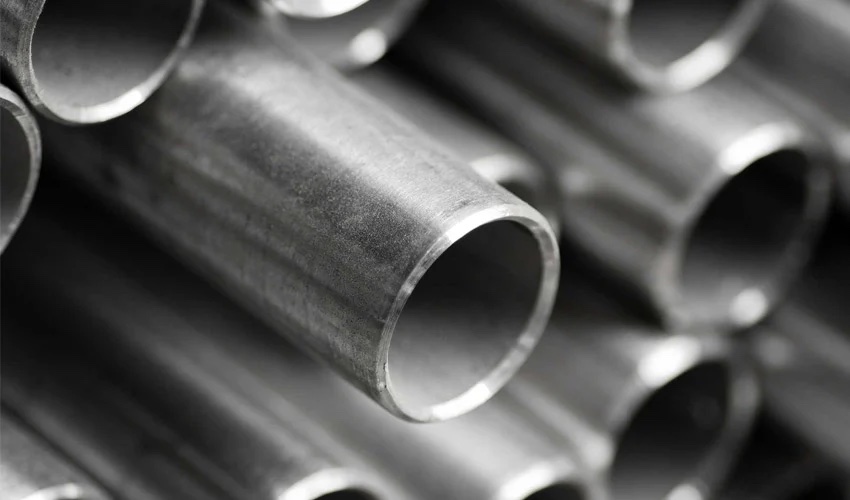
Steel is a metal prized for its resistance to corrosion and is used by many sectors in the 3D printing industry. As is stainless steel which is actually an inox, an alloy made of iron, chromium, and a little carbon. But are you familiar with 17-4 precipitation hardening (PH) stainless steel? This particular stainless steel is a metal that’s also known for being extremely hard, in addition to being corrosion resistant. For the first time, a team of researchers at the National Institute of Standards and Technology (NIST) has reportedly succeeded in 3D printing it while retaining both of these essential characteristics.
Metal additive manufacturing has been growing for a few years now and is expanding a variety of possibilities in many industries, from aerospace to medicine to automotive. However, it poses some challenges which are not easy to master. Metal 3D printing involves a significant variation of temperatures during the manufacturing process when using a material that heats up and cools down extremely quickly. Fan Zhang, a physicist at NIST and co-author of the study, explains, “When you think about additive manufacturing of metals, we are essentially welding millions of tiny, powdered particles into one piece with a high-powered source such as a laser, melting them into a liquid and cooling them into a solid. But the cooling rate is high, sometimes higher than one million degrees Celsius per second, and this extreme nonequilibrium condition creates a set of extraordinary measurement challenges.”
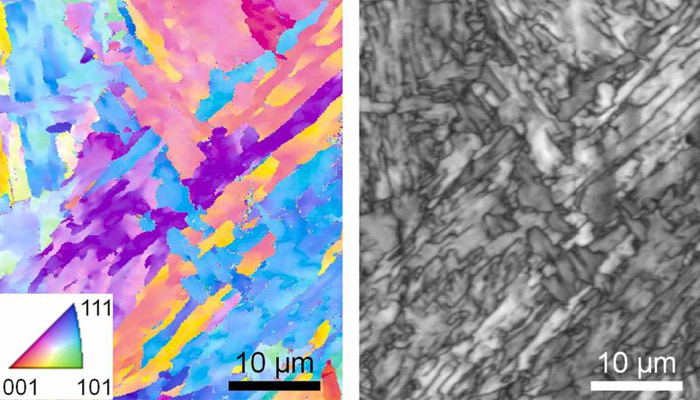
A Microscopic image of a 3D printed 17-4 stainless steel. The colors on the left represent the different orientations of the crystals in the alloy (photo credit: Q. Guo/University of Wisconsin-Madison)
These temperature changes cause some irregularities and it is not always easy to obtain a metal part with the desired properties. The team of researchers, therefore, wanted to know more about the variations in the crystalline structure of a metal, in this case, PH 17-4 steel, in order to obtain the desired properties – hardness and corrosion resistance. To do this, they had to use a synchrotron, which is an electromagnetic instrument that accelerates elementary particles. The researchers explained that they projected x-rays from the device onto the steel in question while it was being printed in order to follow the evolution of its crystal structure. This allowed them to understand a number of factors such as the influence of the alloy’s composition.
More from the desk
Six other notes from the rest of the bench.
 MaterialsFillamentum Talks Environmental Responsibility in the Polymer 3D Printing SectorWhen it comes to 3D printing materials, polymer filaments still reign supreme worldwide with the market expected to be worth $8.1B by 2030 according to a report from Market Research Future. However, in a world increasingly aware of the impact…
 NewsWhat are the ambitions of Marie Langer, the new CEO of EOS GmbH?Last October, Marie Langer was appointed CEO of the EOS GmbH Group, succeeding her father, Dr. Hans Langer, who founded the German company in 1989. The manufacturer of industrial additive manufacturing solutions quickly made a name for itself on the…
 ApplicationsLyten Aims to Transform Motorsports with 3D Printed Parts3D printing continues to gain ground in the world of motor racing. In recent years, its use has become widespread, particularly in Formula 1 and other motorsport disciplines, where it enables parts to be produced more quickly, optimizing performance and…
 NewsFlorida Atlantic University to 3D Print Seaweed Structures to Combat Harmful Algal BloomsIt’s a bad time to be a harmful algal bloom (HAB)! On August 6th, Florida Atlantic University announced that a team of its researchers were awarded an $800,475 grant from the Gulf of America Division U.S. Environmental Protection Agency to…
 NewsDesktop Metal Moves to Acquire ExOne in $575 Million DealDesktop Metal (DM) and ExOne announced yesterday that they have entered a definitive agreement for Desktop Metal to acquire all issued and outstanding shares of ExOne common stock. The expected value of the transaction will be $575 million, consisting of…
 NewsFormlabs Make Major Move With Micronics AcquisitionThe additive manufacturing industry certainly does not seem to be taking a summer vacation! Not long after the surprising news about Desktop Metal and Nano Dimension, now we have yet another unexpected announcement: Formlabs will be acquiring Micronics. At this…