Applications
3D Printed Skull Played “Pivotal” Role In Murder Conviction
Sherlock Holmes, Hercule Poirot, Columbo…3D printing? In a story that seems pulled straight from the latest detective novel, additive manufacturing has been used as a way to get a conviction for a murder in the United Kingdom. A 3D printed…
- 3 min read
- Applications
- Six more stories
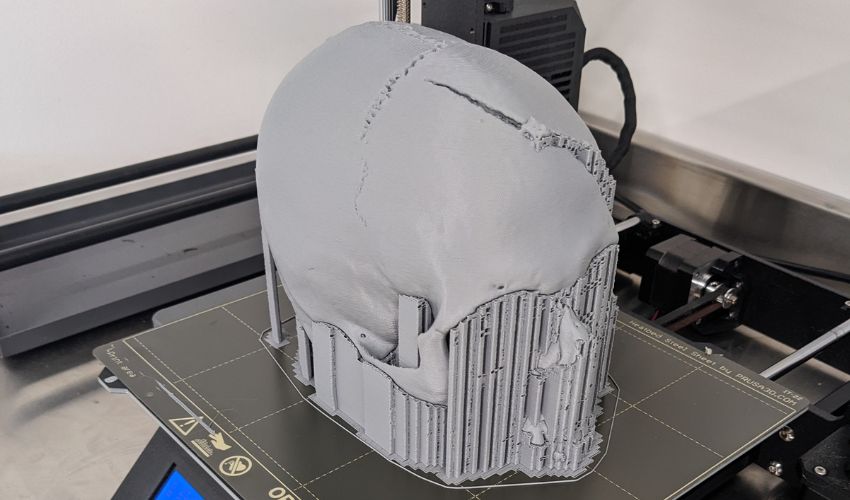
Sherlock Holmes, Hercule Poirot, Columbo…3D printing? In a story that seems pulled straight from the latest detective novel, additive manufacturing has been used as a way to get a conviction for a murder in the United Kingdom. A 3D printed skull created as part of a joint partnership between the Hampshire and the Isle of Wight Constabulary was a key piece of evidence in finding four men guilty of his murder after an eight-week trail.
The case in question was that of Frazer Brabant who was found in his front garden with serious head injuries on October 31, 2019. Though he survived the initial attack, he suffered catastrophic brain damage and was in a coma until he succumbed to his injuries on January 21, 2020, at only 31 years old. His 3D printed skull was used to show the extent of his injuries as well as to help visualize the immense trauma to the head of the victim.

The victim Frazer Brabant (photo credits: Hampshire Constabulary)
The Murder Victim’s 3D Printed Skull
Dr. Morgan Lowther, Senior Scientific Official from the University of Portsmouth’s School of Mechanical and Design Engineering was behind the design and printing of the skull. He explained, “I attended the trial and saw the pathologist use the model to help guide the jury through the injuries sustained by the victim. He was able to demonstrate the order in which the blows were likely to have occurred, whether they’d come at the same angle, and whether they would have come from the same assailant or the same weapon. The jurors were allowed to handle the model and take it into the deliberation room. I think it was a valuable piece of evidence to help them understand the severity of the attack.”
More from the desk
Six other notes from the rest of the bench.
 NewsTop 5 videos: 3D printing metal parts for the automotive industry, and moreThis week we found the top 5 videos about 3D printing and the way additive manufacturing is changing production. The technology has infiltrated many sectors, from medical to automotive – check our selection of the week to keep up with the innovations! If you enjoy these, you&hell
 GuidesThe #3DStartups of 2018!Throughout every year, we present you with the monthly new, innovative #3DStartup and learned more about their exciting applications. Whether it is software or hardware, the applications were in sports or construction it is all interesting. Regardless of the general use…
 Applications3D Printed Respiratory Masks May Be Able to Help Premature BabiesAccording to the World Health Organization, 15 million babies are born prematurely each year. A newborn is considered premature when it is born before 37 weeks of pregnancy. This abnormality can cause health complications for the baby, especially in terms…
 MaterialsMIT Engineers Use Machine Learning to Develop Ultra-Strong Aluminum Alloy for 3D PrintingCreating alloys means combining two or more metals to achieve new and improved properties, such as greater strength or resistance to corrosion. Traditionally, researchers test countless combinations to find the perfect formula, a process that can take months or even…
 NewsSydney Launches World’s First E-Waste Recycling Facility for 3D Printing FilamentLast week, the city of Sydney, Australia, announced the launch of a new facility dedicated to recycling hard plastics from electronic waste into 3D printing filament. The facility, a joint venture between the University of New South Wales (UNSW) and…
 ApplicationsResearchers 3D print functioning human heart pumpAt the University of Minnesota, researchers have 3D printed a functioning centimeter-scale human heart pump. Scientists believe that this discovery could have some major implications for studying heart disease, one of the leading causes of death in the United-States, killing&hell