Guides
What Are the 3D Printing Applications in the Oil & Gas Sector?
The oil & gas sector is one of the largest industries in the world as it is a critical part of the energy sector with about 4.2 billion metric tons of oil produced globally in 2021. Though due to climate…
- 3 min read
- Guides
- Six more stories
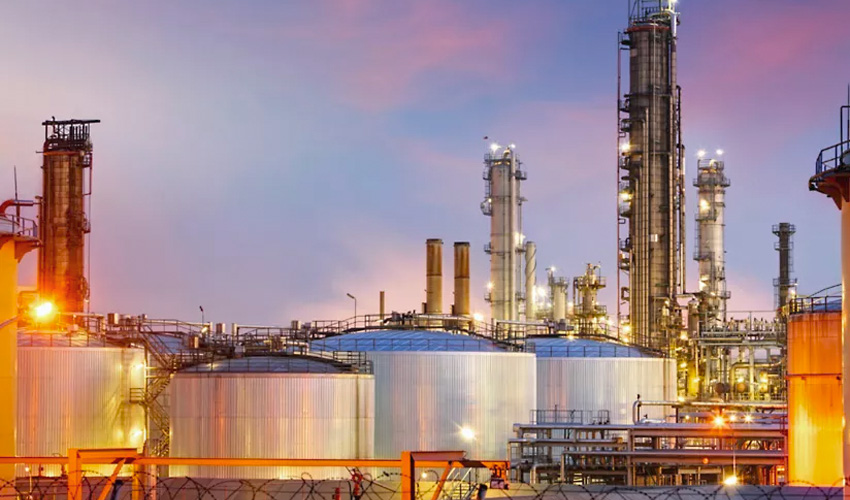
The oil & gas sector is one of the largest industries in the world as it is a critical part of the energy sector with about 4.2 billion metric tons of oil produced globally in 2021. Though due to climate change as well as issues with supplier countries, such as what is happening currently with the war in Ukraine, many have been looking for alternative solutions, it still is the number one energy source especially as it comes to heating. As such, it should come as no surprise that as companies are looking for ways to make the pipelines and other components more efficient to reduce wasteful consumption and accidents due to leaking. One of these is that more and more oil & gas companies are turning to 3D printing to create geometrically complex, cost-effective parts, notably when it comes to replacements and spare parts. We took a closer look at some of the top examples from the market.
3D Metalforge and Shell Collaborate to Make Heat Exchanger Parts
You have almost certainly heard of Shell, one of the world’s largest energy companies. But did you know that it has also turned to additive manufacturing? At the end of 2021, 3D Metalforge announced that it had collaborated with Shell Jurong Island, a dedicated chemical manufacturing site based in Singapore and owned by Shell, to provide 3D printed heat exchanger parts. The one-time agreement was driven by Shell Jurong Island’s engineers need to reduce the required lead time for the manufacturing of heat exchanger tube components, a feat that thanks to 3D printing was accomplished in a record timeframe of only two weeks. Heat exchanger tube components are thin-walled tubes inserted into the inlet-end of condensers and heat exchangers to transfer heat and prevent tube failures, as such they are critical components in the oil & gas industry. By turning to AM, Shell Jurong Island was able to extend the lifespan of the existing equipment thanks to quickly receiving cost-effective replacement parts.
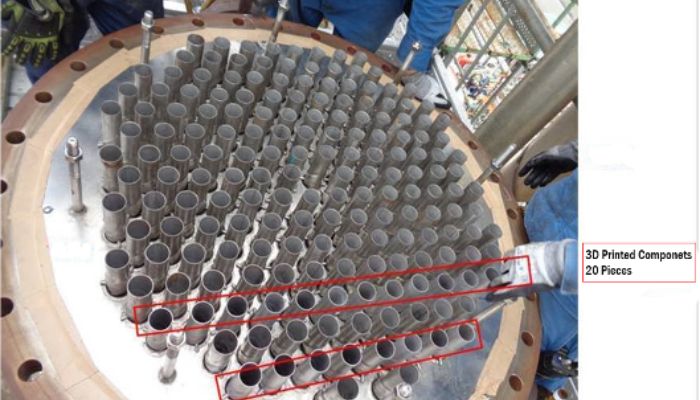
Photo Credits: 3D Metalforge
A 3D Printed Pressure Vessel from AML3D
AML3D is an Australian manufacturer of metal 3D printers, specifically machines that rely on the directed energy deposition (DED) process. This summer, it announced a new project with the American oil company ExxonMobil. The project involves the design of a metal pressure vessel, 8 meters long and 1.5 meters in diameter, with a total weight of 2000 lbs, using 3D printing. It is believed to be the largest commercially available 3D printed vessel on the market. Thanks to AML3D’s technology, which is currently compatible with aluminum, titanium, steel and nickel alloys, AML3D believes it is possible to manufacture this part in only 12 weeks.
More from the desk
Six other notes from the rest of the bench.
 Printers#3DStartup: Addimetal and Its More Repeatable and Reliable Metal Binder Jetting SolutionThe metal additive manufacturing market has been booming for some years now. A number of processes and materials fall under the umbrella, not the least binder jetting, which is becoming increasingly popular in a wide range of industries. Among the…
 ApplicationsMIT Researchers Use 3D Printing to Democratize the Production of Electrospray EmittersResearchers at the Massachusetts Institute of Technology (MIT) have created low-cost electronic nozzles, called triaxial electrospray emitters, via 3D printing. Traditionally, producing these devices requires days inside a multi-million-dollar semiconductor “cleanroom”
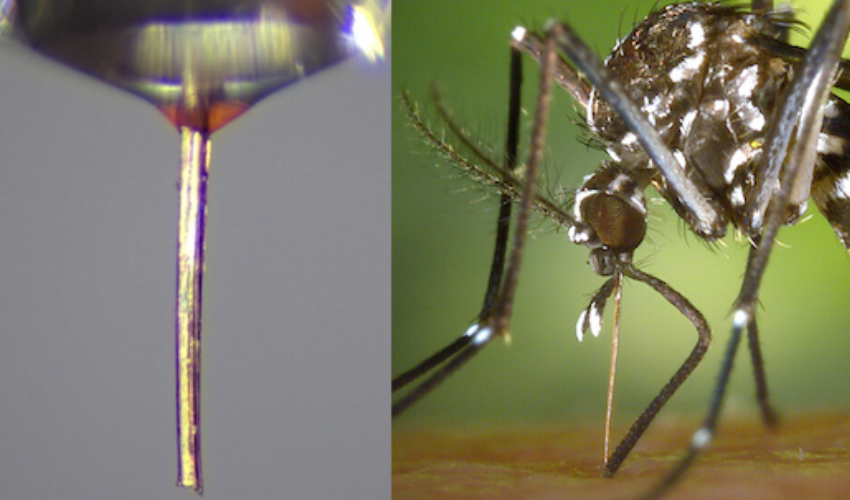 ApplicationsMosquito Proboscis Repurposed as a Micro Nozzle for High Resolution 3D PrintingMost people think of mosquitoes as pests, not as tools for next-generation micro-fabrication. Yet researchers at McGill University have shown that the proboscis of a deceased female mosquito can serve as a biodegradable micro nozzle for high-resolution 3D printing. With…
 ApplicationsSpecialized’s New 3D Saddle Boosts Pro Cycling ComfortSpecialized has introduced a new saddle that allows elite cyclists to stop choosing between comfort and performance. The S-Works Power EVO with Mirror is an upgraded version of the brand’s well-known Power series. Designed for riders who shift their weight…
 NewsWhat impact does 3D printing have on the world of cinema?The applications of 3D printing are extremely diverse: from food to automotive parts, this technology is used to create a wide variety of shapes from various materials. The world of filmmaking is another area where 3D printing shows its full…
 NewsWhat are the ambitions of Marie Langer, the new CEO of EOS GmbH?Last October, Marie Langer was appointed CEO of the EOS GmbH Group, succeeding her father, Dr. Hans Langer, who founded the German company in 1989. The manufacturer of industrial additive manufacturing solutions quickly made a name for itself on the…