Applications
A New 3D Printed Sweat Sensor Could Help Monitor Health
Though there are many benefits to the summer months, it is safe to say that not everything about the season is fun. Notably, sweating in the heat is an uncomfortable phenomenon that also can leave embarrassing marks on clothes as…
- 3 min read
- Applications
- Six more stories
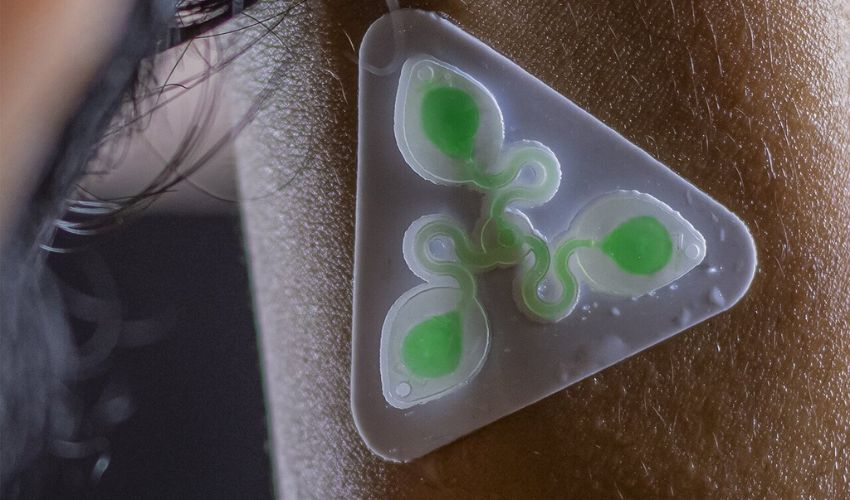
Though there are many benefits to the summer months, it is safe to say that not everything about the season is fun. Notably, sweating in the heat is an uncomfortable phenomenon that also can leave embarrassing marks on clothes as well as make us agitated and smelly. But did you know that sweat can actually be a key to helping patients to track their health? Or that’s what researchers at the University of Hawai’i at Mānoa College of Engineering are betting on with a new project where they are using an innovative 3D printed wearable sweat sensor, nicknamed the “sweatainer,” in order to obtain key information about health and diseases.
Sweating is actually extremely beneficial to the body. It helps us to regulate our body temperature as well as flesh out toxins. But it is also a vital resource for doctors for tracking different health indicators. In this case, the researchers point to the fact that it is able to not only provide clues to dehydration, fatigue and blood sugar levels, but also help monitor more serious conditions. These include cystic fibrosis, diabetes and heart failure. Considering that there are an estimated 40,000 children and adults living with cystic fibrosis, 37.3 million adults living with diabetes and 6.5 million with heart failure in the United States alone, this could be crucial to helping maintain the health of these individuals. And 3D printing offered the researchers the flexibility needed to create this innovative device.
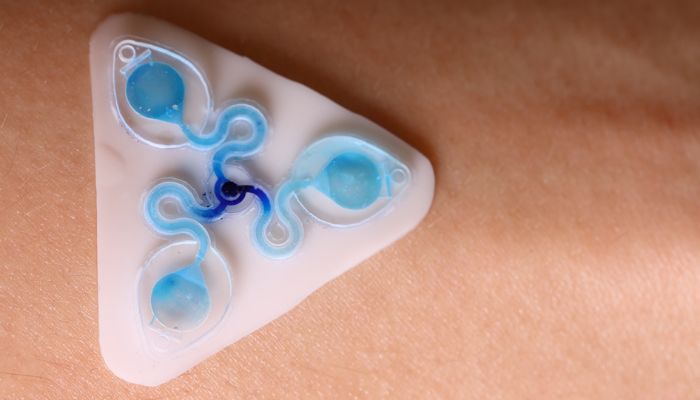
The sweat sensor is designed to go directly on the skin (photo credits: Ray Research Group)
The Benefits of the 3D Printed Sweat Sensor
Though perhaps not as widely discussed as procedures like blood drawing, sweat collection is already used as part of testing for different diseases, especially cystic fibrosis. However, traditional approaches can be costly and difficult as they require the use of absorbent pads or microbore tubes pressed against the epidermis to capture sweat. This requires of course trained personnel, special handling and costly laboratory equipment. Even with the emergence of wearable devices, they are still single use. But thanks to the use of additive manufacturing, the researchers were able to create this new wearable device that they claim expands the capability of wearable sweat devices and will be a giant leap forward in sweat analysis.
More from the desk
Six other notes from the rest of the bench.
 NewsRevolutionary Glass Printing Technique Creates World’s Smallest 3D Printed Wine GlassIn a remarkable technological feat, researchers at the KTH Royal Institute of Technology have successfully 3D printed the world’s smallest wine glass. This tiny glass, with a rim thinner than a human hair, serves as a demonstration of a groundbreaking…
 NewsDesktop Metal Moves to Acquire ExOne in $575 Million DealDesktop Metal (DM) and ExOne announced yesterday that they have entered a definitive agreement for Desktop Metal to acquire all issued and outstanding shares of ExOne common stock. The expected value of the transaction will be $575 million, consisting of…
 GuidesHow is ACCIONA using AM to support sustainability?ACCIONA, founded back in 1931, is a Spanish conglomerate group dedicated to the development and management of infrastructure and renewable energy. The sectors with which ACCIONA works include energy and infrastructure, which is why, not long ago, they began to integrate…
 PrintersUC Berkeley Paves Way for Digitizing Vertebrate Collections With oVert ProjectMuseums worldwide are embracing innovative technologies to revolutionize access to their extensive artifact collections. Among these advancements, 3D scanning and printing have emerged as powerfully useful tools, offering unprecedented opportunities for researchers, educators, an
 NewsOlivier van Herpt prints in 3D Delft BlueFor centuries Delft pottery, also known as Delft Blue, has gained worldwide renown; these Dutch pieces are particularly known for their finesse and quality. So when we combine 3D printing with this tradition of the seventeenth century, we can only…
 NewsStratasys Introduces New 3D Printer for High-End Fashion and DesignTo anyone in the 3D printing industry, the American-Israeli company Stratasys should be well known. Having been one of the pioneer manufacturers since its founding in 1989, Stratasys has already produced a variety of different types of 3D printing devices,…