Guides
How is ACCIONA using AM to support sustainability?
ACCIONA, founded back in 1931, is a Spanish conglomerate group dedicated to the development and management of infrastructure and renewable energy. The sectors with which ACCIONA works include energy and infrastructure, which is why, not long ago, they began to integrate…
- 3 min read
- Guides
- Six more stories
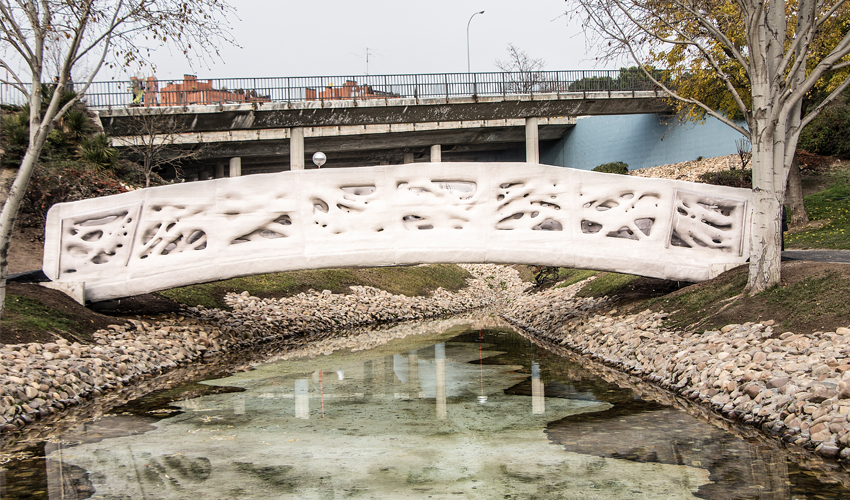
ACCIONA, founded back in 1931, is a Spanish conglomerate group dedicated to the development and management of infrastructure and renewable energy. The sectors with which ACCIONA works include energy and infrastructure, which is why, not long ago, they began to integrate additive manufacturing in their activities. 3D printing technologies are often considered a greener alternative to traditional manufacturing methods. But is it truly the case? To learn more about how ACCIONA is using additive manufacturing for sustainable applications, we interviewed Luis Clemente from the ACCIONA group.
3DN: Could you introduce present yourself and tell us about your relationship with 3D printing?
I am Luis Clemente, a Civil Engineer with 20 years of experience. I worked for more than 10 years in the innovation area at ACCIONA where I had my first contact with 3D printing technologies. Specifically, 7 years ago, in the Corporate Innovation Department, we identified additive manufacturing, at that time still emerging, as a disruptive technology. We acquired an FDM printer and began to inform ourselves, study and analyze the potential of the technology in order to identify its possible applications at ACCIONA and foresee possible effects on our activity.
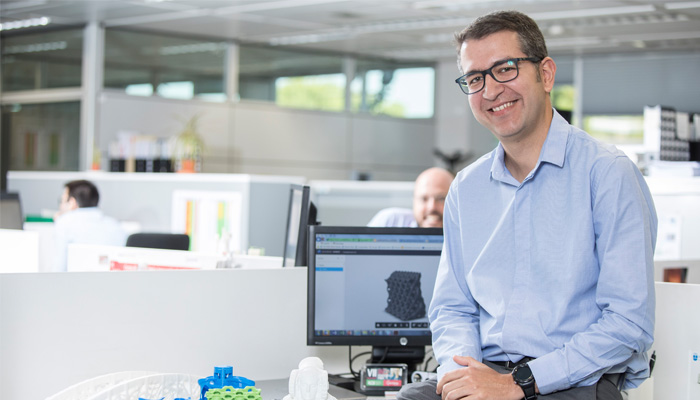
Luis Clemente
3DN: Why did ACCIONA decide to invest in additive manufacturing?
The first step was taken when we defined the line of work we would follow, which was to adopt large-scale 3D printing technology with concrete in order to make structural elements. At that time there were very few initiatives at a global level, but we were able to identify the two main technologies available: extrusion (contour crafting) and powder bed (D-Shape), opting for the latter because of the advantages we saw in terms of freedom of form.
More from the desk
Six other notes from the rest of the bench.
 PrintersInkbit raises $12 Million to industrialize its AM systemAs we’ve told you before, the startup straight out of MIT, Inkbit, is working towards overcoming traditional 3D printing constraints by giving its machines ‘eyes’ and a ‘brain’. Recently, the company managed to close a $12M equity financing round. The…
 MaterialsHow to Choose a Polymer for Your 3D Printing Application? Experts Give Their Advice!Today, there are a wide variety of materials that are compatible with additive manufacturing technologies, from thermoplastics to metals, ceramics and photosensitive resins. The largest family of these materials is polymers, which can be found in different forms depending on&hell
 SoftwareFreeCAD: An Open-Source 3D Modeler for All Users3D printing requires for a 3D model to be sent to a slicer, before being sent to the 3D printer. There are sites such as Thingiverse where a variety of such models are available to download. But if you want…
 NewsTOP 5 videos of the week: bioprinting, boat propellers and more!A new selection of the best 3D printing videos of the week, just for you! Find our TOP 5 videos of the week below and tell us what your favorite video is in a comment or on our Facebook and Twitter page.…
 Applications3D Printed Antibacterial Scaffolds for Bone RegenerationBone surgeries are a complex and painful process, and surgeons take extensive precautions to prevent infection. Bone infections are difficult to treat, often requiring at best antibiotics and at worst lengthy hospital stays and surgeries. Therefore, any product which aims…
 ApplicationsGroundbreaking First Arena Test on 3D Printed Bombs Shows PromiseFor much of his career, Russ Maines has been dedicated to designing bombs with cast, forged or pressed metals. However, these bombs were expensive and not scalable. So, as a Test and Evaluation Division Director at the Naval Surface Warfare…