News
3D printed micro robots could repair injuries inside the human body
Researchers from the Georgia Institute of Technology have created a new type of 3D printed robot. It is about two-millimeters long, the size of the world’s smallest ant and has been 3D printed using two-photon polymerization lithography (TPP). These 3D…
- 3 min read
- News
- Six more stories
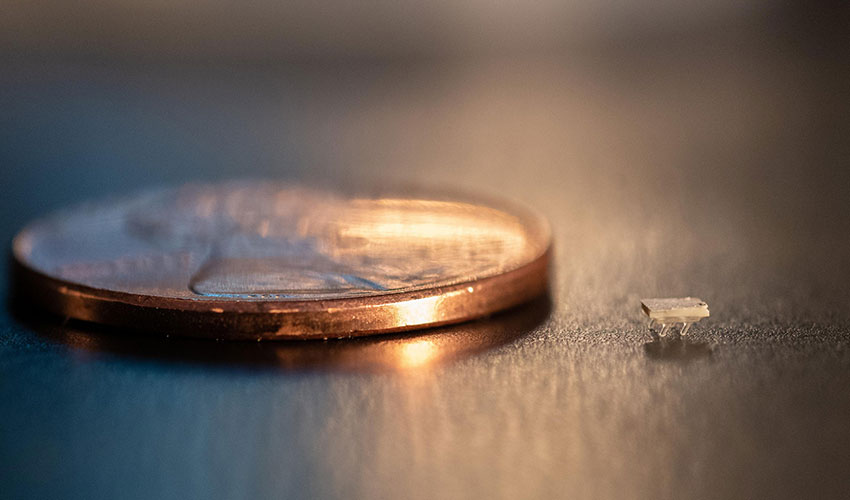
Researchers from the Georgia Institute of Technology have created a new type of 3D printed robot. It is about two-millimeters long, the size of the world’s smallest ant and has been 3D printed using two-photon polymerization lithography (TPP). These 3D printed micro robots are vibration-powered, they respond to piezoelectric actuators, ultrasound sources and even tiny speakers in order to move.
As you might have noticed, there has been an emergence in micro scale 3D printing over the last months. Recently, we told you about Nanofabrica – the startup announced the commercial launch of micron resolution 3D printing technology in March. The CEO of Nanofabrica had explained, “There is an inexorable shift towards miniaturisation, with many applications demanding extremely exacting levels of micron and sub-micron precision on macro and micro parts and there is huge potential for an AM platform that can service this trend.” We also reported on Nanoscribe’s two-photon polymerization (2PP) technology, that enables nano, micro and mesoscale fabrication.
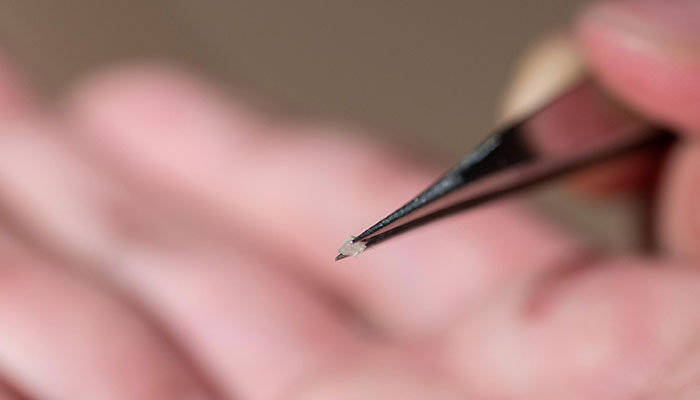
Credits: Allison Carter, Georgia Tec
So, what is the purpose of these tiny robots? Apparently, they could serve for many applications. For example, swarms of them could work together to sense environmental changes, move materials, or perhaps even repair injuries inside the human body. Azadeh Ansari, an assistant professor in the School of Electrical and Computer Engineering at Georgia Tech explains, “We are working to make the technology robust, and we have a lot of potential applications in mind. We are working at the intersection of mechanics, electronics, biology and physics. It’s a very rich area and there’s a lot of room for multidisciplinary concepts.”
More from the desk
Six other notes from the rest of the bench.
 NewsHow does a concrete 3D printer work?In recent years the role of additive manufacturing in the construction industry has become increasingly important. In particular, concrete 3D printers have been continuously gaining popularity among architects and construction firms. After water, concrete is the most widely used
  NewsVerbatim presents Durabio; an eco-friendly 3D printing filamentA subsidiary of Mitsubishi Chemical Corporation, Verbatim has announced the arrival of a new filament for FDM 3D printing made from Durabio’s eco-friendly material. This transparent material combines the properties of polycarbonate (PC) and polymethacrylate (PMMA). It has g
 NewsTest Form ENRegister and win a Bambu Lab PS1 3D Printer! * Required Email * First Name * Last Name * Company * Country * 3D Printing IndustryAerospaceAutomotive and transportArchitecture / ConstructionDesignConsumer GoodsEducationElectronicManufacturingMakers / FabLabMedicalOil and GasOther
  Applications3D printing to treat spinal cord injuriesResearchers from the University of California, San Diego, have successfully treated rats with spinal cord injuries using 3D printing. Their research offers hope for people with the same injury. 3D printing to help heal spinal cord injuries The Researchers from…
 SoftwareIs generative design changing additive manufacturing?Generative design is an iterative design process that generates multiple design outputs that meet predefined constraints. This process is used in various fields such as art, architecture, and product design to produce outputs from sounds, images to CAD models. One…
 ApplicationsFlorida researchers print corneas for the first time in the U.S.At Florida A&M University, a small team of researchers focus on corneal 3D printing, a rapidly evolving application case in the bioprinting market. The team managed to create the first high throughput printing of human cells in a 3D print…