Applications
Mass customization of a 3D printed electric vehicle
In the automotive industry, additive manufacturing has historically been used to create functional prototypes. Over the years, the automotive sector started leveraging the benefits of 3D printing technologies for end-use part applications too, to produce complex parts, or to allo
- 3 min read
- Applications
- Six more stories
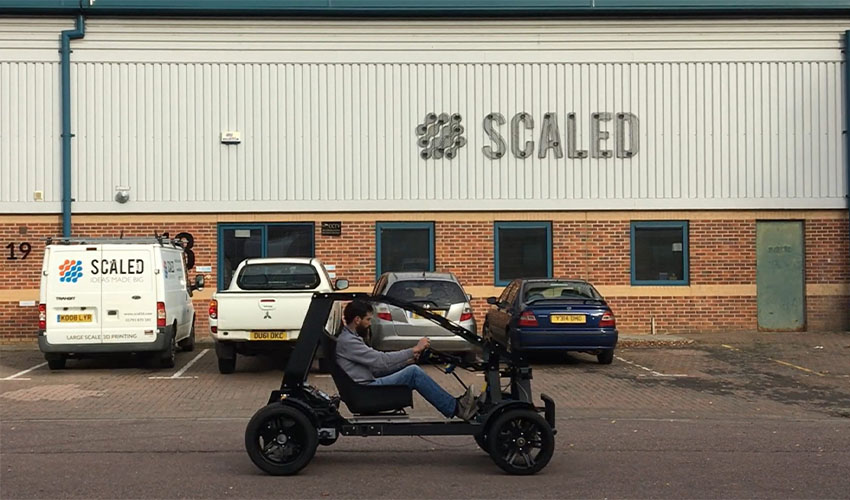
In the automotive industry, additive manufacturing has historically been used to create functional prototypes. Over the years, the automotive sector started leveraging the benefits of 3D printing technologies for end-use part applications too, to produce complex parts, or to allow greater customization at the design level for example. A recent project which showcases some of the possibilities of AM in automotive is Project Chameleon. This is a 3D printed electric vehicle project initiated in the UK by Scaled, a company specialized in material extrusion large format 3D printing using robotics.
Behind Project Chameleon lies “the opportunity to own a vehicle, designed from the ground up to be ideally suited to a particular environment. True mass customisation. Sustainable. Affordable. Aesthetic,” you can read on the Scaled website. In fact, this project explores various applications of 3D printing, including optimizing structural design thanks to DfAM (Design for Additive Manufacturing) techniques to produce higher performance parts, in conjunction with delivering a more sustainable, affordable and aesthetically pleasing product.
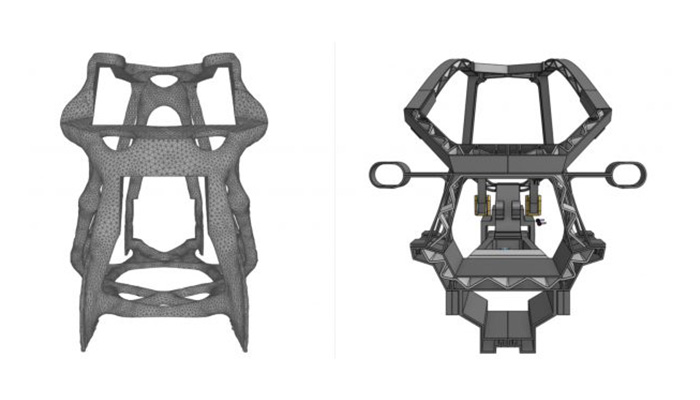
The 3D printed electric vehicle chassis was optimized using topology optimization software | Image via Scaled
Whereas additive manufacturing is cost effective for prototyping, it is not competitive with conventional manufacturing technologies for mass production; injection molding or CNC machining remain indefinitely cheaper and reliable when you need to produce a part at scale. However, in the case of customization, AM has the advantage: “By moving away from mass production to mass customisation, specialisation becomes affordable. This paradigm shift is possible by being able to prototype and manufacture using the same technology: large scale 3D printing. Design and manufacture of a first production vehicle will be cheaper than traditional methods,” you can read on the website. In the Project Chameleon, Scaled explains that expensive, specialised production equipment and tools were not needed. Every vehicle variant could be produced in a single, versatile manufacturing cell, with no need for large assembly lines. Additionally, lead times were only limited by the speed at which a vehicle could be printed.
More from the desk
Six other notes from the rest of the bench.
 NewsThe Infill Puzzle: Cracking the Code for Perfectly Balanced 3D PrintsInfill serves a vital purpose in 3D printing, offering precise control over the interior structure of printed parts. Unlike traditional manufacturing methods like injection molding or subtractive manufacturing, 3D printing allows for the creation of intricate infill patterns and
  ApplicationsFDA approval for K2M 3D printed spinal implantFollowing a line of 3D printing innovations in medicine this year, such as 3D printed ovaries and skin, the latest medical innovation in 3D printing comes out of the K2M headquarters in Leesburg, Virginia with their announcement of their FDA…
 News4D printed micro needles to replace conventional injectionsSeveral engineers at Rutgers University have used additive manufacturing to create tiny needles that could replace conventional hypodermic needles. 4D printing is a technological revolution, incorporating intelligent materials that can be programmed to change shape once printed.
  ApplicationsUrsa Major and US Navy Invest $25 Million in SRM ManufacturingIt’s no secret that Ursa Major has been making significant strides in rocket propulsion technology. A few months ago, they saw success with the first flight of their 3D printed Hadley engine, and last November, they unveiled Lynx, a groundbreaking…
 GuidesD-House Urban Laboratory on Using 3D Printing for Luxury BrandsA study by the Additive Manufacturer Green Trade Association (AMGTA), conducted in Italy in collaboration with Dyloan Bond Factory and Stratasys, highlighted that the use of 3D printing in the fashion and luxury sectors could lead to considerable time and…
 NewsTop 5 Videos: DAMM 2020, the largest virtual AM show is coming up…This week we found the top 5 videos about 3D printing and the way additive manufacturing is changing production. The technology has infiltrated many sectors, from medical to automotive – check our selection of the week to keep up with the innovations! If you enjoy these,…