Materials
A 3D Printed Copper Radio Frequency Quadrupole (RFQ) Component for the Large Hadron Collider
CERN, or the European Organization for Nuclear Research, currently houses the world’s largest particle accelerator. Called the Large Hadron Collider (LHC), its objective is to transmit energy to particles through electric or magnetic fields. Today, we bring your attention t
- 3 min read
- Materials
- Six more stories
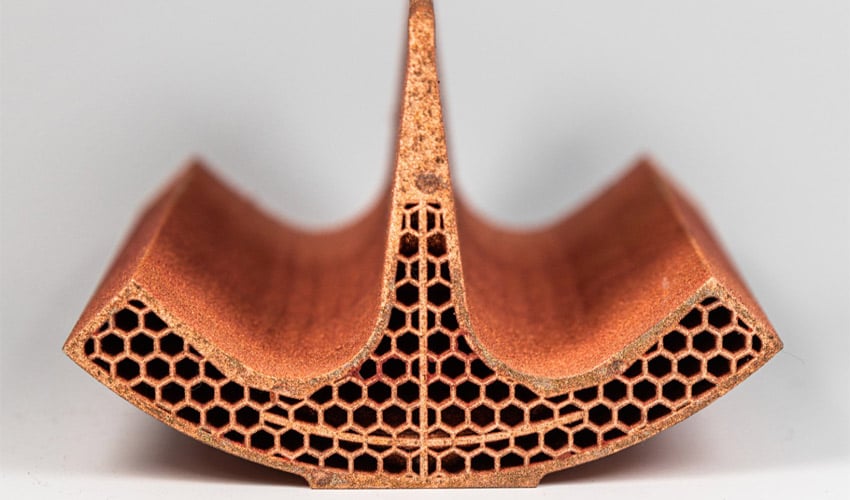
CERN, or the European Organization for Nuclear Research, currently houses the world’s largest particle accelerator. Called the Large Hadron Collider (LHC), its objective is to transmit energy to particles through electric or magnetic fields. Today, we bring your attention to the LHC because it could include for the first time a 3D printed copper radio frequency quadrupole. Specifically, this is a radio frequency quadrupole linear accelerator (RFQ), one of the most difficult parts to design and assemble. For these reasons, Fraunhofer IWS, in collaboration with CERN, the Technical University of Riga and the Polytechnic University of Milan, chose additive manufacturing, or more specifically laser powder bed fusion, to produce it.
The partners all part of the I.FAST (Innovation Fostering in Accelerator Science and Technology) Horizon 2020 project, which is funded by the European Union and aims to develop new particle accelerator designs. With 49 partners, it hopes to accelerate innovation in a subject that can be quite challenging. It is in this context that metal additive manufacturing has been used, a new concrete example of the technology’s potential.
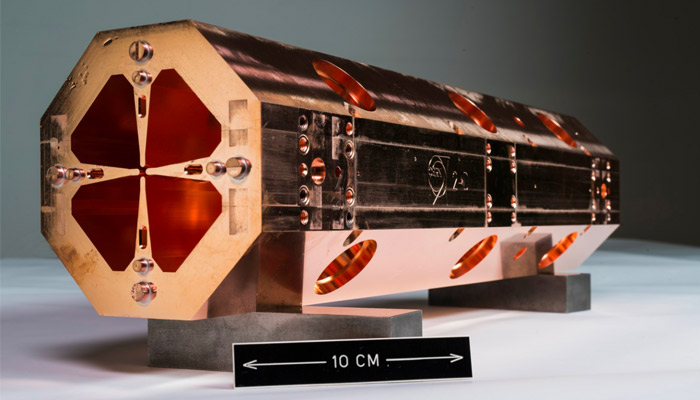
The classic model of a complete quadrupole (photo credits: CERN)
Additive manufacturing for overcoming assembly problems
According to the project partners, the RFQ is traditionally manufactured from highly conductive materials and alloys, via multi-axis milling of “prefabricated large-scale-forged single-piece components”. In concrete terms, the RFQ integrates 4 modules that are assembled by furnace brazing. However, the latter generally releases residual stresses, which can lead to geometric distortion. Several heat treatments during machining are then necessary to maintain the quality level and ensure the proper functioning of the part. As you can imagine, all these steps are time-consuming, costly and not very efficient. To overcome this, the project partners turned to additive manufacturing, particularly because of its ability to produce components in a single block, thus avoiding the assembly steps and their constraints.
More from the desk
Six other notes from the rest of the bench.
 NewsJackson Pollock Inspires Harvard 3D Printing ResearchOne of the most important American artists of the 20th century, Jackson Pollock has played a decisive role in shaping contemporary art. Known for his abstract expressionism, he was an artist who stood out because of his drip painting technique.…
 ApplicationsA Breakthrough for 3D Printed Heart Valves from Georgia Tech3D printed heart valves have been around for years. In fact, in 2023 the Cureus Journal of Medical Science published Trends and Challenges in the Development of 3D-Printed Heart Valves and Other Cardiac Implants: A Review of Current Advances, which…
 MaterialsUNSW Scientists use new bioink to create 3D printed boneScientists from the University of New South Wales (UNSW Sydney), a leading research and teaching university in Australia, have developed a ceramic-based ink that could allow surgeons to create 3D printed bone parts with actual living cells. We’ve seen recently…
 PrintersVelo3D on Creating Large, Mission Critical Parts With Metal Additive ManufacturingFounded in the United States by Benny Buller, Velo3D is known for its metal additive manufacturing solutions especially in sectors like aerospace. Not only do its solutions essentially eliminate the need for Design for Additive Manufacturing (DfAM), allowing for less…
 ApplicationsRestoration of vintage car thanks to 3D technology and KW HeritageThe KW Heritage affiliate of the UK group KW Special Project recently unveiled its plans to restore the famous 1967 car: Alfa Romeo Tipo 33/3. Thanks to 3D technologies, the team in charge of the project were able to present this classic…
 PrintersMastrex Expands Access to Metal AM With Affordable MX-Series LPBF SystemsMetal additive manufacturing has long been associated with high costs and complex infrastructure, keeping the technology out of reach for all but the largest industrial players. A new generation of manufacturers is now working to change that. Among them is…