Materials
3D Printed Clay Bricks Aim For Sustainable, Eco-Friendly Construction
In recent years, 3D printed structures and housing construction projects have been growing around the world both in scale and scope. Depending on the materials used, 3D printed buildings offer multiple advantages over conventional construction, including fire resistance, local or
- 3 min read
- Materials
- Six more stories
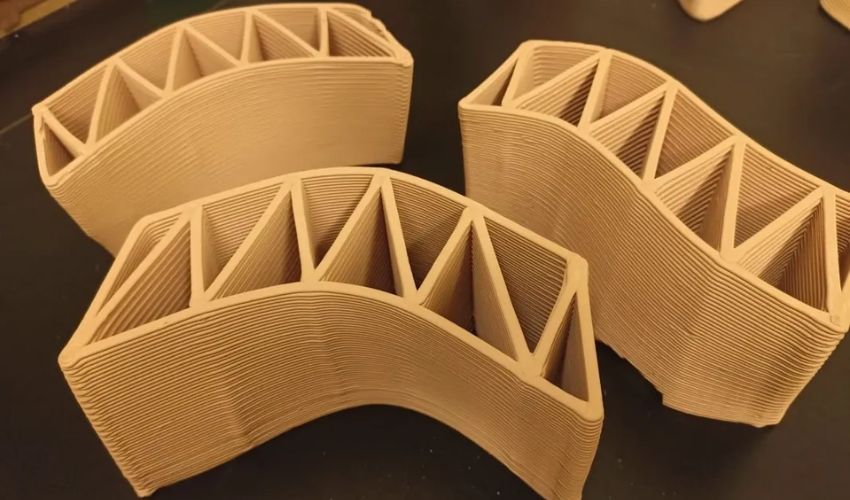
In recent years, 3D printed structures and housing construction projects have been growing around the world both in scale and scope. Depending on the materials used, 3D printed buildings offer multiple advantages over conventional construction, including fire resistance, local or recyclable materials, lower overall costs, and of course, shorter build times to accommodate population growth in a more timely manner. At The American University in Cairo (AUC), researchers have been hard at work developing an additive manufacturing-based construction system of their own which prioritizes local construction materials, robotic fabrication, and a strong push towards carbon-zero manufacturing. The result? Their 3D printed clay brick project’s success has been the first of its kind for North Africa and provides a glimpse at the potential in the region.
The researchers are at one of only three labs that are currently experimenting with clay bricks in Africa and the Middle East. More specifically, the metal and clay material-based method of additive manufacturing was developed through a collaboration between the AUC’s Additive Manufacturing Centennial Lab (AMCL) and the Robotic Fabrication Lab (RFL). This process is capable of utilizing robotic arms to build complex structures at a fraction of the cost in energy, time and emissions compared to traditional construction practices. Eschewing concrete mixtures which are commonly used for AM construction projects, the team has opted for what they term a specialized red fire clay which is more durable and resistant to heat than normal clay due to its composition which includes minerals such as feldspar, quartz and kaolin. The mixture can then be easily extruded into the desired shapes using the team’s large-scale robotic 3D printing apparatus.
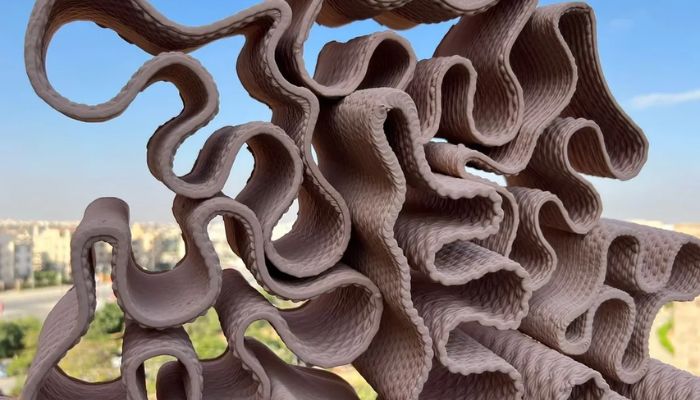
The 3D printed clay is more resistant to heat and able to hold complex shapes (photo credits: The American University in Cairo RFL)
The use of clay plays a critical role in the team’s vision and commitment to sustainability. Based in Egypt, the team is well aware that clay (and the material to make clay) is found in abundance, as traditionally produced clay bricks have been used in the region since time immemorial. The upshot for the AUC team is a steady supply of local materials to work with on an as-needed basis. Indeed, the positive impacts have been touted by the team who predict the technology will help stimulate the local economy while providing readily available and more affordable housing to those in need.
More from the desk
Six other notes from the rest of the bench.
 NewsThis Material Stops Flames! HP Presents 3D Material, Scalable Solutions at Formnext 2024HP is always aiming to contribute to technological progress. The company has a diverse portfolio of technology, services, printers and 3D printing solutions, including its innovative Multi Jet Fusion technology. In recent years, HP has increasingly focused on sustainability and&h
 NewsUsing 3D Printing in the Fight Against Fast FashionWhen it comes to the environmental concerns plaguing our planet, the textile industry is quickly coming under scrutiny as one of the worst offenders. The rapid change in fashion trends, the constantly appearing new collections and the growing consumption of…
 NewsRevo Foods and their 3D Printed SeafoodLast July, we presented a crazy concept from Legendary Vish, founded by a group of students who came up with a way to 3D print fish. A few months later, the project was structured and a startup was born: Revo…
 ApplicationsNew Study Examines if EU Regulations Are Stifling Medical 3D PrintingThe medical 3D printing market has grown sharply in recent years. This includes in the EU, where the overall healthcare AM market is expected to grow at a CAGR of 15.4% until 2029. Unsurprising when you consider that the European…
 ApplicationsZebro Robots to Use 3D Printing to Help Colonize MarsWhat may still sound like science fiction to some is actually becoming more and more likely in reality: the colonization of another planet. Various projects are actively working on the implementation of ideas that are supposed to bring about the…
 NewsLarge format 3D printing with foam that expands 40 times its volumeIt’s an accepted limitation that parts produced with additive manufacturing must be smaller than the machine that produced them. Once these parts have been manufactured, they can be post-processed and bonded together to form larger structures. Large scale 3D printing…