Applications
New Study Examines if EU Regulations Are Stifling Medical 3D Printing
The medical 3D printing market has grown sharply in recent years. This includes in the EU, where the overall healthcare AM market is expected to grow at a CAGR of 15.4% until 2029. Unsurprising when you consider that the European…
- 3 min read
- Applications
- Six more stories

The medical 3D printing market has grown sharply in recent years. This includes in the EU, where the overall healthcare AM market is expected to grow at a CAGR of 15.4% until 2029. Unsurprising when you consider that the European Patent Office found last year that international patent families in 3D printing technologies had grown at an annual rate of 26.4% in the region, with nearly one-fifth of those done between 2001 and 2020 in the healthcare sector. But are there factors that are still slowing its growth?
New research from Dr. Marc Mimler, senior Lecture in Law at The City Law School, seems to suggest so. In the article “Core Legal Challenges for Medical 3D Printing in the EU,” Mimler along with other collaborators from different University hospitals as well as departments of mechanical engineering, sought to examine the EU legislation and case law, falling under Medical Device Regulation (MDR), on issues related to pre-market approval and post-market liability for 3D printed devices. And the results seem to show that gray areas within this are indeed hindering the growth of medical 3D printing, with more work needed to be done to clarify issues.
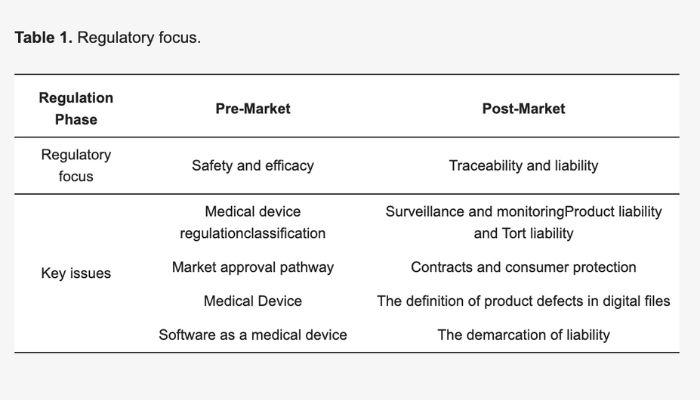
The focus of the study is on pre-market and post-market regulations for 3D printed medical devices (image credits: Mimler et al.)
Are EU Regulations Hurting Medical 3D Printing Growth?
The results, as outlined in a press release from the City School, are divided based on pre- and post-market status. Looking at the pre-market regulations, the researchers focused on the EU’s ‘Custom Device Exemption’ which allows devices made per a written description by an authorized person to bypass requirements like CE marking. And though this would seem a positive for 3D printing, the fact that ‘patient-matched’ devices (which have been made for a specific patient) do not fall under this creates a gray area for 3D printed medical devices. Especially since this distinction is not in place for ‘mass-customized’ devices.
More from the desk
Six other notes from the rest of the bench.
 NewsDynamic 3D Printing Method Achieves Unmatched Speed and AccuracyRelying on the speed of light, researchers at Northwestern University have developed a remarkably faster photopolymerization-based 3D printer. The researchers claim to be able to deposit 4,000 layers in just 2 minutes! But that’s not all: this 3D printer, equipped…
 PrintersStratasys J55: A PolyJet desktop 3D printer that offers thousands of coloursThe manufacturer Stratasys has just launched its new PolyJet machine: the J55 is a compact solution, suitable for all designers who want to bring their designs to life. The printer is smaller but retains its multi-material and multi-colour capabilities: it…
 GuidesThinking Huts Relies on 3D Printing to Increase Access to EducationThinking Huts is an association that seeks to promote access to education through 3D technologies. By 3D printing schools, it hopes to rapidly multiply the number of available infrastructures, as well as seeking to create jobs locally while promoting more…
 PrintersThe new Origin One 3D printer for high-volume productionOrigin, the Californian startup that developed its Open Additive Production platform to offer a new manufacturing method based on open materials, expandable software and modular hardware, with the aim of meeting the demand for better quality materials and customisation, just&hell
 NewsWebinar: Metal additive manufacturing for industrial applicationsAdditive Manufacturing can represent the next stage of evolution for industries around the world. This is already the case in segments like Aerospace, Healthcare or Motorsports. But, for many companies which are aware of the specific challenges of these segments,…
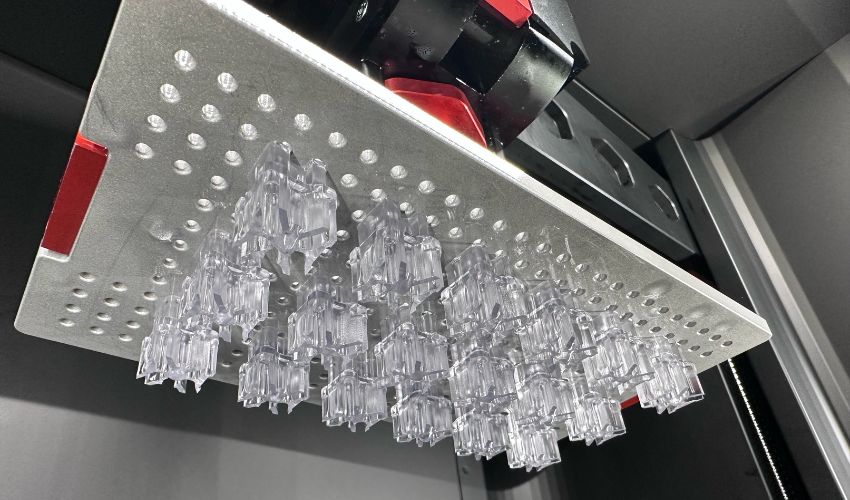 PrintersThe Lumia X1 Is Overcoming Limitations in Resin 3D Printing With an Innovative Hybrid ProcessSince stereolithography, the first additive manufacturing technology, was invented in the early 80s, there has always been a place for resin 3D printing in the sector. Currently, a number of different variations exist but the two most common remain DLP…