News
Large format 3D printing with foam that expands 40 times its volume
It’s an accepted limitation that parts produced with additive manufacturing must be smaller than the machine that produced them. Once these parts have been manufactured, they can be post-processed and bonded together to form larger structures. Large scale 3D printing…
- 3 min read
- News
- Six more stories
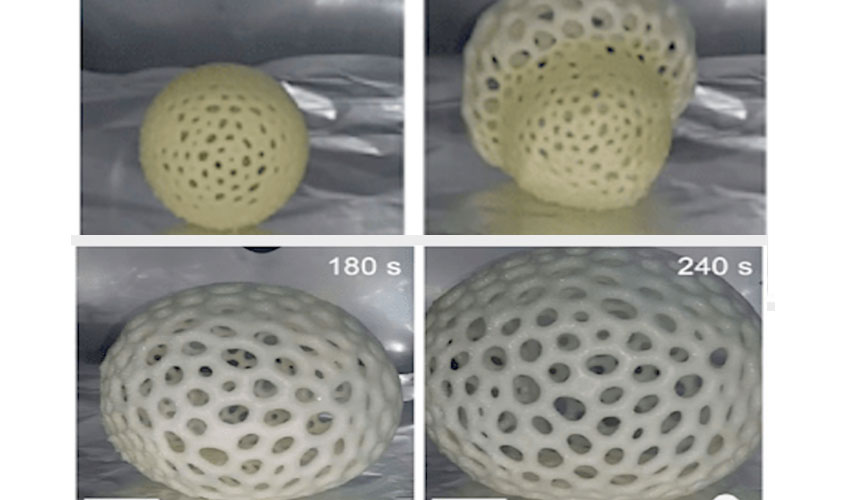
It’s an accepted limitation that parts produced with additive manufacturing must be smaller than the machine that produced them. Once these parts have been manufactured, they can be post-processed and bonded together to form larger structures. Large scale 3D printing is possible, but there are less systems available than desktop 3D printing. As of today, one of the biggest machines on the market can print volumes up to 1 m3. In a research paper published in Applied Materials & Interfaces, scientists explore the expandability of 3D printed foam as a possible solution to the limitation of build volumes.
In their Highly Expandable Foam for Lithographic 3D Printing paper, the researchers from UC San Diego explain that they developed a foaming prepolymer resin for lithographic additive manufacturing. Lithographic AM, which relies on the process of polymerization, hardens layers of material, in this case resin, using a light source. The foaming prepolymer resin can expand after being 3D printed to produce parts up to 40 times their original volume. Therefore, the build volume of the 3D printer does not limit the size of parts anymore using this process.
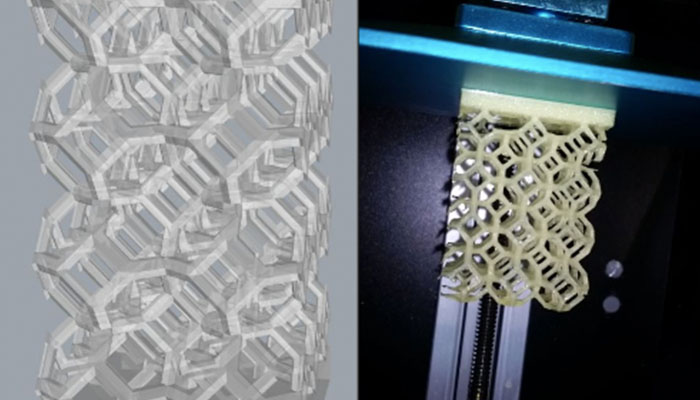
The part is modelled on CAD software and then printed on a lithography 3D printer
For what sectors will foam 3D printing be useful you might ask. The researchers write in the abstract: “Complex geometries comprised of porous foams have implications in technologically demanding fields such as architecture, aerospace, energy, and biomedicine.” During the development of their technology and material, two demonstrations were constructed. The first one was a helical wind turbine, 3D printed at one third scale and then expanded to its intended size. Then, a small boat hull was also printed at the same scale before expanding. The team heated these parts at 200°C for up to ten minutes for them to expand.
More from the desk
Six other notes from the rest of the bench.
 PrintersOKM3D and Raise3D to conquer EuropeWith offices in France and Germany, OKM3D has become the largest distributor of Raise3D products and solutions in Europe. It now operates for Raise3D in 7 countries, including France, Germany, Austria, Poland, etc. Offering a portfolio of innovative brands and…
 GuidesWhich Additive Manufacturing Companies are Publicly Traded?It is no secret that additive manufacturing has been growing rapidly over the past few years, especially since it proved its resiliency during the COVID-19 crisis. Though one sign of this of course has been the significant investment in the…
 Applications3D Systems Announces All New VSP Hybrid Surgical Guides3D Systems has just announced their latest enhancement to their VSP surgical planning portfolio. The all new VSP Hybrid Guides will deliver a breakthrough patient-specific, occlusal-based solution for maxillofacial surgeries. By combining nylon and titanium guides the new enhance
 NewsA New Process Allows for Mass Production of 3D Printed Microscale ParticlesOver the past year, we have seen a number of major milestones in the field of microscale 3D printing. Now there has been yet another, as researchers at Stanford University in California have developed a new microscale 3D printing process…
 NewsDISPERSEED is Using 3D Printing to Help Reforestation EffortsThis summer, the impact of global warming has clear worldwide. One particularly worrying sign has been the rise in fires, a direct result of numerous heat waves as well as low rainfall. In the United States alone, the National Interagency…
 NewsInfographic: The Role of 3D Technologies in the Art WorldAdditive manufacturing is increasingly gaining popularity in the worlds of art and cultural heritage. Indeed, the wider art sector, which has always been creative and in search of innovations and new conservation techniques, can benefit from 3D technologies in many…