Applications
Researchers create 3D printed artery to monitor blood pressure remotely
At the University of Wisconsin-Madison, scientists have developed 3D printed blood vessels that enable patients to monitor their blood pressure remotely. This is promising research given that today, when surgeons replace part of a blood vessel, the grafted vessel is…
- 3 min read
- Applications
- Six more stories
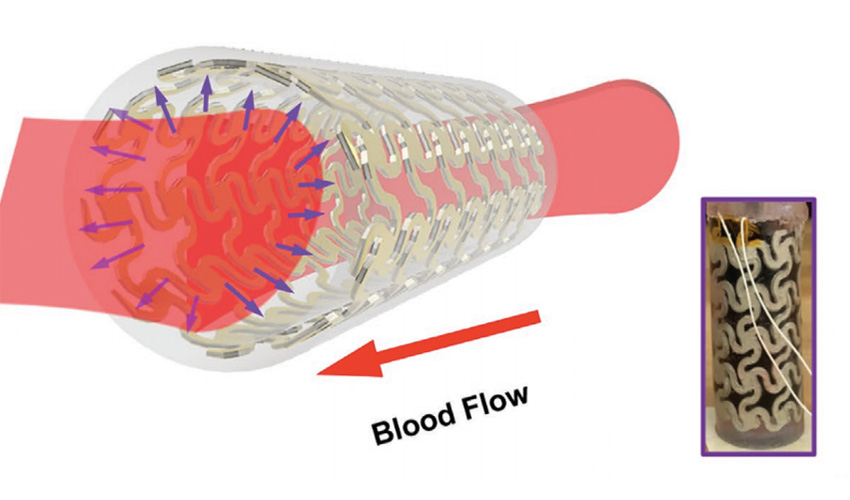
At the University of Wisconsin-Madison, scientists have developed 3D printed blood vessels that enable patients to monitor their blood pressure remotely. This is promising research given that today, when surgeons replace part of a blood vessel, the grafted vessel is monitored by CT scans, ultrasounds and other expensive imaging techniques. In the United-States alone, it’s 450,000 patients per year that undergo this operation to treat blood clots, coronary disease, stroke damage and other cardiac diseases. Moreover, between 40% and 50% of these grafts fail, which is why researchers are attempting to develop solutions to monitor blood pressure in order to initiate safer treatments early on.
At the University, it’s materials science engineers that successfully 3D printed the artificial blood vessel to allow doctors and patients to keep tabs on the patient’s health remotely. The implantable vessel was made of a composite material that is also flexible. Xudong Wang, and graduate student Jun Li that worked on this project published the study in the Advanced Functional Materials journal. Wang explains: “This artificial vessel can produce electric pulses based on pressure fluctuation which will be able to tell precisely the blood pressure in the vessel without using any additional power source. And because of the 3D geometry, the electric pulse profile will be able to tell if there is an irregular motion due to blockage inside in the very early stages.”
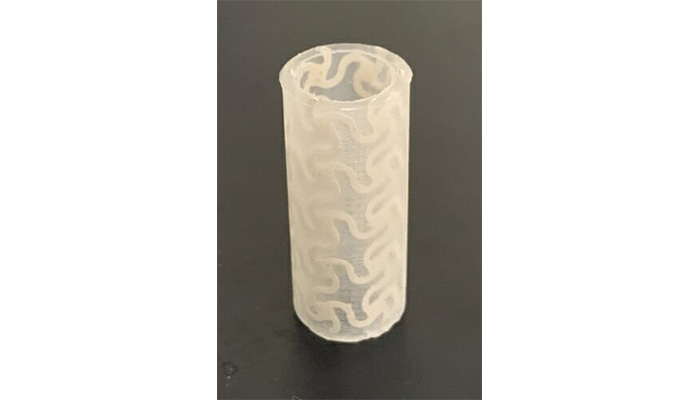
The 3D printed implantable blood vessel
Wang has researched materials for artery projects for a long time in previous research projects. He was especially interested in a material that would be flexible and piezoelectric, meaning that it is able to produce an electric charge from mechanical stress, as well as biocompatible. Therefore, the team combined sodium potassium niobite piezoceramic nanoparticles with a polyvinylidene fluoride polymer which is ferroelectric (able to flip polarity when an electric field is applied). They then 3D printed a tubular artery using the material and an off-the-shelf 3D printer. The printer extrudes the material through a strong electric field close to the nozzle to polarize the ceramic particles, giving the structure its piezoelectric property.
More from the desk
Six other notes from the rest of the bench.
 Applications3D-Printed Vaccine Patch Delivers Stronger Immune Response Than a Vaccine ShotSince the emergence of this recent global pandemic, researchers across the globe have been coming up with new medical interventions to combat the virus. One such intervention has emerged through a collaboration between scientists from Stanford University and the University&hellip
 ApplicationsCan Recycled Titanium 3D Printing Secure the UK’s Defense Supply Chain?British defense leader QinetiQ has reached a milestone in “circular” defense manufacturing with the successful maiden flight of a 3D-printed structural component made from recycled titanium. The test, conducted by QinetiQ’s Flight Test Organisation at MOD Boscombe Dow
 News3D printed art installation installed at the iLight Marina Bay Festival in Singapore3D printing is now taking on the art world with this new mesh-like art installation that was erected for the iLight Marina bay festival in Singapore. Designed by professors Felix Raspall and Carlos Bañón from the Singapore University of Technology…
 GuidesHow Haddy Redefines Manufacturing and Design with Its MicroFactory Model3D design and printing make for a powerful combination in the world of furniture. Thanks to additive manufacturing, it is now possible to turn creative concepts into functional pieces using almost any material and reducing production times. In this article,…
 NewsWhat is Two-Photon Polymerization?Nano- and microscale 3D printing offers design freedom and efficiency, paving the way for numerous pioneering innovations, particularly in the fields of micro-optics and micromechanics. In turn, these achievements drive new developments, promoting technological progress. As a res
 NewsWEBINAR: How to choose your AM engineering grade material and 3D printer?There are many things to consider when choosing material for 3D printing projects, and the questions to be answered just become more daunting when materials need to be engineering-grade, meaning they should be able to stand up to more rigorous…