News
What is Two-Photon Polymerization?
Nano- and microscale 3D printing offers design freedom and efficiency, paving the way for numerous pioneering innovations, particularly in the fields of micro-optics and micromechanics. In turn, these achievements drive new developments, promoting technological progress. As a res
- 3 min read
- News
- Six more stories
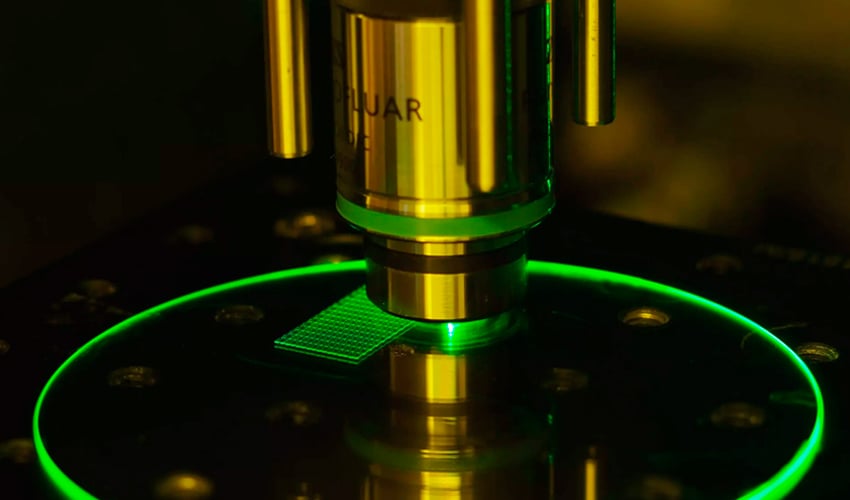
Nano- and microscale 3D printing offers design freedom and efficiency, paving the way for numerous pioneering innovations, particularly in the fields of micro-optics and micromechanics. In turn, these achievements drive new developments, promoting technological progress. As a result, the commercialization of 3D printing techniques that can be used to produce these micro- and nano-objects has increased in recent years. One of the most important processes in this context is two-photon polymerization.
Two-photon polymerization is often abbreviated simply as 2PP. Other terms that can be found concerning this technology are two-photon lithography, direct laser writing, or two-photon polymerization graphene. 2PP falls under the umbrella microscale 3D printing and could be considered an advanced additive manufacturing technology. The basic principles were developed by Shoju Maruo, Osamu Nakamura and Satoshi Kawata at Osaka University in 1997. Since then, numerous companies have continued developing the technology, bringing their equipment to market under various patented names.
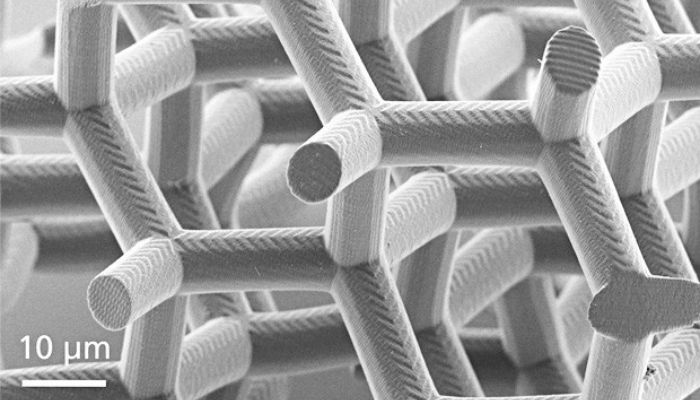
A 3D printed microstructure: two-photon polymerization can be used to produce complex structures at the micro- and nanometer scale (photo credits: Fraunhofer ISC)
How Does Two-Photon Polymerization Work?
Two-photon polymerization, as the name suggests, is based on the principle of photopolymerization. Here, targeted exposure to light triggers the polymerization, or the process to bring monomers together to create a polymer chain, of synthetic resins. This chain reaction causes the molecules to bond and harden, resulting in 3D models. All light-curing processes work in similar ways, but differ in the procedure.
More from the desk
Six other notes from the rest of the bench.
 NewsTop 5: How Cold Spray Technology Offers Faster Additive ManufacturingHello everyone, and welcome to our top 5 videos of the week! As always, we have an exciting and educational select of 3D printing video content for you. This week’s range from cold spray technology for additive manufacturing, an interview…
 Printers3Dnatives Lab: Our Test of the Micro 3D Printer by M3DIf you’ve been watching the 3D printing market for some time, you’ve heard about the Micro from M3D. The Micro 3D printer is a compact printer that was launched through a Kickstarter campaign in April 2014, and was advertised as one…
 PrintersFlashforge Launches its New Guider 3 PLUS 3D PrinterChinese 3D printing manufacturer Flashforge has just launched its new FDM 3D printer, the Guider 3 PLUS. The Zhejiang province-based company has already expanded its presence internationally, selling its products to nearly 100 countries and regions around the world since…
 ApplicationsThe Growing Market of 3D Printed ImplantsResearch firm, Precedence Research, recently published a report on 3D printed medical implants. According to the report, 3D printed implants should generate more than 9 billion dollars in 2030 against 1.5 billion in 2020, an annual growth of 19%. Faced with increasingly complex&h
 SoftwareRiven Launches New Re-Scaling Tool to Prevent Shrinkage and WarpingBerkeley-based American company, Riven is launching a brand new re-scaling tool in order to reduce the effects of shrinking or warping incurred during the printing process on all 3D printed parts and allow users to print parts more accurately. The…
 GuidesThe 3D Printing Books to Read This YearWorld Book Day is celebrated annually on April 23rd (except in the UK and Ireland where a similar event is observed in March). And as it is coming up fast, so we thought there was no better occasion to present…