Applications
3D Bioprinting of Elastic Ear Cartilage
There is a widespread belief that we are on the verge of 3D printing functional organs, but the reality in the lab is far more complex. Although that goal remains distant, a team of researchers at ETH Zurich has reached…
- 3 min read
- Applications
- Six more stories
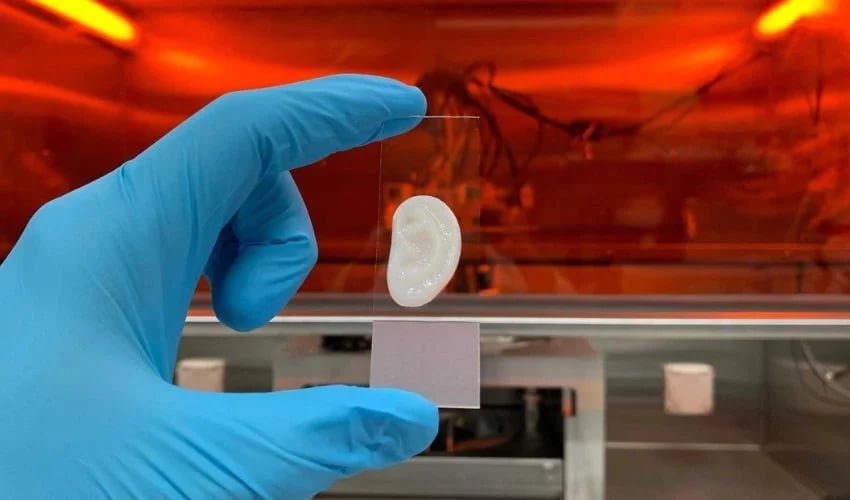
There is a widespread belief that we are on the verge of 3D printing functional organs, but the reality in the lab is far more complex. Although that goal remains distant, a team of researchers at ETH Zurich has reached a milestone that brings it closer. They successfully created elastic, stable ear cartilage from human cells grown in the lab. Led by researcher Philipp Fisch and Professor Marcy Zenobi-Wong, the team developed a 3D-printed artificial ear that retained its shape and mechanical properties after implantation in animal models, bringing personalized solutions for patients with severe malformations or injuries one step closer.
The main objective of this research is to overcome the limitations of current reconstruction methods. Today, the standard treatment for ear malformations or ear loss caused by accidents involves harvesting cartilage from the patient’s own ribs to sculpt a new ear. In addition to being painful, this method often results in an ear that is stiffer than a natural one. For this reason, scientists are working to create a tissue that offers the necessary stability and flexibility before being implanted in the human body.
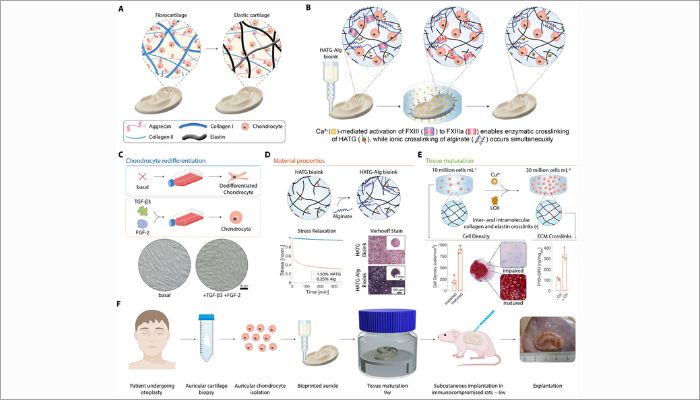
Schematic overview of the ear cartilage manufacturing process (credits: P. Fisch, S. Kessler, S. Ponta, et al.).
To obtain the necessary biological material, the researchers extracted cells from small cartilage fragments left over from previous surgeries performed on other patients. From a tiny sample measuring just three millimeters, they initially isolated about 100,000 cells, which they then grew in a special nutrient solution until reaching the hundreds of millions needed to create a complete ear. During this cultivation process, the team optimized the environment to ensure that the cells produced type II collagen and elastin, both characteristic of ear cartilage, rather than turning into fibroblasts, which would produce much softer scar tissue.
More from the desk
Six other notes from the rest of the bench.
 NewsGuatemala’s First 3D Printed (and Earthquake-Proof!) House Has Been InstalledHow far has concrete 3D printing progressed? Over the recent months, we have told you about a number of different projects using this technology to create housing. Now it has arrived in another Central American country. The first 3D printed…
 GuidesQOROX Transforms the Construction Game with 3D PrintingThe construction industry is undergoing constant change thanks to advances in 3D printing. We’ve seen the creation of a variety of 3D-printed structures, from shopping malls and houses to boats. This innovative technology offers numerous solutions to current challenges in&h
 SoftwareSmartBuild Brings Stereolithography to an Industrial ScaleWhile stereolithography is a well-established additive manufacturing technology used by many, it comes with its share of challenges, particularly when it comes to scaling up. Manufacturers are often forced to make a difficult trade-off between speed and quality, while also&hellip
 NewsSpanish Police Bust Illegal 3D Printed Weapons WorkshopIn a joint effort between the National Police and officials of the Tax Agency, the first illegal 3D printed weapons manufacturing workshop in Spain has been dismantled. While the operation itself was carried out a few months ago on September…
 NewsResearchers Make 3D Printed Models of Endangered Languages3D modeling is conceived as a way to demonstrate the complexity of systems, and accessibly showcase intricacy and fine details. While 3D models might bring to mind surgical planning or engineered parts, today we bring you a project from 2022…
 MaterialsEXTEM™AMHH811F filament can resist highest temperatures on the marketThe Italian manufacturer Roboze and the chemical company SABIC have unveiled the fruit of their recent collaboration: a new high-temperature 3D printing material, EXTEM™AMHH811F filament. Compatible with Roboze’s ARGO 500 3D printers, designed for production, this amorphous