

The Dawn of Self-Sensing 3D Printed Materials: Revolutionizing Structural Integrity and Safety
Imagine a world where the materials comprising our infrastructure, vehicles, and even medical implants could communicate their condition in real-time, long before a minor issue escalates into a catastrophic failure. This visionary concept is swiftly becoming a reality, thanks to groundbreaking research spearheaded by engineers at the University of Glasgow. Their innovative work focuses on developing a sophisticated system capable of precisely modeling the physics of **self-sensing 3D printed composites**. These remarkable materials possess an inherent ability to detect critical parameters such as **strain, load, and damage** solely by monitoring changes in their electrical current. This unprecedented capability paves the way for continuous, **real-time structural health monitoring**, unlocking immense potential for advanced **safety and quality assurance features** across a vast spectrum of industrial and technological applications.
Understanding the Mechanics: How Self-Sensing Materials Function
At the core of these ingenious materials lies a phenomenon known as **piezoresistivity**. As articulated in the official press release from the University of Glasgow, the secret lies in **”weaving fine strands of carbon nanotubes throughout materials [to] allow them to carry an electrical current, imbuing them with the ability to monitor their own structural integrity through a phenomenon called piezoresistivity.”** To elaborate, carbon nanotubes (CNTs) are incredibly strong and highly conductive nanomaterials. When these microscopic conductive pathways are uniformly dispersed within an insulating or semi-conductive polymer matrix, they form an interconnected network capable of carrying an electrical current.
When the composite material is subjected to mechanical stress – whether it’s stretched, compressed, or twisted – its internal structure undergoes subtle deformations. These deformations, in turn, alter the physical arrangement and contact points of the embedded carbon nanotube network. For instance, under compression, CNTs might be forced closer together, increasing conductivity, while under tension, they might be pulled further apart, potentially disrupting conductive paths and increasing resistance. This change in the electrical current or resistance acts as a direct indicator of the material’s mechanical state. A measurable shift in electrical properties therefore directly signifies that the material has undergone deformation or incurred damage, providing an immediate, intrinsic warning that a fault needs to be addressed before it compromises the material’s integrity or the system it supports.
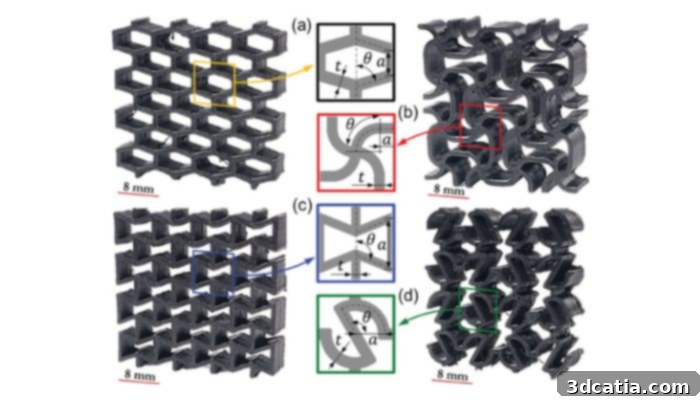
The four different lattices created by the University of Glasgow engineers (Photo credit: University of Glasgow)
The pioneering research was spearheaded by Professor Shanmugam Kumar, a distinguished academic from the University of Glasgow’s James Watt School of Engineering. Professor Kumar underscored the profound significance of their achievement, stating, **“Imparting piezoresistive behavior to 3D-printed cellular materials gives them the ability to monitor their own performance without any additional hardware.”** This inherent self-sensing capability eliminates the need for external sensors, wiring, or bulky monitoring equipment, leading to lighter, more integrated, and potentially more reliable structures. This integration is particularly crucial for complex geometries and applications where space and weight are at a premium, such as in aerospace or robotics.
Rigorous Testing and Advanced Predictive Modeling
Fabrication and Initial Characterization of Autonomous Sensing Materials
To validate their theoretical models and prove the concept, the University of Glasgow engineers embarked on an extensive experimental program. They meticulously fabricated four distinct lightweight lattice structure designs using a combination of **polyetherimide (PEI)**, a high-performance thermoplastic renowned for its excellent mechanical and thermal properties, and uniformly dispersed carbon nanotubes. The choice of PEI as the matrix material, combined with the integration of carbon nanotubes, was strategic, aiming for a robust and conductive composite. These composite structures were created using **Fused Filament Fabrication (FFF)**, a widely adopted **additive manufacturing** technique. FFF allowed for the precise creation of intricate cellular geometries, which were aptly termed “autonomous sensing architected materials” due to their designed-in self-monitoring capabilities.
The initial phase of testing involved a comprehensive evaluation of their **piezoresistive behavior** under various mechanical stresses. Beyond just sensing, the team also rigorously assessed other critical material properties, including their **stiffness, strength, and energy absorption capabilities**. Understanding these mechanical characteristics is vital for predicting how the materials will perform in real-world applications where they are expected to bear loads and withstand impacts.
Developing and Validating Complex Computer Models
Following the physical characterization, a crucial step involved the development of **complex computer models**. These sophisticated computational tools, likely employing techniques such as **Finite Element Analysis (FEA)**, were designed to predict with high accuracy how these newly developed materials would respond to a diverse array of mechanical loads and environmental conditions. The goal was to create a digital twin, a predictive framework that could simulate the material’s behavior under stress and anticipate changes in its electrical resistance. This modeling capability is paramount because it offers a non-destructive and cost-effective method to optimize material design before extensive physical prototyping.
Once the team generated predictions from their computational models, the next critical phase involved **validation under real-world conditions**. This wasn’t merely a theoretical exercise; it required subjecting the actual physical materials to intense analysis to confirm the models’ accuracy. A key method employed for this validation was **infrared thermal imaging**. By visualizing the electrical current flowing through the materials using thermal cameras, the researchers could directly observe how electrical resistance changed in response to applied stress and strain. The direct correlation between the thermal images (indicating current flow/resistance) and the applied mechanical forces provided compelling evidence that their computer models could indeed accurately predict the materials’ mechanical and electrical responses. This robust validation signifies a major leap forward in the engineering of intelligent materials.
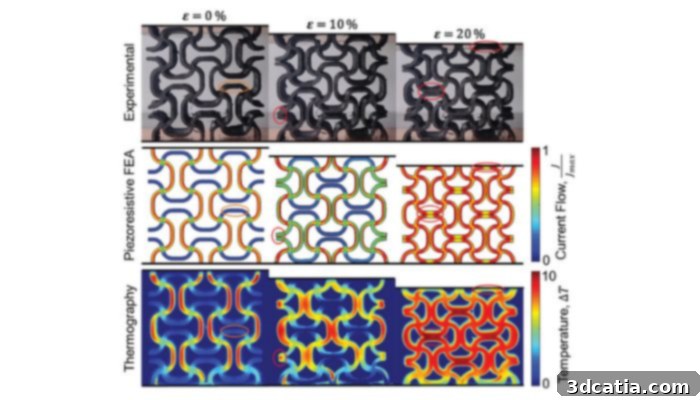
The lattices and their thermal imaging (Photo credit: University of Glasgow)
Professor Kumar further elaborated on the transformative impact of these developed models on the optimization of **self-sensing materials**. He highlighted a long-standing challenge in material science: **“While researchers have known about these properties for some time now, what we’ve not been able to do is provide a way to know in advance how effective new attempts at creating novel self-sensing materials will be.”** Traditionally, material development often relied heavily on a labor-intensive and expensive process of **“trial and error”** to identify optimal approaches. This new predictive modeling system dramatically shifts this paradigm, allowing engineers to simulate and fine-tune material designs digitally before committing to physical fabrication. This not only accelerates the development cycle but also significantly reduces associated costs and resource consumption, making the creation of advanced functional materials more efficient and accessible.
Transformative Applications of 3D Printed Self-Sensing Materials
The advent of self-sensing materials holds immense promise for **diverse applications** across various sectors, particularly within the burgeoning field of **additive manufacturing**. Their ability to provide intrinsic, real-time feedback opens up revolutionary possibilities for enhancing safety, efficiency, and longevity in numerous products and structures.
- Aerospace and Automotive Industries: In critical sectors like aerospace and automotive, where component failure can have catastrophic consequences, these smart materials could profoundly enhance **safety and maintenance features**. By integrating self-sensing capabilities into aircraft, spacecraft, and vehicle parts, engineers can achieve continuous, **real-time structural integrity monitoring**. This means detecting minute cracks, fatigue accumulation, or excessive stress points on an engine bracket, wing component, or chassis element before they become critical. Early detection could drastically reduce maintenance downtime, optimize inspection schedules, and ultimately prevent accidents, leading to safer travel and more reliable transportation systems.
- Civil Infrastructure: Beyond moving vehicles, the implications for static infrastructure are equally profound. Imagine bridges, tunnels, pipelines, or high-rise buildings constructed with self-sensing materials. These structures could autonomously report signs of structural degradation, such as stress fractures, corrosion-induced strains, or material fatigue, long before these problems lead to structural collapse. Such proactive monitoring would allow for timely repairs, significantly extending the lifespan of critical infrastructure, improving public safety, and yielding substantial economic savings by averting costly emergency interventions and rebuilds.
- Smart Orthopedics and Medical Devices: The engineers’ findings also possess **“profound implications for smart orthopedics.”** In the medical field, self-sensing materials could revolutionize the design of prosthetic limbs, implants, and wearable medical devices. For instance, a prosthetic could monitor its own wear and tear, pressure distribution, or even the success of its integration with the body, providing valuable data to clinicians and enhancing patient comfort and outcomes. Similarly, sensing capabilities in surgical tools or diagnostic equipment could provide enhanced precision and safety.
- Advanced Sensors: The piezoresistive nature of these composites makes them ideal candidates for next-generation, embedded sensors. They could be designed to monitor various environmental factors (pressure, temperature, humidity when combined with other elements) or act as stress-strain sensors in challenging environments where traditional sensors might fail or be impractical to install.
- Batteries and Energy Storage: While less immediately obvious, these materials could also play a role in advanced battery technologies. Monitoring internal stresses, swelling, or minor structural changes within battery components could potentially enhance safety by detecting early signs of degradation or thermal runaway, leading to more reliable and longer-lasting energy storage solutions.
- Other Multifunctional Applications: The ability to detect physical changes intrinsically opens doors for countless other **multifunctional applications**, from smart packaging that indicates product damage to intelligent robotics that can self-diagnose mechanical issues.
The Path Forward: Future Research and Industry Impact
Looking ahead, the research team is optimistic about the broader applicability of their findings. They emphasized that **“While we focused on PEI materials with embedded carbon nanotubes in this paper, the multiscale finite element modeling our results are based on could be easily applied to other materials which can be created through additive manufacturing too.”** This statement highlights the versatility and scalability of their predictive modeling framework. It suggests that the principles and methodologies developed for PEI/CNT composites can be adapted to a wide array of other polymers, ceramics, or metals that can be processed via various **additive manufacturing techniques**, thereby greatly expanding the potential for intelligent material design.
The University of Glasgow engineers expressed a clear vision for the future, stating, **“We hope this approach encourages other researchers to develop new autonomous sensing architected materials, unlocking the full potential of this methodology in material design and development across a wide range of industries.”** This call to action is an invitation for the global research community to build upon their foundational work, pushing the boundaries of what is possible with **smart materials** and **3D printing**. The implications are nothing short of revolutionary, promising a new era of materials that are not only stronger and lighter but also inherently more intelligent, capable of informing us of their well-being and preventing unforeseen failures. For more comprehensive details on this pioneering self-sensing material research, the University of Glasgow’s press release provides further insights, accessible here.
Do you believe that self-sensing materials represent the inevitable future of the **additive manufacturing industry**? We invite you to share your thoughts in a comment below or engage with us on our LinkedIn, Facebook, and Twitter pages! Don’t miss out on the latest advancements in 3D printing; make sure to sign up for our free weekly newsletter here, delivering news directly to your inbox! You can also explore all our insightful videos on our YouTube channel.
*Cover Photo Credits: Polyetherimide (PEI) in pellet form