
Transforming Police Vehicles: How MOSOLF Leverages SLS 3D Printing for Advanced Customization
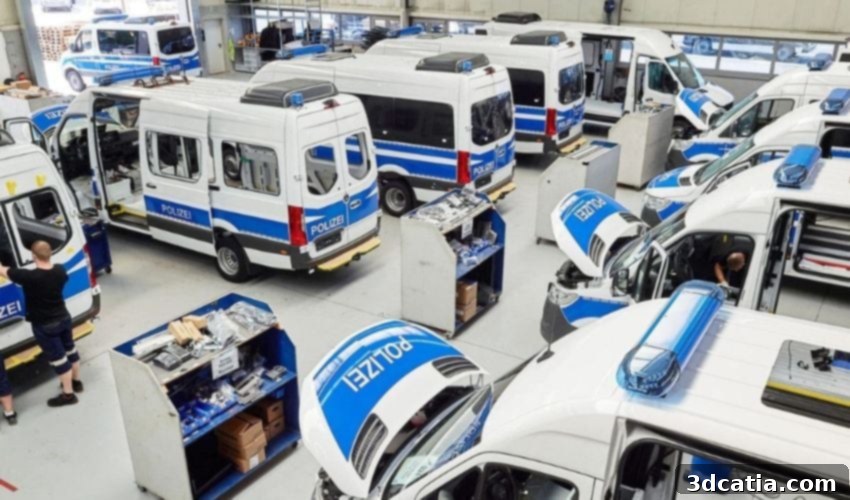
Police vehicles are far from ordinary automobiles. While their exteriors might bear a resemblance to standard models, often distinguished only by specialized lettering and emergency sirens, their interiors are meticulously engineered and profoundly different. These patrol cars are purpose-built and specially equipped to handle critical security missions, respond to diverse emergencies, and operate effectively in demanding situations. This often means integrating advanced communication systems like radios and computers, installing dashboard camera mounts, radar equipment, and even completely transforming trunk spaces for specialized gear. However, these crucial modifications must be precisely tailored to the unique operational requirements and ergonomic preferences of each individual police force, necessitating an exceptionally high degree of customization. This is precisely where the expertise of companies like MOSOLF Special Vehicles GmbH becomes indispensable. Going a step further, MOSOLF has strategically integrated advanced 3D printing technologies into its development and production processes to efficiently meet the stringent and varied demands of Germany’s police forces.
MOSOLF Special Vehicles GmbH, based in Kippenheim, Germany, is a distinguished leader specializing in the intricate conversion of standard vehicles into highly specialized units. Their client roster includes German police forces, defense agencies, and various emergency services, underscoring the critical nature of their work. Annually, the company undertakes the modification of approximately 1,000 units, providing comprehensive support to its customers throughout the entire vehicle lifecycle – from initial design and production to the eventual resale of the specialized vehicles at the end of their operational life. Today, we delve into their innovative application of Selective Laser Sintering (SLS) technology to radically transform and customize the interiors of mass-produced vehicles into highly functional police cars.
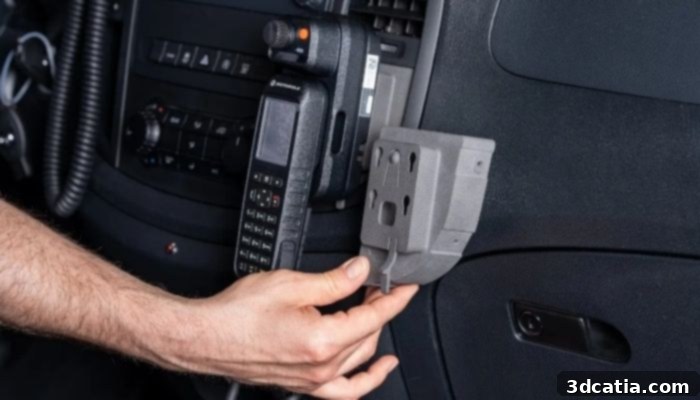
A custom-designed radio stand, perfectly fitted using 3D printing (photo credits: Formlabs)
MOSOLF’s Customization Imperative: Tailoring Every Police Vehicle
MOSOLF’s operational model revolves around taking standard production vehicles—including cars, trucks, and vans—and meticulously adapting them to the precise, often idiosyncratic, specifications of each client. The unique challenges associated with this level of customization have been profoundly addressed and overcome through the integration of additive manufacturing. This is particularly true for newer vehicle models, which tend to feature more intricate designs and components, leaving increasingly less space for the inclusion of essential communication or signage systems. The inherent design flexibility offered by 3D printing has emerged as the pivotal solution to this complex challenge, enabling MOSOLF to engineer and produce bespoke components that fit seamlessly into every available nook and cranny of the vehicle’s interior.
The complexity of MOSOLF’s customization work is further amplified by the fact that each police force maintains distinct requirements concerning ergonomics, specific equipment integration, and interior layouts. MOSOLF currently manufactures and converts vehicles for no fewer than 17 different police forces across Germany, each presenting its own unique set of specifications and preferences. This diversity in demand would typically pose significant logistical and production hurdles for traditional manufacturing methods. However, thanks to the agility and adaptability of 3D printing, the company is able to rapidly adjust its designs and production models to accommodate these variations with remarkable efficiency. This capability is not just an advantage; it is absolutely essential for MOSOLF to consistently meet the exceptionally high levels of personalization demanded by its diverse customer base, ensuring that every vehicle is perfectly optimized for its intended operational role.
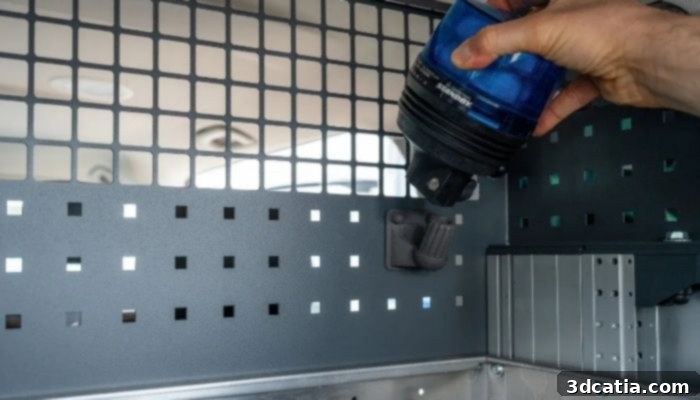
A robust, trunk-mounted holder for an emergency lamp, manufactured using SLS 3D printing (photo credits: Formlabs)
Selective Laser Sintering (SLS) 3D Printing: The Ideal Production Method
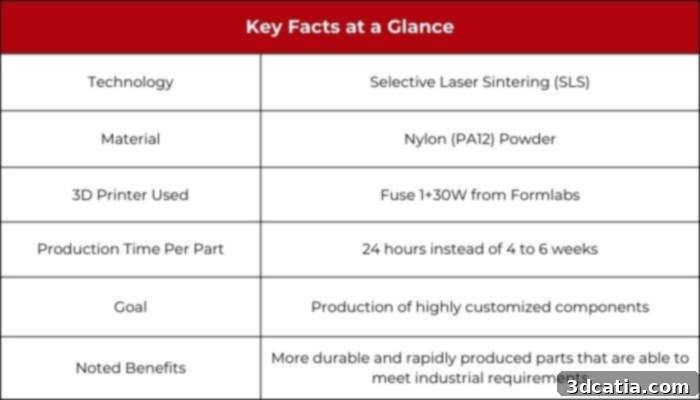
Among the various additive manufacturing technologies available, Selective Laser Sintering (SLS) has proven to be the unequivocally ideal process for MOSOLF. The rationale behind this choice is compelling: SLS 3D printing delivers an optimal combination of superior part quality, exceptional precision, and robust durability, all while enabling the simultaneous production of multiple components in a highly cost-efficient manner. Prior to adopting SLS, MOSOLF utilized FDM (Fused Deposition Modeling) technology. The transition to SLS marked a significant upgrade, allowing the company to dramatically increase its production capacity for the specialized parts it requires, and crucially, to achieve the stringent industrial standards demanded by the automotive and security sectors.
Furthermore, traditional manufacturing methods typically employed for vehicle components are inherently better suited for high-volume production runs of standardized products. These methods often involve expensive tooling and lengthy setup times, making them economically unviable for unique, low-volume requirements. In stark contrast, MOSOLF’s customers, the various police forces, consistently require only small batches of highly customized parts. This fundamental mismatch between demand and traditional supply methods is precisely why 3D printing, particularly SLS, has emerged as the perfect solution for the rapid, on-demand production of these unique and specialized components.
Unmatched Speed and Agility in Production
One of the most significant strengths and transformative benefits of SLS technology for MOSOLF is its unparalleled ability to produce finished parts in an incredibly short timeframe. With SLS, MOSOLF can now manufacture final, ready-to-install parts in as little as 24 hours. This represents a monumental improvement compared to the traditional lead times, which often stretched from four to six weeks. The remarkable agility and speed of this production method were key factors that decisively encouraged MOSOLF to fully embrace the technology. Today, an impressive 80% of their specialized parts are produced using SLS technology, primarily utilizing advanced systems such as Formlabs’ Fuse 1+30W SLS 3D printer. This rapid turnaround not only accelerates project timelines but also allows for greater flexibility in responding to evolving requirements and urgent demands from their clients.
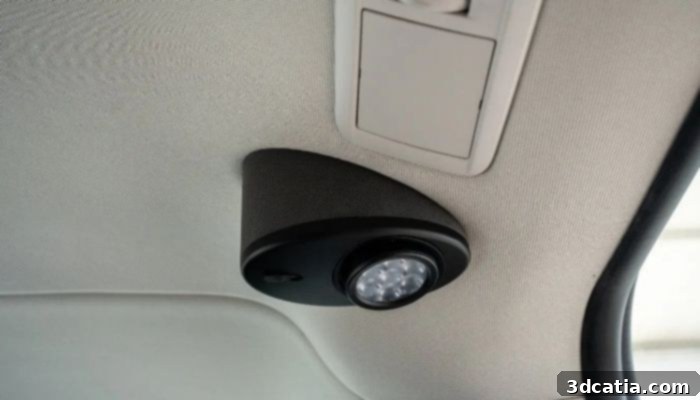
A precisely engineered housing for a roof-mounted lamp on a police vehicle, produced with 3D printing (photo credits: Formlabs).
The Material of Choice: Robust Nylon PA12
The material predominantly used by MOSOLF for these critical components is nylon, specifically PA12 powder. This choice is deliberate and crucial, primarily due to nylon’s exceptional resistance to heat and its superior mechanical properties. PA12 powder ensures that the printed parts maintain their structural integrity, dimensional stability, and aesthetic quality even when subjected to adverse environmental conditions. For instance, police vehicles are often left exposed to direct sunlight for extended periods during the summer months, leading to significant temperature fluctuations within the vehicle’s interior and on exterior mounted parts. Nylon PA12’s ability to withstand these high temperatures without deforming, cracking, or losing strength is paramount, guaranteeing the reliability and longevity of the additively manufactured components in real-world operational scenarios. Furthermore, its inherent durability and resistance to wear and impact make it an ideal material for components that endure constant use and potential stress within a demanding law enforcement environment.
The Tangible Impact: A Revolution in Law Enforcement Vehicle Design
The profound impact of 3D printing on MOSOLF’s operations and, by extension, on German police vehicles, cannot be overstated. In a revealing interview with Formlabs, Carsten Busam, Head of Project Planning at MOSOLF Special Vehicles GmbH, provided a compelling insight into the widespread adoption of this technology. He stated, “I estimate that every third police van [in Germany] now contains additively manufactured parts. At MOSOLF, we are now so far advanced with 3D printing that there is no vehicle that leaves our yard without an additively manufactured part in it. We now 3D print around 5,000 parts per year, but we are on an upward trend, which means that we have at least three parts in every vehicle if not more.” This testimony highlights not just an incremental improvement, but a fundamental shift in their manufacturing paradigm. The statistic that every vehicle leaving their facility contains at least one 3D printed part underscores the technology’s integral role, moving beyond niche applications to become a core part of their production strategy. The production of 5,000 parts annually, with a clear upward trajectory, demonstrates the significant scale and growing importance of additive manufacturing in meeting the evolving demands of modern law enforcement agencies.
Conclusion: The Future of Specialized Vehicle Manufacturing is Additive
The journey of MOSOLF Special Vehicles GmbH exemplifies a compelling case study for the transformative power of additive manufacturing in specialized vehicle customization. By embracing Selective Laser Sintering (SLS) 3D printing, MOSOLF has not only surmounted the complex challenges of tailoring standard vehicles to the exacting demands of various German police forces but has also set new benchmarks for efficiency, flexibility, and rapid production. The ability to create highly customized, durable, and precisely fitting components in a fraction of the time, utilizing robust materials like Nylon PA12, has revolutionized their operational workflow. From intricate radio stands and robust lamp holders to specialized interior fittings, 3D printing ensures that every police vehicle is optimally equipped for its critical duties. As evidenced by their significant annual output and the integration of 3D printed parts in virtually every vehicle they convert, MOSOLF is at the forefront of a technological paradigm shift. This innovative approach not only enhances the functionality and ergonomics for law enforcement personnel but also demonstrates the immense potential of additive manufacturing to drive innovation across the broader automotive and emergency services sectors. The future of specialized vehicle manufacturing is undoubtedly being shaped by the precision and versatility of 3D printing.
What are your thoughts on MOSOLF’s pioneering use of SLS printing to customize law enforcement vehicles? We’d love to hear your insights! Let us know in a comment below or join the conversation on our LinkedIn, Facebook, and Twitter pages! Don’t forget to sign up for our free weekly newsletter here for the latest 3D printing news straight to your inbox! You can also find all our compelling videos on our YouTube channel, offering more in-depth looks into the world of additive manufacturing.
*Cover Photo Credits: MOSOLF Special Vehicles GmbH