
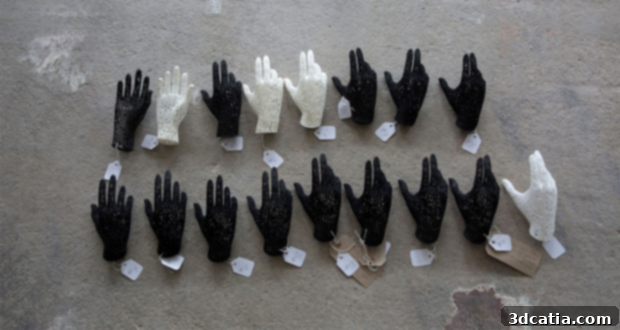
IKEA’s Groundbreaking OMEDELBAR Collection: Ushering 3D Printing into Mass-Produced Home Furnishings
The global furniture giant, IKEA, renowned for its innovative and accessible home solutions, has officially ventured into the realm of additive manufacturing with the launch of its pioneering 3D printed collection, “OMEDELBAR.” This visionary collection, primarily comprising distinctive decorative objects, marks a significant milestone in the industry. At the forefront of this release is an exquisitely designed hand sculpture, a versatile piece engineered to function both as a stylish coat hanger and an elegant jewelry holder. While the concept of 3D printed decorative items isn’t entirely novel – many independent artists and designers have explored this medium – IKEA’s integration into its mass production framework is truly revolutionary. Interestingly, some design elements within the OMEDELBAR collection evoke a sense of creative affinity with Diana Law’s innovative 3D printed jewelry, hinting at a broader artistic movement embracing the possibilities of additive design.
For years, 3D printing, or additive manufacturing, has been a powerful tool in various high-tech sectors, primarily for rapid prototyping and creating complex molds for traditional manufacturing processes. However, its adoption for direct, large-scale consumer product manufacturing by a brand of IKEA’s magnitude has remained largely untapped until now. The OMEDELBAR collection boldly redefines this paradigm, positioning IKEA as the first major furniture brand to seamlessly integrate advanced 3D printing technology into its core production processes. This isn’t merely about creating a niche product; it’s about exploring new manufacturing frontiers for mainstream home furnishings. The collection itself is a testament to creative collaboration, born from a partnership with the illustrious Swedish artist and fashion director, Bea Åkerlund. Åkerlund is celebrated for her avant-garde aesthetic and her work with global icons such as Madonna, Beyoncé, and Lady Gaga, bringing a distinct flair and high-fashion sensibility to everyday objects.

Bea Åkerlund and two of the 3D printed hands from the collection
The visionary behind this strategic move commented on the timely nature of the project: “We started this project one and a half years ago, predicting the boom in 3D printing in mass production. Traditionally the technology has been used for prototyping in high-tech industries or molds used for traditional production methods. Now, we are closing fast on the breaking point where 3D is cost efficient in mass production. In that context, the OMEDELBAR hand will have its place in design production history.” This statement underscores IKEA’s forward-thinking approach, recognizing the nascent potential of additive manufacturing to transcend its traditional roles and become a viable, cost-effective method for large-scale consumer goods production. The “OMEDELBAR” collection, which translates to “immediate” or “instantaneous” in Swedish, perfectly encapsulates the rapid prototyping capabilities of 3D printing and the instant visual impact of Åkerlund’s designs.
Bea Åkerlund’s involvement is pivotal to the collection’s unique appeal. Known for her bold and theatrical style, Åkerlund’s influence transforms utilitarian objects into pieces of art. Her collaborations with some of the world’s most influential pop culture figures have cemented her reputation as a groundbreaking creative force. For OMEDELBAR, she brought her signature blend of whimsy, elegance, and edgy sophistication, manifesting in pieces that are both functional and conversation-starting. The 3D printed hand, for instance, is more than just a holder; it’s a sculptural statement, reflecting Åkerlund’s artistic philosophy of making the ordinary extraordinary. This partnership highlights how advanced manufacturing techniques can be leveraged to democratize high design, making it accessible to a broader audience, which aligns perfectly with IKEA’s core values.
The technical prowess behind the OMEDELBAR collection’s flagship piece, the 3D printed hand, comes courtesy of Finnish 3D printing service Materflow. Utilizing the highly efficient and precise Selective Laser Sintering (SLS) process, Materflow was able to produce these intricate designs with exceptional detail and durability. SLS technology works by using a high-powered laser to selectively fuse small particles of polymer powder into a solid structure, layer by layer. This method is particularly adept at creating complex geometries and internal features that would be challenging, if not impossible, to achieve with traditional manufacturing techniques, offering unparalleled design freedom. For this specific project, Materflow pushed the boundaries of standard SLS practices by developing an innovative technique to optimize production cycles. They devised a method where, immediately after printing, the powder block containing the newly formed 3D printed object is carefully removed from the 177°C 3D printer and promptly transferred into a sealed wooden box. This specialized box then houses the object for a controlled cooling period of 24 hours.
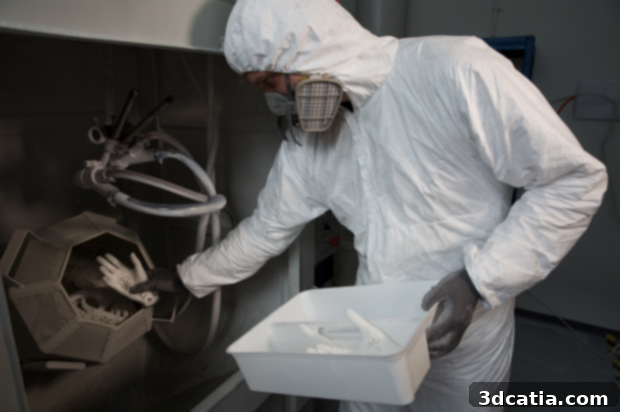
Sami Mattila removes a hand that has been 3D printed
This ingenious post-processing technique is critical for several reasons. Once the desired temperature is reached within the sealed environment, ensuring the material properties of the Nylon hands are optimized, the objects undergo a meticulous process of cleaning, drying, and rigorous quality testing before being dispatched to IKEA. Sami Mattila, co-founder of Materflow, elucidated the rationale behind this groundbreaking approach: “We developed this technique to be able to start a new print session immediately instead of letting the machine cool down.” This innovation directly addresses one of the common bottlenecks in additive manufacturing – the extensive cooling times required before a new print cycle can commence. By externalizing the cooling process, Materflow significantly enhances machine utilization and throughput, making 3D printing more viable for larger production volumes. Furthermore, this method facilitates the creation of robust, solid pieces that leverage the strengths of SLS, offering design complexities and structural integrity that traditional manufacturing processes simply cannot match.
The implications of IKEA’s foray into 3D printing extend far beyond a single collection. This move signals a profound shift in how the Swedish furnishing giant, and potentially the wider home decor industry, perceives manufacturing, design, and consumer engagement. Whether it’s for creating intricate decorative accents, bespoke furniture “hacks,” or even on-demand replacement parts, IKEA is firmly convinced that additive manufacturing holds immense potential. The company envisions a future where 3D printing can dramatically lower production costs, reduce waste by enabling on-demand manufacturing, and offer unprecedented levels of product customization. This could revolutionize the supply chain, allowing for more localized production and a diminished environmental footprint. Imagine the possibility of walking into an IKEA store in a few years and having a personalized item 3D printed on-site, tailored to your exact specifications. This vision of instant gratification and hyper-customization could fundamentally alter the consumer experience and how we interact with products.
Beyond OMEDELBAR, the future trajectory for IKEA’s integration of 3D printing is vast and exciting. The ability to produce items with unique textures, intricate internal structures, and complex geometries opens up new avenues for product innovation that align with IKEA’s democratic design principles – functional, beautiful, sustainable, and affordable. From ergonomic furniture components to innovative storage solutions and even customizable accessories, the possibilities are virtually limitless. This strategic adoption by a global leader like IKEA not only validates 3D printing as a mainstream manufacturing technology but also accelerates its development and widespread acceptance. It challenges traditional manufacturing norms and inspires other industries to explore how additive manufacturing can transform their operations, reduce costs, and foster greater creativity and sustainability.
What are your thoughts on IKEA’s pioneering OMEDELBAR collection and its embrace of 3D printing technology for mass production? Do you believe this marks a turning point for the home furnishing industry, and how do you envision 3D printing transforming your future shopping experiences at IKEA? We invite you to share your perspectives and engage in the conversation by leaving a comment below or joining the discussion on our vibrant Facebook and Twitter pages! Furthermore, to stay abreast of all the latest advancements, innovations, and news in the rapidly evolving world of 3D printing, don’t miss out on signing up for our free weekly Newsletter, delivered directly to your inbox with curated content and exclusive insights!