
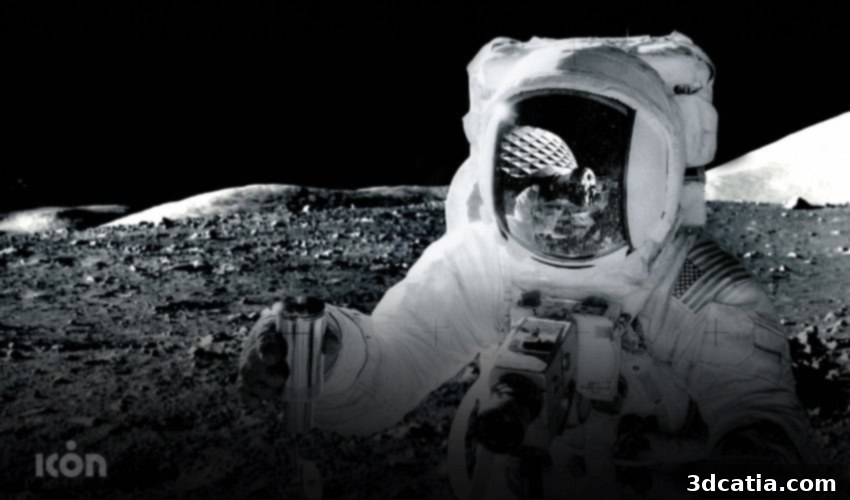
Revolutionizing Lunar Construction: ICON and NASA Partner to 3D Print Humanity’s Future on the Moon
For centuries, the idea of venturing beyond Earth and establishing a presence on other celestial bodies has captivated the human imagination, largely confined to the realm of science fiction. Today, however, with unprecedented advancements in technology and a renewed focus on space exploration, this once-unreachable dream is rapidly transforming into an imminent reality. At the forefront of this groundbreaking endeavor is ICON, an American startup renowned for its pioneering work in advanced construction technologies. ICON recently announced a significant achievement: securing a government contract, substantially funded by NASA, to initiate the research and development of a sophisticated system designed to enable additive construction in space. More precisely, their mission is to lay the groundwork for building vital infrastructure and habitats on the Moon, ushering in a new era of off-world habitation.
The journey for ICON to revolutionize the construction sector began with a historic milestone in 2018: the completion of the first permitted 3D-printed house in the United States. This initial success was merely a prelude to a series of increasingly ambitious projects that have since cemented ICON’s reputation as a leader in innovative building solutions. The company has since broken ground on the world’s first 3D-printed community in Mexico, providing resilient and affordable housing solutions in partnership with local communities. They have also completed a series of homes in Austin, Texas, specifically designed to serve the chronically homeless, demonstrating the profound social impact and humanitarian potential of their technology. Furthermore, ICON has forged a significant partnership with the United States Marine Corps and the Defense Innovation Unit, showcasing the adaptability and robustness of their additive manufacturing systems for defense and extreme environments. These diverse initiatives underscore ICON’s unwavering commitment to tackling complex challenges through innovation, clearly signaling their ambition to undertake projects of monumental scale. Their latest, most audacious mission yet? To transform humanity into a truly spacefaring civilization, beginning with the Moon.
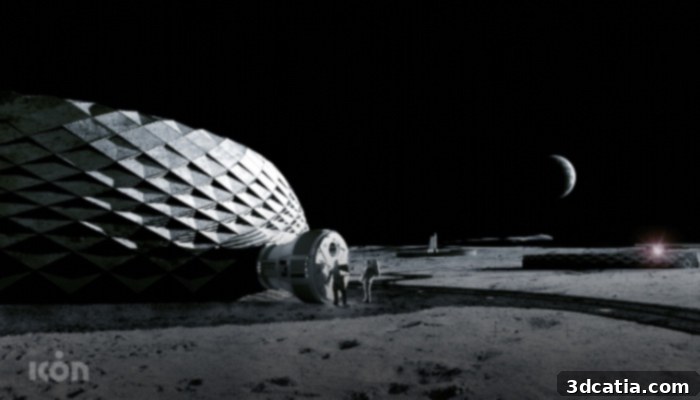
Image credits: BIG-Bjarke Ingels Group
Project Olympus: Pioneering Sustainable Lunar Habitats Through 3D Printing
NASA has made it unequivocally clear that, through its ambitious Artemis program, the Moon will serve as the premier off-Earth destination for sustainable surface exploration and the eventual establishment of a long-term human presence. This vision necessitates far more than just powerful rockets and sophisticated landers. For humanity to truly establish a permanent lunar foothold, robust, durable, and self-sufficient structures must be constructed directly on the Moon’s surface. These structures must offer significantly enhanced protection against the harsh lunar environment compared to what conventional metal or inflatable habitats can provide. The Moon’s surface is exposed to extreme thermal cycling, intense solar and cosmic radiation, and constant bombardment from micrometeorites. Therefore, future lunar bases – encompassing everything from landing pads and shelters to laboratories and vital infrastructure – demand materials and construction methods capable of withstanding these formidable challenges. 3D printing, particularly with locally sourced lunar regolith, offers a promising pathway to developing structures that provide superior thermal insulation, radiation shielding, and micrometeorite protection, driving the collective efforts to make humanity a truly spacefaring civilization.
“Building humanity’s first home on another world will undoubtedly stand as the most ambitious construction project in all of human history,” stated Jason Ballard, Co-founder and CEO of ICON. “This endeavor will not only redefine the boundaries of engineering and architecture but also push science and technology to literal new heights. NASA’s visionary investment in space-age technologies, such as our additive construction system, holds immense potential. It can profoundly help to advance humanity’s future in space, while simultaneously offering innovative solutions to very real, complex problems we currently face on Earth, such as affordable housing crises and resilient infrastructure development. We are deeply honored and immensely excited to embark on this critical research and development phase for ICON’s ‘Project Olympus’ and the associated ‘Olympus Construction System,’ knowing its potential to benefit both our terrestrial and extraterrestrial aspirations.” This sentiment underscores a dual commitment: conquering the challenges of space while harnessing the lessons learned to improve life on our home planet.
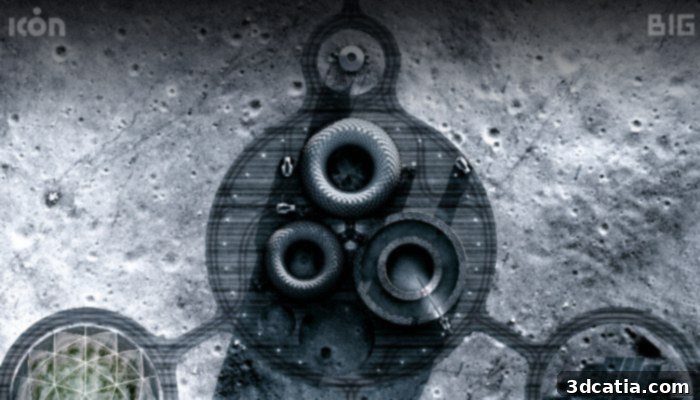
Image credits: BIG-Bjarke Ingels Group
In a crucial collaborative effort, ICON will partner with NASA’s Marshall Space Flight Center, located in Huntsville, Alabama. This partnership will focus on rigorous testing of lunar soil simulant using various processing and advanced printing technologies. These experiments are vital to understand the mechanical properties of lunar regolith and how it can be efficiently transformed into a viable construction material. The data and insights gathered from these tests will be instrumental in the meticulous design, comprehensive development, and robust demonstration of prototype elements for a possible future full-scale additive construction system. Such a system would be capable of autonomously printing a wide array of infrastructure on the Moon, from blast shields and landing pads to pressurized habitats and advanced scientific outposts. To ensure the architectural integrity and functionality of such audacious lunar structures, ICON has engaged two globally recognized and award-winning architecture firms as key partners for Project Olympus: BIG-Bjarke Ingels Group and SEArch+ (Space Exploration Architecture). SEArch+ brings over a decade of invaluable association with NASA and leading aerospace corporations, possessing deep expertise in human-centered design for extreme environments. Meanwhile, BIG has an impressive portfolio of innovative concepts for both lunar and Martian habitats developed over the past several years, renowned for their forward-thinking and sustainable approaches to architectural challenges in space.
Ballard, who is currently pursuing a master’s degree in space resources, offered further insights into the long-term vision behind Project Olympus. He commented, “From the very founding of ICON, the concept of off-world construction has been an integral part of our strategic thinking. It’s a surprisingly natural progression when you deeply consider the myriad ways additive construction and 3D printing can genuinely create a better future for humanity, both on Earth and beyond. I am profoundly confident that the invaluable knowledge and breakthroughs we achieve by learning to build on other worlds will directly inform and provide the necessary innovations to solve critical housing and infrastructure challenges we face on this world. These are not disparate goals but rather mutually reinforcing endeavors. Sometimes, when confronted with the biggest and most intractable problems, it becomes absolutely necessary to look up at the sky for inspiration and solutions, rather than solely down at our feet. It would be incredibly hard to overstate the inherent difficulty and complexity of this monumental task, but the dedicated ICON team is fully prepared for the journey and absolutely delighted to undertake this historic mission alongside our esteemed partners at NASA, BIG, and SEArch+.” The implications of this project extend far beyond space, promising to unlock new paradigms for sustainable, resilient, and accessible construction worldwide.
The prospect of ICON’s advanced 3D-printed infrastructure on the Moon marks a pivotal moment in human history, promising to redefine our capabilities for space exploration and colonization. Are you eager to follow this groundbreaking journey? You can delve deeper into the company’s innovative projects and discover more about their transformative work by visiting their official website, HERE. Share your thoughts on this incredible initiative in a comment down below or join the conversation on our Facebook and Twitter pages! And don’t forget to sign up for our free weekly Newsletter to receive all the latest news and updates in the world of 3D printing delivered directly to your inbox!