
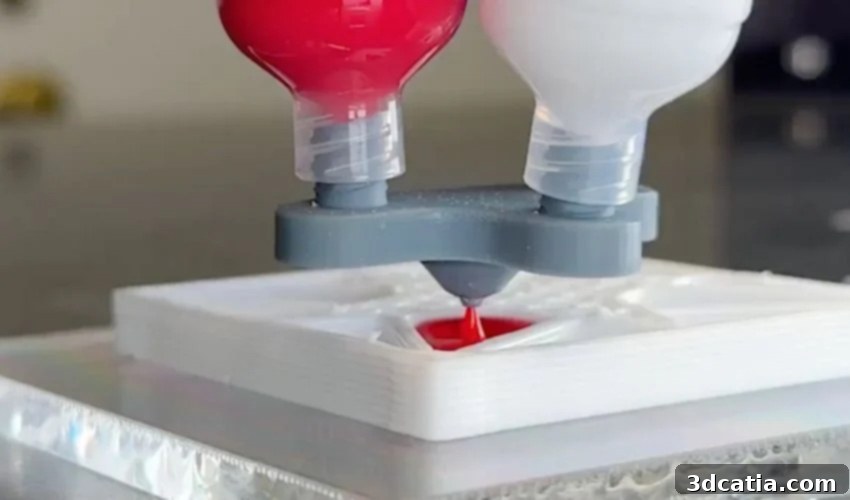
HyFAM: Revolutionizing Manufacturing with Hybrid Additive-Formative 3D Printing Technology
Imagine a manufacturing paradigm where the unparalleled precision and complexity achievable through additive manufacturing could seamlessly merge with the speed and efficiency of formative manufacturing, all within a single, integrated system. This groundbreaking vision is now a reality, thanks to a pioneering team of researchers from the Johns Hopkins Whiting School of Engineering. They have developed an innovative method that not only promises hybrid production but fundamentally redefines the balance between quality and speed in advanced manufacturing. Christened Hybrid Formative-Additive Manufacturing (HyFAM), this revolutionary approach leverages a sophisticated extrusion system to meticulously 3D print intricate geometries, which can then be efficiently filled and completed using traditional molding or casting techniques. The profound synergy between these two distinct processes offers compelling advantages. It empowers manufacturers to create extraordinarily complex shapes, incorporating granular detail exactly where it is most critical, while simultaneously enabling the rapid and efficient filling of less precise or larger internal areas. This dual capability addresses long-standing limitations in both additive and formative methods, paving the way for a new era of manufacturing versatility and performance.
Despite its transformative potential, 3D printing, often synonymous with additive manufacturing, continues to grapple with a spectrum of inherent challenges that can hinder its widespread industrial adoption and efficiency. Foremost among these are issues related to production speed, which can be painstakingly slow for large or highly detailed parts, and a variety of structural defects. These defects commonly include inefficient internal filling, leading to suboptimal material usage and structural weaknesses; warping, where parts deform during the printing and cooling process; and the pervasive problem of internal voids, which compromise mechanical integrity and can necessitate post-processing. While additive manufacturing excels in its capacity to generate parts with an astonishing level of detail and intricate geometries, it’s crucial to acknowledge that such extreme precision is not always uniformly required across an entire component. This disparity often leads to inefficiencies. As team member Nathan Brown insightfully explains, “Additive manufacturing offers significant detail, but when you use a small nozzle to achieve it, the entire process slows down. This becomes a real hindrance in parts with large internal features and widely-varying feature sizes.” This highlights a fundamental trade-off: pursuing maximum detail everywhere, even where unnecessary, exacts a heavy toll on production time, making the process economically unviable for many applications and creating bottlenecks for larger-scale production.
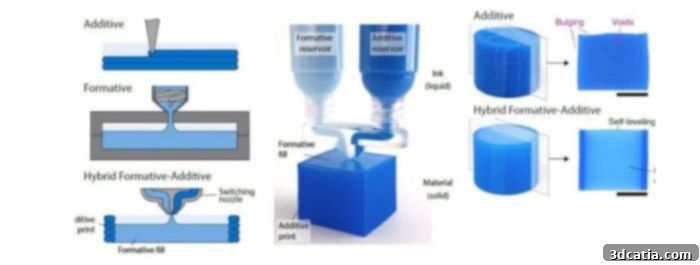
The HyFAM method combines the advantages of additive manufacturing with those of formative manufacturing, offering a new dimension in part creation.
To ingeniously circumvent these long-standing limitations, the research team, spearheaded by the visionary Professor Jochen Mueller, engineered an innovative extrusion system featuring a dual-reservoir design. This sophisticated setup forms the core of the HyFAM method. The first reservoir functions much like a conventional FDM (Fused Deposition Modeling) 3D printer, meticulously depositing the primary desired material layer by layer. This stage is dedicated to fabricating the precise external contours and intricate internal structures that demand high resolution and geometric complexity. Following this, the second reservoir comes into play. It is specifically designed to efficiently fill the model that has been meticulously created with another, often bulk, material. This strategic filling stage introduces a remarkable degree of flexibility and control; it can be selectively applied to a single layer, multiple specific layers, or even across all layers of the component, depending on the design requirements and desired material properties. This two-stage process allows for the strategic allocation of resources – high-precision additive manufacturing for critical features and rapid formative filling for bulk volumes – thereby optimizing both the manufacturing speed and the structural integrity of the final part. The ability to choose when and how much material is injected for filling empowers engineers to tailor the internal composition and mechanical properties of parts in unprecedented ways, significantly expanding design possibilities and material integration.
The versatility of the HyFAM method has been rigorously validated through extensive testing involving a diverse array of materials. The researchers have successfully demonstrated its capability to print and fill components utilizing materials as varied as ceramics, silicones, clays, and even various metals. This broad material compatibility underscores HyFAM’s potential to revolutionize manufacturing across numerous industries. A key feature of the HyFAM method is its inherent multi-material capability, which is achieved through the researchers’ precise control over the rheological properties of the materials involved. Rheology, the study of the flow of matter, particularly in a liquid or semi-liquid state, is crucial here; by manipulating these properties, the team can ensure optimal flow, deposition, and curing for both the printed structural material and the injected filling material, preventing issues like delamination or poor adhesion. In essence, the process can be elegantly summarized: intricate details and external features are meticulously formed through high-resolution 3D printing, while the bulk volume and internal sections are rapidly completed by injecting a complementary material. This intelligent combination yields remarkable results. According to the Johns Hopkins team, this hybrid process is astonishingly 10 to 20 times faster than purely additive methods for comparable parts, marking a significant leap in production efficiency. Concurrently, it offers enhanced precision, primarily because the formative filling stage actively eliminates the internal voids and inconsistencies that are often inherent in purely layer-by-layer additive processes. This eradication of voids not only improves structural integrity and mechanical performance but also leads to more predictable and reliable final products, addressing critical concerns in advanced manufacturing.
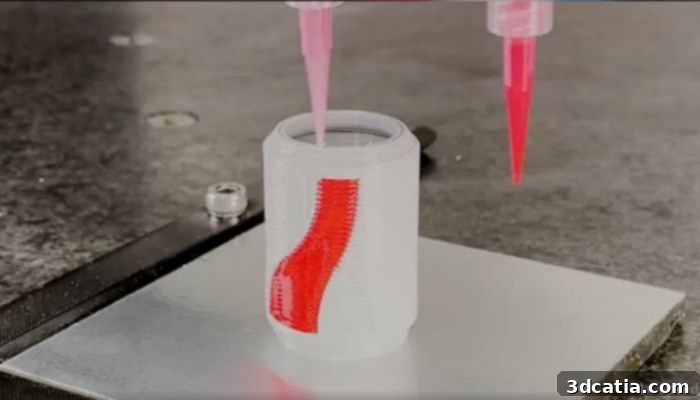
HyFAM is compatible with several materials, enabling diverse applications from ceramics to metals.
Professor Jochen Mueller further elaborates on the strategic applications of this novel technology. While acknowledging that “HyFAM is less advantageous for highly intricate, uniform objects,” where traditional additive manufacturing might still hold an edge due to its singular focus on detail, he strongly emphasizes its compelling strengths in other domains. The true power of HyFAM lies in its ability to masterfully combine speed, unparalleled material flexibility, and the capacity to tackle complex design challenges. These attributes collectively position it as an exceptionally promising solution for an expansive array of industries, demonstrating its broad applicability. Consider, for instance, the construction sector, where rapid fabrication of large-scale, custom architectural components, or even entire building sections, could be dramatically accelerated. The ability to print detailed outer shells and quickly fill them with cost-effective, structural materials offers tremendous potential for efficiency and design freedom. In the burgeoning field of soft robotics, HyFAM provides an invaluable tool for creating intricate, flexible structures with integrated functional materials. This could involve printing precise channels for fluidic actuation or embedding sensors within a rapidly molded flexible matrix, enabling the development of more sophisticated and responsive robotic systems. Beyond these, the technology could also find significant traction in areas like the automotive industry for producing lightweight yet robust components, in the medical sector for highly customized prosthetics and implants with varied internal structures, and in consumer goods manufacturing for bespoke product designs. The ability to optimize part performance by strategically placing different materials, and varying their density and structure, opens up countless opportunities for innovation that were previously unachievable.
The potential impact of the HyFAM process is particularly profound for applications demanding extensive mass customization, where individual parts require unique modifications without incurring prohibitive costs or production times. This method excels in designing components that intrinsically feature distinct areas: those requiring meticulous detail and high precision, alongside others where bulk material and structural integrity are paramount, but intricate detailing is unnecessary. For example, a medical implant might require bio-compatible, high-resolution structures on its surface for tissue integration, while its core needs to be rapidly filled with a strong, lighter material for structural support. Similarly, in aerospace, lightweighting is critical; HyFAM could create precise external aerodynamic surfaces with rapidly filled internal lattice structures for optimal strength-to-weight ratios. The flexibility to selectively apply additive and formative processes means designers are no longer constrained by the limitations of a single manufacturing method, fostering unprecedented creative freedom and engineering efficiency. The promise of HyFAM extends beyond mere efficiency gains; it represents a significant leap towards truly intelligent manufacturing, where material deposition and process selection are optimized for every section of a part. One thing is abundantly clear: this innovative hybrid method is brimming with transformative potential, poised to reshape the landscape of modern manufacturing. We are committed to keeping you thoroughly informed on all its latest advancements and exciting future developments as this technology matures.
What are your thoughts on the groundbreaking HyFAM method and its potential to revolutionize manufacturing? We encourage you to share your insights and opinions in a comment below, or engage with us on our vibrant social media platforms: LinkedIn, Facebook, and Twitter pages! Don’t miss out on the latest advancements in 3D printing; be sure to sign up for our free weekly Newsletter here to receive the most current industry news straight to your inbox. You can also explore a wealth of informative and engaging content, including demonstrations and interviews, on our dedicated YouTube channel. To delve deeper into the original research and learn more about HyFAM, click HERE.
*All Photo Credits: Johns Hopkins Whiting School of Engineering