
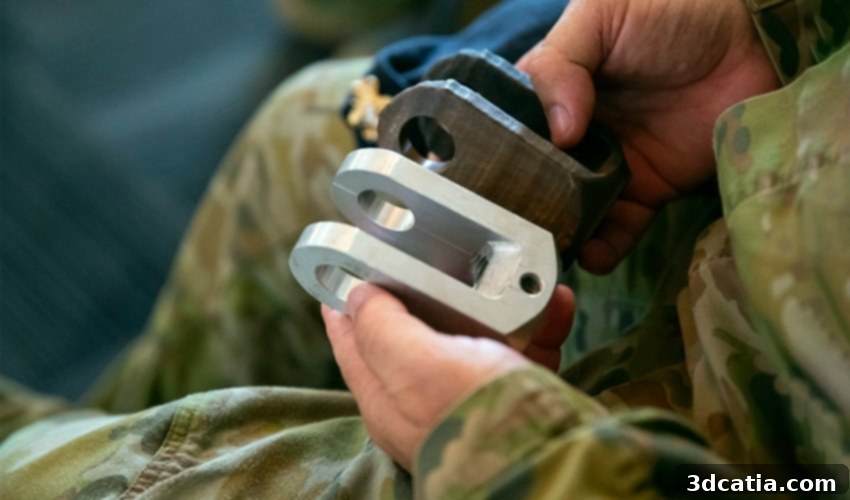
Additive Manufacturing: Revolutionizing the Defense Sector with Rapid Growth and Strategic Advantages
Additive manufacturing, commonly known as 3D printing, has been steadily carving out an indispensable niche within the defense sector. For those who have been following this technological evolution, its increasing integration into military operations and strategic planning comes as no surprise. This significant trend has now been firmly validated by a comprehensive market report published by Stratview Research, which unequivocally confirms that 3D printing in the military is poised for substantial and sustained growth over the next five years. The report projects that this dynamic market segment will generate an impressive total value of $1.7 billion by the year 2027, underscoring its pivotal role in future defense capabilities.
This optimistic forecast is particularly noteworthy given the challenges faced by the global economy in recent years. The defense sector, like many others, experienced a significant setback in 2020 due to the unprecedented Covid-19 health crisis. This period saw a notable decline of -3.8%, which profoundly impacted market dynamics, intensified competition, and disrupted global supply chains. However, the industry has demonstrated remarkable resilience and adaptability. The latter part of last year marked the beginning of a robust recovery, and the trajectory for the coming years is expected to show exponential growth in market value. This resurgence is a testament to the inherent value and strategic importance that additive manufacturing brings to military applications, pushing it beyond recovery into a phase of accelerated expansion.
The advanced capabilities of 3D printing technologies play a crucial and multifaceted role within the military landscape. Their importance stems not merely from their ability to manufacture complex parts quickly and locally, thereby reducing lead times and logistical burdens, but also, and perhaps more critically, from their profound impact on supporting military readiness directly on the battlefield. This innovative production method empowers defense forces to adapt swiftly to evolving operational requirements, providing customized solutions where and when they are needed most. Despite these significant advantages, it is important to acknowledge that 3D printing in the military is still largely in an introductory phase. Its primary applications currently revolve around rapid prototyping, iterative design, and conducting extensive analysis to ascertain suitability for rigorous military environments, rather than widespread implementation in frontline real-world operations. The thoroughness of this introductory phase ensures that as the technology matures, it will be robust, reliable, and fully integrated into critical systems.
Even with the initial negative repercussions of the global pandemic, 2021 saw the industry begin to rebound strongly. This recovery was fueled by several key factors: the resumption of manufacturing facilities operating at full capacity, improved availability of specialized materials, the continuation and acceleration of previously pending projects, and a renewed focus on innovation. It is precisely through these concerted actions and strategic investments that the industry’s impressive growth is being sustained. This momentum is projected to culminate in a remarkable compound annual growth rate (CAGR) of 14.8% over the forecast period, cementing additive manufacturing’s position as a transformative force in defense technology.
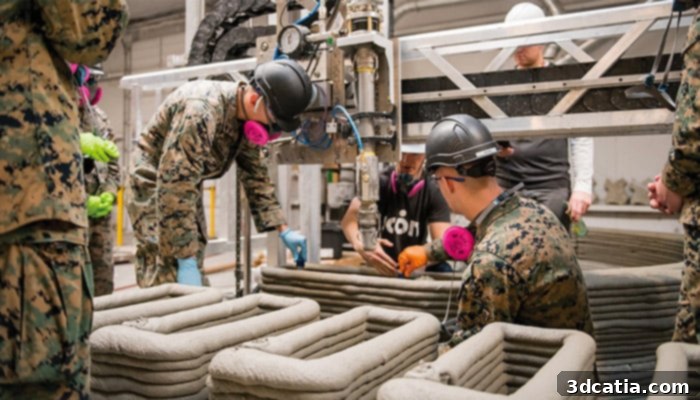
Military 3D printing expected to reach 14.8% annual growth (photo credits: ICON)
The comprehensive market report from Stratview Research provides an in-depth, granular breakdown of the diverse ways additive manufacturing is being leveraged across various military applications. The study segments its use into several critical “types,” offering a clear picture of where the technology is making the most significant impact. One primary segmentation is by platform, which includes land, naval, and air forces. Among these, the air platform emerges as the strongest segment. This dominance is primarily attributed to the ever-increasing demand for 3D printing solutions for aircraft spare parts, which can drastically reduce maintenance times, improve operational readiness, and allow for the rapid production of complex, lightweight components that enhance performance and fuel efficiency. Furthermore, the ability to print custom jigs, fixtures, and tools for aircraft maintenance on-site further streamlines operations and reduces reliance on traditional supply chains.
Regarding the type of supply, the market report meticulously distinguishes between several key categories: 3D printers themselves, specialized materials, sophisticated software, and comprehensive services. Within this crucial segmentation, 3D printers are anticipated to maintain their position as the dominant offering type throughout the forecast period. This reflects the foundational requirement for the hardware that enables additive manufacturing, along with ongoing advancements in printer speed, precision, and material compatibility. However, the growth of the overall ecosystem also necessitates significant innovation in materials—ranging from high-performance metals and composites to advanced polymers—specifically engineered to meet stringent military specifications for durability, strength, and environmental resistance. Concurrently, the development of intelligent software for design optimization, simulation, process control, and data management is vital for maximizing the efficiency and effectiveness of 3D printing workflows. Finally, expert services encompassing training, maintenance, and customized application development are crucial for successful adoption and scaling.
Another particularly insightful aspect highlighted by the report is the diverse range of applications within the military sector. These include, but are not limited to, prototyping, the manufacturing of both finished parts and specialized tooling. All these application areas are receiving substantial impetus from continuous investment in research and development (R&D) aimed at creating cutting-edge equipment and innovative products. For instance, in prototyping, 3D printing allows military engineers and designers to quickly iterate on new designs for weapons systems, protective gear, and vehicle components, dramatically shortening development cycles. For part manufacturing, it enables the production of obsolescent parts, custom modifications, or on-demand components for rapid field repairs. The ability to produce bespoke tooling, jigs, and fixtures further enhances manufacturing and repair capabilities, ensuring precision and efficiency in often challenging environments.
Finally, the report classifies the various additive manufacturing technology types that are currently in use or gaining traction. These include material extrusion (such as FDM/FFF), powder bed fusion (including SLS and SLM), photopolymerization (like SLA and DLP), binder jetting, and directed energy deposition (DED). By 2027, material extrusion is expected to retain its leading position. This is primarily due to its inherent ease of use, relatively lower cost, and versatility for a wide array of applications, particularly for prototyping and certain non-critical parts. However, other technologies like powder bed fusion are critical for high-performance metal components, offering superior strength and complex geometries, while DED is vital for repair and large-scale metal part fabrication. The continuous evolution and convergence of these technologies promise an even broader spectrum of capabilities for the defense industry in the years to come.
Geographically, it comes as no surprise that North America, particularly the United States, is at the forefront of additive manufacturing implementation within the military category. This region is leading the charge in integrating 3D printing into its defense infrastructure, both at domestic bases and in overseas operations. This leadership is not accidental; it is significantly driven by forward-thinking government policies and strategic initiatives aimed at expanding the pervasive use of additive manufacturing across all defense activities. A prime example of this commitment was demonstrated in January 2021, when the U.S. Department of Defense (DoD) unveiled its comprehensive strategy for the large-scale adoption of additive manufacturing across its various departments and within the extensive defense industrial bases. The overarching goal of this strategic roadmap is to actively promote advanced training and intensive research into the practical and agile use of 3D printing, ensuring its safe and effective integration into defense operations. This proactive approach fosters innovation, enhances supply chain resilience, and ensures technological superiority.
Beyond North America, the Asia-Pacific region is also projected to be the fastest-growing geographical segment over the next five years. This accelerated growth is fueled by significant investments from defense industries across the region, as various nations increasingly recognize and seek to harness the transformative advantages of this technology. Factors contributing to this rapid expansion include rising defense budgets, a growing emphasis on indigenous manufacturing capabilities, and the strategic imperative to modernize military forces and enhance operational self-sufficiency. As geopolitical dynamics evolve, countries in the Asia-Pacific are increasingly leveraging additive manufacturing to strengthen their defense postures, improve readiness, and reduce dependence on external supply chains, making it a critical area for future advancements in military 3D printing.
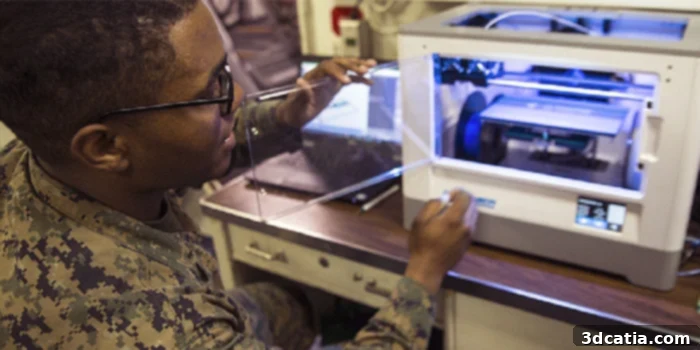
North America is the region that is most integrating additive manufacturing into the defense sector
These regional trends and strategic pronouncements are perfectly aligned with the steady stream of news and developments observed within the sector. In just the past year alone, numerous military organizations, particularly within the American defense establishment, have made substantial investments in additive manufacturing technologies for a wide array of innovative projects. For example, in the United States, a groundbreaking achievement saw the unveiling of the first 3D printed military barracks in Texas, demonstrating the potential for rapid, cost-effective, and scalable construction in austere environments. Concurrently, the Department of Defense (DOD) awarded ExOne a crucial contract to develop a field-deployable 3D printing factory pod, designed to bring manufacturing capabilities directly to forward operating bases, significantly enhancing logistical independence and battlefield repair capabilities. This initiative underscores a shift towards more agile and decentralized manufacturing models.
Simultaneously, the US Navy made strategic investments in 3D printers from MatterHackers, among other projects, reflecting a broader commitment to empowering sailors with on-demand manufacturing capabilities for spare parts, tools, and custom components at sea or in port. This not only reduces the reliance on traditional supply chains but also fosters a culture of innovation and problem-solving among service members. Furthermore, General Lattice was awarded a contract to develop improved combat helmets for the United States Army, leveraging advanced additive manufacturing techniques to create lighter, stronger, and more customizable protective gear, enhancing soldier safety and comfort. Beyond American shores, the Australian Army conducted successful field tests with 3D printed metal spare parts for armored vehicles, validating the technology’s potential to facilitate rapid repairs and maintenance in remote and challenging operational environments. In a field where agility, responsiveness, and quick decision-making are not merely advantageous but absolutely imperative for success, additive manufacturing demonstrably stands out as the transformative technology of the future. The ability to rapidly design, prototype, and produce critical components on demand provides an unparalleled operational edge, significantly shortening lead times and enhancing mission readiness. This profound impact on defense capabilities is precisely what is suggested and extensively detailed in the comprehensive market research report, solidifying AM’s role as a cornerstone of modern military strategy.
Stratview Research’s comprehensive market study offers an invaluable and detailed analysis, meticulously reflecting the current reality of the military 3D printing market and providing crucial insights into its future prospects for the forecast period extending up to 2027. This report serves as an essential resource for stakeholders, decision-makers, and anyone interested in the confluence of advanced manufacturing and defense strategy. If you are keen to delve deeper into these findings and gain a more thorough understanding of the nuances, trends, and growth drivers shaping this vital sector, the full report is available for further exploration. Its insights are critical for anticipating market shifts, identifying investment opportunities, and understanding the technological trajectory of military modernization.
What are your thoughts on the accelerating growth and evolving applications of military 3D printing? We invite you to share your perspectives and engage in the conversation by leaving a comment below. Alternatively, you can join the discussion on our official Linkedin, Facebook, and Twitter pages! Don’t miss out on the latest advancements and breaking news in the additive manufacturing world; remember to sign up for our free weekly Newsletter here, delivering the freshest 3D printing news straight to your inbox! Additionally, you can find all our engaging videos and in-depth content on our YouTube channel, where we explore the most exciting developments in the industry.
*Cover Photo Credits: SPEE3D