
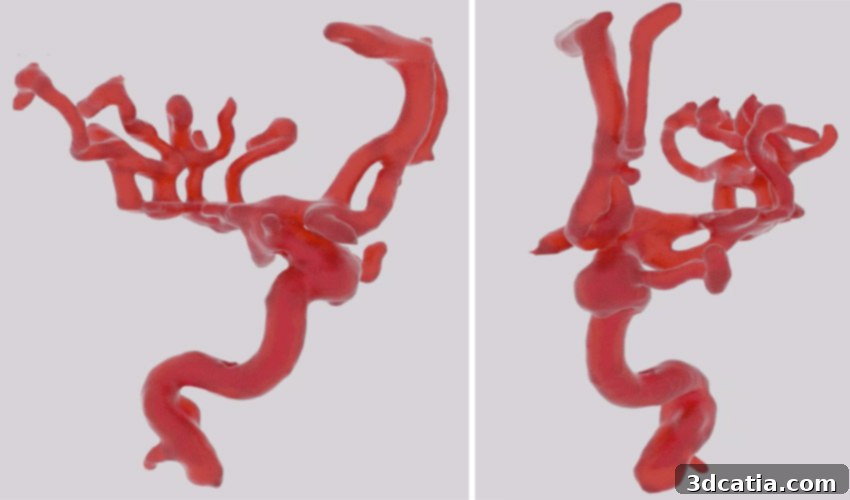
Revolutionizing Neurosurgery: Ultra-Precise Brain Blood Vessel Replication with AMULIT Silicone 3D Printing
The field of medical science stands on the cusp of a profound transformation, driven by innovations in additive manufacturing. At the forefront of this revolution, a dedicated team of researchers at the University of Florida is pioneering a groundbreaking method to precisely reproduce intricate blood vessels within the human brain. This monumental undertaking utilizes advanced silicone 3D printing techniques, promising unprecedented accuracy and opening new avenues for surgical training, patient-specific modeling, and medical research. The challenge of replicating the delicate and complex network of cerebral vasculature is immense, yet these researchers have developed a sophisticated process known as AMULIT, which stands for Additive Manufacturing at Ultra-Low Interfacial Tension. This innovative approach represents a significant leap forward in additive manufacturing, allowing for the direct printing of silicone into a specialized material bath. This unique bath serves as a dynamic printing medium, meticulously crafted from an emulsion of microdroplets of water suspended within silicone oil. Through the application of the AMULIT method, the research team has demonstrated an extraordinary capability to design models with features as small as a mere four micrometers. This remarkable precision enables them to reproduce the labyrinthine blood vessels of the brain with an accuracy previously thought unattainable, setting a new benchmark in biomedical 3D printing and offering new hope for complex neurological interventions.
Silicone, as a material, possesses an array of particularly interesting properties that make it exceptionally well-suited for biomedical applications. Its inherent biocompatibility, meaning it can safely interact with biological systems without adverse reactions, is paramount for medical implants, prosthetics, and anatomical models. Furthermore, silicone exhibits impressive resistance to environmental factors such as heat, various chemicals, and humidity, ensuring the durability and stability of printed structures, even in demanding medical environments. Its flexibility and elasticity also closely mimic the soft tissues of the human body, making it ideal for replicating biological structures like blood vessels. However, despite these advantageous characteristics, silicone presents considerable challenges when it comes to traditional 3D printing methods. Unlike thermoplastic filaments commonly used in techniques like FDM/FFF (Fused Deposition Modeling/Fabrication), where materials can be melted, extruded, and then resolidified repeatedly, silicone is a thermoset polymer. Once it undergoes curing or hardening from its liquid state, this process is irreversible, preventing it from being melted down again. Therefore, silicone must typically be printed in a liquid, uncured form before being permanently hardened through a chemical reaction or heat. The primary difficulty also extends to the complexity and structural integrity of the shapes that can be reliably created. When attempting to print intricate, self-supporting structures from a low-viscosity, liquid material, a crucial question arises: how can researchers ensure that the delicate architecture will not collapse, deform, or sag under its own weight before it has a chance to solidify and maintain its intended form? This inherent instability has historically limited the achievable resolution and geometric complexity with conventional silicone 3D printing, especially for structures as fine and intricate as the microvasculature of the brain.
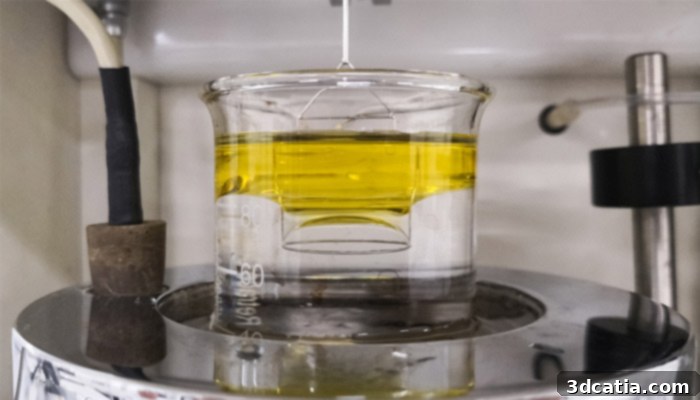
The University of Florida researchers relied on the principle of ultra-low interfacial tension to achieve high-resolution silicone 3D printing (photo credits: Brighton Science)
An Innovative Silicone 3D Printing Process to Reproduce Brain Blood Vessels with Unmatched Fidelity
To definitively overcome the aforementioned challenges associated with printing flexible, liquid silicone into highly complex geometries, the University of Florida researchers ingeniously devised their unique bath printing process, known as AMULIT. The core concept behind AMULIT is to deposit successive layers of the printing material – in this case, a specialized silicone ink – while it is entirely submerged and surrounded by a meticulously engineered support material. This support material is not air or a traditional water-soluble gel, but a specific type of silicone oil emulsion. The strategic choice of silicone as the support material is a critical innovation that profoundly differentiates this method from previous attempts. The research team elaborates on their rationale, stating, “We decided to tackle the problem of interfacial tension by developing a support material made from silicone oil. We reasoned that most silicone inks would be chemically similar to our silicone support material, thus dramatically reducing interfacial tension, but also different enough to remain separated when put together for 3D printing. With our AMULIT support medium, we were able to print off-the-shelf silicone at high resolution, creating features as small as 8 micrometers (around 0.0003 inches) in diameter. The printed structures are as stretchy and durable as their traditionally molded counterparts.” This insightful approach addresses a fundamental principle of fluid dynamics: interfacial tension. To recall, interfacial tension is the force required to break the surface between two immiscible liquids or, more generally, the energy required to increase the surface area between two distinct phases. By drastically minimizing this tension between the printing silicone and its surrounding support bath, the delicate liquid silicone structures can maintain their intended form without collapsing, deforming, or losing fidelity during the crucial printing process. This allows for the creation of incredibly fine, intricate, and precise features that would otherwise be impossible to achieve. This low-tension environment acts like a gentle, invisible scaffold, holding the freshly deposited liquid silicone in perfect alignment until it undergoes its irreversible curing process and solidifies, thereby preserving the structural integrity and high resolution.
A significant hurdle in developing effective support materials for printing soft, oil-based substances like silicone lies in the common use of water-based solutions. Most conventional support materials available on the market are predominantly water-based, often gels or sacrificial polymers. However, when silicone, which is inherently an oil-based polymer, comes into contact with water, a natural and problematic phenomenon occurs: due to their immiscibility (their inability to mix), they naturally exhibit a high interfacial tension to maintain separation. This high tension inevitably leads to deformations, surface imperfections, and a loss of detail in the printed structure. Specifically, small, uncontrolled drops of the printing oil tend to form within the water-based support, disrupting the smooth deposition and compromising the structural integrity of the 3D printed object. This adverse interaction directly impacts the achievable resolution and overall structural stability, especially for delicate geometries. Recognizing this critical incompatibility, the University of Florida team ingeniously conceived the idea of a specialized silicone oil bath as their support medium. By creating a support medium chemically similar to the printing material itself, they drastically reduced the interfacial tension, thereby circumventing the deformation issues and enabling truly high-fidelity printing. The team further elaborates on their innovative bath composition, adding, “We created many candidate support materials but found that the best approach was to make a dense emulsion of silicone oil and water. One can think about it like crystal clear mayonnaise, made from packed microdroplets of water in a continuum of silicone oil. We call this method additive manufacturing at ultra-low interfacial tension, or AMULIT.” This emulsion acts as a viscous yet fluid medium, providing robust mechanical support for the freshly deposited silicone layers without exerting detrimental disruptive forces. The “crystal clear mayonnaise” analogy beautifully illustrates the unique consistency and composition of this groundbreaking support bath – a stable, dense, and optically clear mixture where tiny water droplets are encapsulated within the continuous phase of silicone oil. This clever formulation ensures that the printed silicone material experiences minimal resistance and surface tension effects, allowing it to hold its complex, delicate shape with exceptional fidelity during the fabrication process. The AMULIT method thus represents a sophisticated and elegantly simple solution to a longstanding problem in advanced soft material additive manufacturing, unlocking capabilities previously deemed impossible.
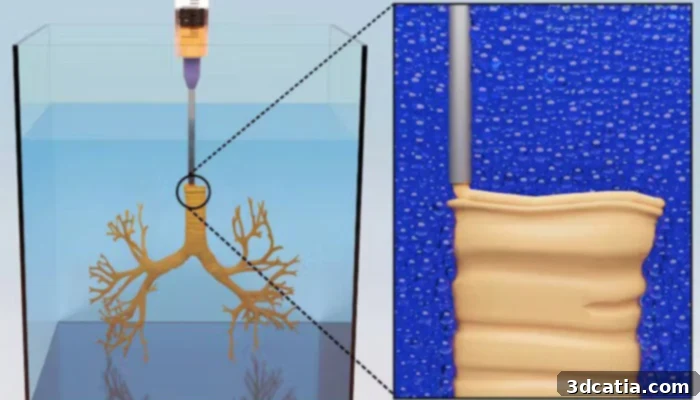
On the left, the innovative material bath, a dense emulsion of silicone oil and water, in which the silicone is deposited layer by layer as shown in the photo on the right, enabling precise brain blood vessel replication (photo credits: Senthilkumar Duraivel/Angelini Lab, CC BY-ND)
The immediate and most impactful applications of this groundbreaking AMULIT technology are centered on the intricate blood vessels found within the human brain. The researchers’ initial tests and primary focus involve creating these highly realistic cerebral vasculature models with unprecedented detail. Such models hold immense promise for the medical community, particularly for neurosurgeons. Imagine a scenario where a neurosurgeon can practice an extremely delicate or complex operation on a patient’s exact anatomical replica before stepping into the operating room. These physical models, custom-made from a high-resolution 3D scan of an individual patient’s brain, would provide an unprecedented level of realism for pre-operative planning and training. Surgeons would be able to physically interact with and touch these bespoke blood vessels, gaining an intuitive, haptic understanding of a patient’s unique vascular anatomy, identifying potential challenges like aneurysms or intricate lesions, and meticulously refining their surgical approach to minimize risks. This capability promises to significantly enhance surgical preparedness, reduce procedural risks, and ultimately improve patient outcomes, especially in critical neurological surgeries. Beyond pre-surgical training, these highly accurate silicone models could revolutionize medical education by offering much more realistic simulations for students and residents, allowing them to gain hands-on experience with complex pathologies. They could also serve as invaluable tools for researchers studying neurological conditions such as strokes, aneurysms, and vascular malformations, allowing for dynamic testing and observation of blood flow within realistic vascular networks, and aiding in the development of new treatments and therapies. The ability to generate such precise, patient-specific, and haptic models of cerebral vasculature is a monumental step towards truly personalized medicine in neurosurgery and beyond. The University of Florida team continues its pioneering work, and we eagerly anticipate further developments and expanded applications of this remarkable technology. For those interested in delving deeper into the scientific intricacies, the entire comprehensive study is available for review HERE.
The implications of AMULIT silicone 3D printing extend far beyond the current focus on brain blood vessels. This revolutionary technique for printing flexible, delicate materials with micron-level precision opens doors to a vast array of future biomedical applications that could transform healthcare. Consider the immense potential for creating intricate organ-on-a-chip devices, where realistic microfluidic channels and cellular structures can faithfully mimic human organ functions. These advanced models could be invaluable for accelerated drug discovery, toxicology testing, and detailed disease modeling, potentially reducing reliance on costly and ethically complex animal testing. Furthermore, the ability to produce highly compliant and durable silicone structures with such fine detail could significantly advance the burgeoning field of soft robotics, paving the way for more dexterous and minimally invasive surgical tools, or prosthetic devices that can seamlessly integrate and interact with the human body in a more natural way. The fundamental breakthrough in precisely managing interfacial tension through the innovative silicone oil emulsion bath provides a robust and versatile platform for printing various other soft, challenging materials that have historically been difficult to handle with conventional additive manufacturing methods. This will undoubtedly push the boundaries of what is achievable in additive manufacturing across not only medical but also industrial and consumer applications, impacting fields from aerospace to fashion. This innovation underscores the critical role of interdisciplinary research, blending advanced materials science, cutting-edge engineering, and sophisticated biology to solve complex problems and drive unprecedented progress. As the AMULIT technology matures and becomes more widely adopted, we can expect to see an accelerated development of advanced medical devices, highly personalized implants, and sophisticated research tools that were once confined to the realm of theoretical possibility or science fiction. The University of Florida’s AMULIT process not only offers a targeted solution for precise brain vessel replication but also serves as a foundational advancement for the broader future of high-resolution soft material 3D printing, promising a healthier, more technologically advanced future.
What are your thoughts on the transformative potential of silicone 3D printing, especially with the innovative AMULIT process, to reproduce intricate blood vessels in the brain and its broader implications for medical science? We invite you to share your insights and comments below or engage with us on our dedicated social media platforms: LinkedIn, Facebook, and Twitter. Stay informed about the very latest advancements in 3D printing technology by subscribing to our free weekly Newsletter here, ensuring the freshest news is delivered directly to your inbox! For visual demonstrations and in-depth discussions, you can also explore all our comprehensive videos on our official YouTube channel. Your engagement helps foster a vibrant community passionate about the future of additive manufacturing and its life-changing applications.