
Pioneering Carbon Capture: GE Harnesses 3D Printing to Combat Climate Change
The escalating climate crisis, starkly evidenced by a summer of record-breaking temperatures and devastating weather events, has underscored the urgent need for innovative environmental solutions. Governments and corporations worldwide are intensely focused on developing strategies to mitigate global warming, with particular attention paid to technologies that can effectively remove carbon dioxide (CO2) from the atmosphere. In a significant move towards this goal, industrial giant GE has joined the forefront of this critical fight. GE Research recently secured a prestigious 2-year, $2 million project award from the U.S. Department of Energy’s Office of Fossil Energy and Carbon Management. This substantial funding is designated for the creation of a pioneering system capable of capturing atmospheric CO2 – a system GE plans to develop with the transformative power of 3D printing.
This endeavor represents a crucial step in the global effort to achieve widespread decarbonization. The ability to directly extract CO2 from the air, often referred to as Direct Air Capture (DAC), is recognized as an indispensable tool alongside efforts to reduce emissions at their source. Such technologies hold the promise of reversing accumulated atmospheric carbon, offering a pathway to stabilize global temperatures and protect our planet for future generations. GE’s commitment, backed by federal support, highlights the growing recognition that advanced technological solutions are paramount to tackling this monumental challenge.
3D Printing: Unlocking Innovation for Unprecedented Challenges
When tackling engineering challenges that involve creating entirely novel technologies, conventional manufacturing methods often fall short in terms of flexibility and design complexity. This is precisely where 3D printing, or additive manufacturing, shines. Its inherent ability to produce intricate geometries, optimize material usage, and accelerate prototyping cycles makes it an invaluable tool for groundbreaking research and development. It is therefore highly logical that GE, a company with a strong track record of technological innovation, would turn to additive manufacturing for this ambitious carbon capture project. This isn’t GE’s first foray into using 3D printing for environmental solutions; they previously leveraged the technology to develop a device capable of generating water from ambient air, demonstrating its versatility in addressing critical resource needs.
For this latest initiative, GE researchers are collaborating with an esteemed group of chemists and engineers from UC Berkeley and the University of South Alabama. Together, their mission is to engineer a system that can efficiently and economically extract carbon in the form of carbon dioxide from the atmosphere. The core of this innovative system will involve the synergistic pairing of advanced 3D-printed heat exchanger technology with highly efficient sorbent materials. This combination is designed to create a robust and scalable solution for direct air capture, addressing one of the most pressing environmental challenges of our time.
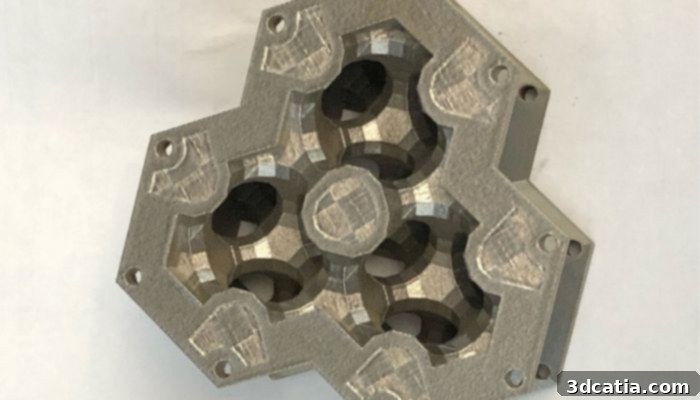
GE’s proposed 3D-designed and printed heat exchanger (photo credits: GE)
A Powerhouse Collaboration for Decarbonization
The formation of this collaborative partnership between GE Research, UC Berkeley, and the University of South Alabama is a strategic alliance, carefully orchestrated to bring together diverse yet complementary areas of expertise. Each institution contributes a unique and essential perspective to the project, forming a multidisciplinary team capable of tackling the complex challenges inherent in developing advanced carbon capture technology. David Moore, the Principal Investigator and Technology Manager for Material Physics and Chemistry at GE Research, eloquently articulated the synergy of this collaboration:
“We’re combining GE’s extensive knowledge in materials science, thermal management, and advanced 3D printing technologies with UC Berkeley’s world-class expertise in sorbent materials development. The University of South Alabama brings invaluable contributions in sorption modeling and rigorous testing methodologies. This trifecta of capabilities allows us to design a truly novel system for removing carbon dioxide from the air. Through this project, our primary objective is to demonstrate the fundamental feasibility and efficiency of a system that could ultimately evolve into a large-scale, economically viable solution, driving widespread decarbonization across the energy sector and beyond.“
This statement underscores the comprehensive nature of the project. GE’s long-standing leadership in engineering and manufacturing, particularly in complex thermal systems and cutting-edge additive processes, provides the foundational hardware and system integration expertise. UC Berkeley, renowned for its chemical and materials research, is tasked with the critical development of highly selective and regenerative sorbent materials—the chemical “sponges” that will absorb CO2 from the air. The University of South Alabama’s contribution ensures that these innovative materials and system designs are rigorously modeled, simulated, and tested for optimal performance, durability, and scalability in real-world applications. This integrated approach is essential for bridging the gap between scientific discovery and practical, deployable technology.
GE’s Additive Manufacturing Prowess: Fueling Complex Designs
As Moore highlighted, a cornerstone of GE’s contribution to this ambitious project is its profound expertise in 3D printing, specifically in advanced metal additive manufacturing. While the press release does not delve into the exact 3D printing technologies that will be deployed, it is a safe and educated assumption that the project will heavily rely on GE’s extensive capabilities in metal and powder-based processes. GE has solidified its position as a leader in industrial additive manufacturing through strategic acquisitions, notably Arcam and Concept Laser. These acquisitions brought advanced technologies like Electron Beam Melting (EBM) from Arcam and Direct Metal Laser Melting (DMLM) from Concept Laser into GE Additive’s portfolio.
These sophisticated metal 3D printing techniques are particularly well-suited for manufacturing the intricate heat exchanger components central to the carbon capture system. EBM and DMLM allow for the creation of incredibly complex internal geometries, such as micro-channels and high-surface-area structures, which are critical for maximizing thermal transfer efficiency and contact with sorbent materials. Traditional manufacturing methods would struggle, if not fail entirely, to produce such complex and optimized designs. Additive manufacturing not only enables these advanced designs but also offers the potential for faster iteration, customization, and ultimately, a more efficient and compact overall system. This inherent design freedom is a significant advantage in developing an entirely new class of hardware for direct air capture.
Focused Roles: Sorbents, Modeling, and Testing
Beyond GE’s manufacturing contributions, the other partners play equally vital roles. UC Berkeley’s team will focus intently on the development and application of the crucial sorbent materials within the system. The effectiveness of any direct air capture system hinges on the efficiency, selectivity, and regenerability of these sorbents. Researchers at Berkeley will work on optimizing their chemical composition and structure to selectively bind with CO2 molecules from the air, even at very low concentrations, and then release them for subsequent storage or utilization with minimal energy input. This delicate balance of chemical properties is paramount to the system’s overall performance and economic viability.
Concurrently, the team from the University of South Alabama will provide critical support in selecting the most appropriate materials for the system’s various components and will lead efforts in sorption modeling and rigorous testing. Their expertise will be instrumental in predicting how the system will perform under different atmospheric conditions, optimizing its operational parameters, and ensuring the durability and longevity of the components. Through advanced simulations and real-world experimental validation, they will help fine-tune the design and material choices to achieve the desired carbon capture efficiency and operational robustness. The comprehensive nature of this partnership ensures that all facets of the system, from fundamental chemistry to advanced engineering and practical application, are meticulously addressed.
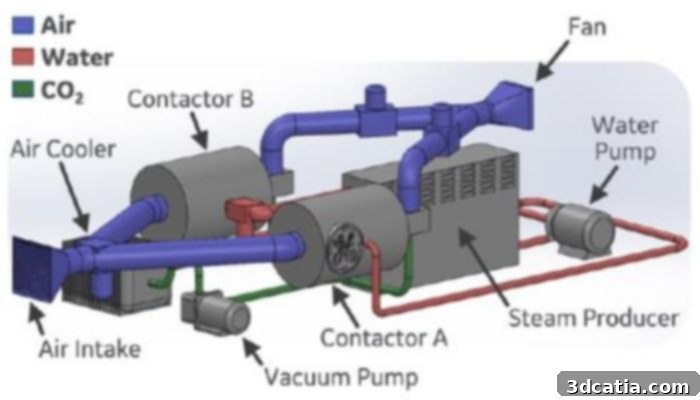
The schematics for the future carbon extractor (photo credits: GE)
Paving the Way for Future Decarbonization and a Sustainable Future
The successful development of GE’s 3D printing-enabled carbon capture system holds immense promise for the future of climate action. If the project successfully demonstrates the feasibility and scalability of this technology, it could mark a significant turning point in our collective ability to combat climate change. An economical and efficient direct air capture system would not only help to reduce legacy CO2 in the atmosphere but also provide a critical tool for achieving net-zero emissions targets globally. Such an innovation could support industries that are difficult to decarbonize directly, offering an essential pathway to offset their emissions and accelerate the transition to a sustainable, low-carbon economy. This project represents more than just a technological advancement; it signifies a hopeful step towards a healthier planet and a more sustainable future for all.
The integration of advanced manufacturing techniques like 3D printing with cutting-edge materials science and thermal engineering is precisely the kind of interdisciplinary innovation required to solve complex global challenges. GE, alongside its esteemed partners, is at the forefront of this crucial endeavor, demonstrating how collaborative research and development can yield transformative solutions for our planet’s most pressing environmental concerns. The project’s outcome will be eagerly watched by scientists, policymakers, and environmentalists alike, as it could lay the groundwork for a new generation of climate technologies.
What are your thoughts on GE’s ambitious plan to extract carbon from the air using the power of 3D printing? We invite you to share your insights and comments below, or engage with us on our Facebook and Twitter pages. Don’t miss out on the latest advancements in additive manufacturing – remember to sign up for our free weekly newsletter, delivering all the essential news in 3D printing directly to your inbox!
*Thumbnail Photo Credits: Ian Barbour via flickr, “10/2/2013 Pollution”