
GE Renewable Energy Unveils Advanced 3D Printing Hub for Sustainable On-Site Concrete Wind Turbine Towers
In a groundbreaking move set to revolutionize the renewable energy sector, GE Renewable Energy has officially opened a state-of-the-art research and development center in Bergen, New York. This innovative facility is singularly focused on harnessing the power of concrete additive manufacturing to design and produce the foundational bases of its next-generation wind turbine towers. The strategic objective behind this initiative is multifaceted: by enabling the on-site construction of these massive lower tower sections, GE aims to drastically cut the prohibitive transportation costs traditionally associated with manufacturing and deploying wind turbines. This localized production approach naturally leads to a more sustainable and economically viable process, significantly reducing the carbon footprint of wind farm development and deployment.
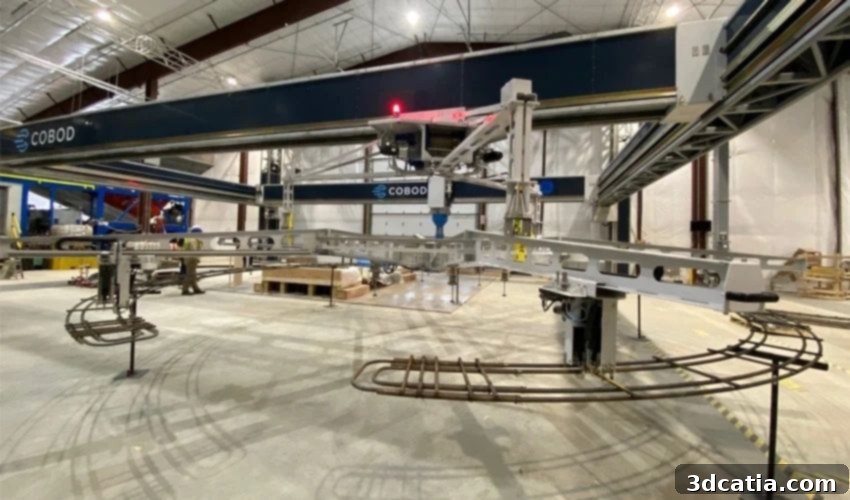
The Bergen research center is not just a hub for theoretical innovation; it is equipped with cutting-edge technology designed to bring these ambitious goals to fruition. Central to its operations is a specialized COBOD concrete 3D printer. This formidable machine possesses the unique capability to manufacture colossal structures, reaching impressive heights of up to 20 meters. This allows for the creation of taller, more efficient wind turbines that can capture stronger, more consistent winds, thereby maximizing energy generation. The establishment of this center marks a pivotal moment for the wind energy industry, showcasing a tangible commitment to advancing sustainable infrastructure through pioneering technological applications.
Pioneering Taller Wind Turbines Through Collaborative Innovation
The journey towards this dedicated research center began much earlier, laying a robust foundation for GE’s current advancements. In June 2020, the industry witnessed the unveiling of a significant milestone: the first 3D-printed wind turbine prototype. This collaborative endeavor involved three key partners: GE, COBOD, and Lafarge. Together, they successfully engineered and produced a concrete base that demonstrated the feasibility and benefits of increasing the height of wind turbines through additive manufacturing. The primary motivation behind this elevation was not merely structural; it was designed with a clear economic and environmental imperative. Taller turbines are capable of accessing higher altitude winds, which are typically stronger and more consistent, leading to a substantial increase in energy generation capacity.
Furthermore, this innovative approach directly addresses the perennial challenge of high manufacturing costs within the renewable energy sector. Three-dimensional concrete printing offers compelling competitive advantages over conventional construction methods. These advantages include significant reductions in material waste, faster construction times, enhanced design flexibility, and a streamlined supply chain. The success of this initial prototype unequivocally validated the potential of 3D concrete printing as a transformative technology for the wind energy industry. Building upon this proven concept, GE is now taking its vision a monumental step further with the inauguration of its dedicated research and development center. This facility will serve as an incubator for continuous innovation, pushing the boundaries of what is possible with concrete additive manufacturing in the realm of wind power.
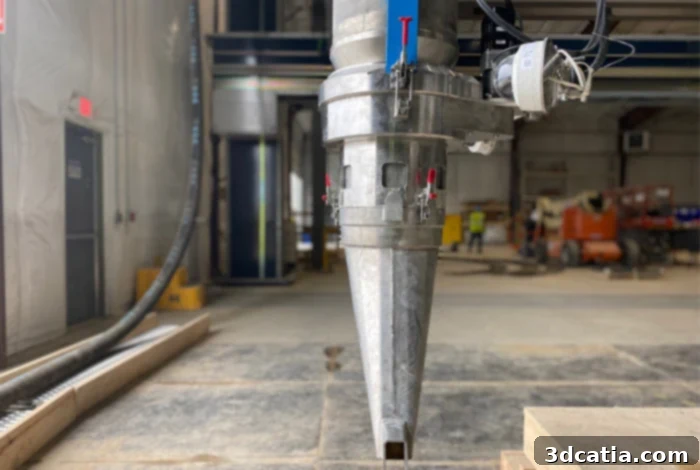
The nozzle of the concrete 3D printer meticulously depositing layers for a wind turbine base (photo credits: GE Renewable Energy)
Strategic Support and Ambitious National Goals
The critical research underway at the Bergen center is not an isolated endeavor but benefits from robust backing at the national level. GE Renewable Energy is leveraging the invaluable support of the U.S. Department of Energy (DOE), recognizing the project’s alignment with broader national objectives. A dedicated team of 20 highly skilled individuals will be at the forefront of this research, meticulously working on optimizing the concrete 3D printing method. Their efforts are geared towards developing and refining applications for this technology, with a strategic rollout plan spanning the next five years. This timeline underscores the immediate and tangible impact expected from this innovative research.
Alejandro Moreno, the Assistant Secretary of the U.S. Department of Energy for Renewable Energy, emphasized the profound significance of this partnership. He articulated the Biden administration’s ambitious climate targets, stating, “Reaching the Biden administration’s ambitious goals of carbon free electricity by 2035 and a net-zero economy by 2050 will require vastly more wind energy capacity. We’re proud to partner with GE Renewable Energy on this innovative 3D printing technology which has the potential to be a game changer in how we harness this resource. With American-made taller towers assembled on site we can cut costs, overcome logistical hurdles, and accelerate progress toward our goals.” Moreno’s words highlight the strategic importance of this project beyond mere technological advancement. It represents a crucial pathway to achieving national energy independence and climate resilience. The ability to produce taller, more efficient wind turbine towers on-site, using American manufacturing prowess, directly addresses critical logistical challenges and offers substantial cost savings, thereby accelerating the transition to a clean energy economy. This synergy between government support and private sector innovation is paramount for achieving such monumental goals.
The Unprecedented Capabilities of the COBOD 3D Printer
At the heart of GE Renewable Energy’s Bergen research facility lies a concrete 3D printer that is truly in a class of its own. This particular unit, developed by COBOD, is not merely an off-the-shelf solution; it has been custom-engineered and precisely tailored to meet the exacting and ambitious demands of the American energy giant. Its unique design allows it to achieve unprecedented printing heights of up to 20 meters, making it possible to construct significantly taller bases for wind turbine towers than previously feasible with conventional methods. This capability is a game-changer for the wind energy industry, as taller towers can access stronger and more consistent wind resources at higher altitudes, directly translating into increased energy capture and greater overall efficiency of wind farms.
The ability to print these massive structures on-site mitigates many of the logistical nightmares and environmental concerns associated with transporting enormous prefabricated tower sections. Traditional methods often require complex and costly heavy-haul logistics, specialized permits, and extensive infrastructure modifications to move components from factories to remote wind farm locations. By contrast, on-site 3D printing reduces the need for such intricate transportation, lowering costs, minimizing traffic disruption, and significantly decreasing the carbon emissions linked to logistics. Furthermore, the inherent flexibility of additive manufacturing allows for optimized structural designs that can be tailored to specific site conditions and wind profiles, leading to more robust and efficient turbine installations. This bespoke approach to construction, powered by COBOD’s advanced printing technology, positions GE Renewable Energy at the forefront of innovation in the global renewable energy landscape.
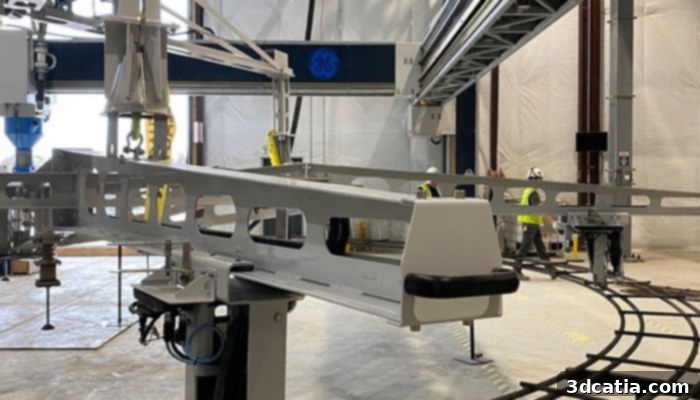
Utilizing the advanced COBOD 3D printer, GE Renewable Energy is able to produce robust and efficient bases for its cutting-edge wind turbine towers directly on-site (photo credits: GE Renewable Energy)
A Multifunctional Construction Robot: COBOD’s Vision
Henrik Lund-Nielsen, the visionary founder and CEO of COBOD, expressed immense pride in their contribution to this pioneering facility. He remarked, “We are extremely proud to have delivered a completely new type of 3D concrete printer — the largest of its kind in the world — for this world class and state of the art facility. The printer we have delivered is second to none: not only can it print in excess of 10 tons of real concrete per hour, but in addition, it is the first 3D concrete printer in the world with two X-axes on the printer. With the multiple functions of the printer, the printer can better be described as a multifunctional construction robot than a printer.” Lund-Nielsen’s statement vividly paints a picture of a machine that transcends the traditional definition of a printer, evolving into a sophisticated construction robot capable of complex, high-volume work.
The printer’s ability to extrude over 10 tons of concrete per hour highlights its industrial-scale capacity and efficiency, far surpassing the capabilities of smaller, more conventional 3D printers. This speed is crucial for meeting the demanding construction schedules of large-scale wind farm projects. The innovative inclusion of two X-axes is another game-changer, providing unparalleled flexibility and precision in the construction process. This dual-axis system allows for more complex geometries, faster build times, and potentially the integration of additional functionalities directly into the printing process, such as rebar insertion or sensor integration. This technological leap enables the creation of highly optimized tower bases that are not only structurally sound but also engineered for maximum performance and longevity in challenging environmental conditions. The collaboration between GE Renewable Energy and COBOD exemplifies how advanced additive manufacturing is pushing the boundaries of construction, making seemingly impossible projects viable and paving the way for a more efficient and sustainable future in infrastructure development.
The Future of Wind Energy and Beyond
The inauguration of GE Renewable Energy’s concrete 3D printing research center in Bergen, New York, marks a significant inflection point for the wind energy industry and the broader renewable energy landscape. This initiative is not merely about building taller towers; it represents a fundamental shift in how large-scale infrastructure projects can be conceived, designed, and executed. By decentralizing manufacturing and moving towards on-site production, GE is not only addressing cost and logistical inefficiencies but also championing a more environmentally responsible approach to development. The potential for this technology to significantly reduce transportation-related carbon emissions, material waste, and overall project timelines is immense, contributing directly to global sustainability goals.
The advancements being made in Bergen, supported by the U.S. Department of Energy, hold the promise of unlocking new frontiers for wind power generation. Taller turbines mean access to better wind resources, leading to higher capacity factors and a more consistent supply of clean electricity. This innovative approach could enable the development of wind farms in locations previously deemed unfeasible due to logistical constraints, thereby expanding the global footprint of renewable energy. Furthermore, the insights gained from optimizing concrete additive manufacturing for wind turbine bases could have ripple effects across other sectors of the construction industry, inspiring similar applications for large-scale, complex structures. This research center is more than a facility; it is a beacon of innovation, demonstrating a tangible path towards a future powered by sustainable, efficiently produced energy.
To delve deeper into the specifics of this groundbreaking initiative, you can find more information in GE’s official press release HERE.
What are your thoughts on GE Renewable Energy’s pioneering concrete 3D printing center? How do you envision this technology impacting the future of renewable energy and construction? We invite you to share your insights in a comment below or join the discussion on our LinkedIn, Facebook, and Twitter pages! Don’t miss out on the latest advancements in additive manufacturing – remember to sign up for our free weekly Newsletter here, delivering the freshest 3D printing news directly to your inbox! You can also explore all our engaging videos and content on our dedicated YouTube channel.