
Unlocking Innovation: Top 5 Revolutionary 3D Printing Breakthroughs Shaping Our World
Welcome to our weekly dive into the fascinating world of 3D printing, where we explore how additive manufacturing is not just a technology but a powerful force reshaping numerous aspects of our society. From groundbreaking advancements in the medical field to transformative developments in automotive engineering and beyond, 3D printing continues to push the boundaries of what’s possible. This week, we’ve curated a selection of the top five videos that highlight some of the most exciting innovations currently taking place. Prepare to be amazed by everything from incredibly detailed 3D printed Moon models and microscopic robots to life-changing medical devices and cutting-edge production techniques. Our goal is to keep you at the forefront of these rapid developments. If you enjoy this selection, remember you can find even more captivating 3D printing content on our YouTube channel. Let’s explore the future, one layer at a time!
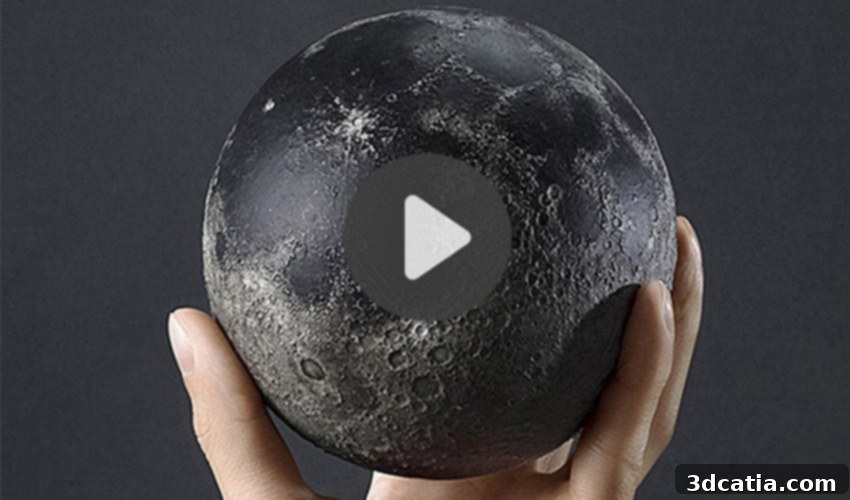
Top 1: Experience the Cosmos with 3D Printed Moon Models
Imagine holding a piece of the Moon in your own hands, feeling its craters and mountains with unprecedented accuracy. That’s precisely what the AstroReality LUNAR Models offer. These aren’t just decorative items; they are high-definition, meticulously 3D printed replicas of our closest celestial neighbor. Leveraging the most advanced industrial additive manufacturing technologies available today, each LUNAR model is crafted with an astounding precision of 0.006 millimeters per pixel. This incredible detail is achieved by utilizing vast datasets captured by NASA’s Lunar Reconnaissance Orbiter, ensuring that every significant geological feature is faithfully reproduced. But the experience doesn’t stop there. By pairing these tactile models with the AstroReality Augmented Reality (AR) app on your smartphone, you unlock an interactive journey. The app overlays rich information, illuminating key lunar landmarks, historical landing sites, and scientific data, transforming the physical model into a dynamic educational tool. This fusion of physical and digital technology provides an unparalleled way to explore and understand the Moon, making complex astronomical concepts accessible and engaging for enthusiasts, educators, and students alike. It’s a testament to how 3D printing can bridge the gap between scientific data and tangible experience, bringing the wonders of space closer to home.
Top 2: The Future is Micro: Tiny 3D Printed Robots for Grand Challenges
Stepping into the realm of the incredibly small, our second innovation showcases the breathtaking potential of micro-scale 3D printing. Researchers are now developing astonishingly tiny robots, 3D printed using a sophisticated method called multi-photon lithography. This advanced technique allows for the creation of intricate structures with features measured in micrometers, pushing the boundaries of what was once thought possible in fabrication. Micro 3D printing represents a relatively new yet rapidly expanding segment of additive manufacturing, with companies and research institutions actively exploring its myriad applications. The vision extends beyond individual micro-robots; imagine swarms of these minuscule, autonomous machines working in concert. These collaborative micro-robots could revolutionize various fields. For instance, Georgia Tech researchers are at the forefront of exploring their potential for groundbreaking medical interventions. Picture a future where these microscopic robots navigate within the human body, delivering targeted drugs, performing minimally invasive diagnostics, or even repairing damaged tissues at a cellular level. Beyond medicine, these tiny marvels could find applications in micro-mechanics, advanced sensor technology, and environmental monitoring, addressing complex challenges that are currently beyond our reach. This innovation underscores the incredible versatility of 3D printing, proving that even the smallest advancements can lead to the most profound impacts on humanity.
Top 3: Precision Medicine: Custom 3D Printed Heart Valves Transforming Patient Care
In the realm of personalized medicine, 3D printing is proving to be a true game-changer, exemplified by the remarkable work of researchers in Zürich and Cape Town. These innovative teams have been at the forefront of developing custom-fit 3D printed heart valves. Unlike traditional, off-the-shelf valves, these patient-specific implants are meticulously crafted using silicone additive manufacturing. One of the most significant benefits of 3D printing technologies, particularly in healthcare, is its unparalleled ability to personalize objects precisely to suit an individual patient’s unique anatomical needs. This level of customization is exceedingly difficult, if not impossible, to achieve with conventional manufacturing methods. Heart valve conditions often require precise fittings to ensure optimal function and long-term efficacy, and a perfect fit can significantly improve patient outcomes, reduce surgical complications, and enhance the quality of life post-operation. The use of biocompatible silicone, combined with the precision of 3D printing, allows for the creation of valves that mimic the natural flexibility and structure of human tissue. This breakthrough represents a monumental leap forward in cardiovascular medicine, offering hope for patients who may not be suitable for standard prosthetic valves or who require highly specialized solutions. Witnessing the intricate process behind these personalized 3D printed heart valves reveals the dedication and ingenuity driving modern medical innovation. This technology is paving the way for a future where every medical implant is perfectly tailored, revolutionizing how we treat complex diseases.
Top 4: Beyond Prototyping: 3D Printing’s Evolution into Small Series Production
While 3D printing gained initial prominence as a cornerstone for rapid prototyping, its role in the manufacturing landscape is undergoing a profound transformation. What was once primarily a tool for quickly creating models and test iterations is now emerging as a viable and highly efficient method for small series production. The following video offers a comprehensive glimpse into the complete 3D printing workflow involved in manufacturing a small batch of parts. From the initial stages of 3D modeling the component with intricate detail to the final printing process on advanced industrial machines, viewers gain a complete understanding of this sophisticated procedure. This shift is driven by several factors, including advancements in material science, increased print speeds, improved reliability of industrial-grade 3D printers, and enhanced cost-effectiveness for low-to-medium volume production. Many progressive companies across various sectors, particularly those requiring highly specialized or customizable components without the overhead of traditional tooling, are rapidly integrating additive manufacturing for direct part production. This approach offers unparalleled flexibility, allowing for design iterations on the fly, reducing lead times, and minimizing waste compared to conventional methods. Industries such as aerospace, medical device manufacturing, and niche automotive sectors are particularly benefiting from this evolution, leveraging 3D printing to create end-use parts that were previously impractical or too expensive to produce in small quantities. This paradigm shift signifies 3D printing’s maturity from a niche technology to a mainstream manufacturing solution, proving its capability to deliver precise, high-quality products at scale for specialized applications.
Top 5: Healing with Innovation: 3D Printing for Bone Fracture Repair and Regeneration
As we age, a natural decline in bone density typically begins around the age of 30, significantly increasing the probability of fractures and weakening the skeletal system. This presents a considerable challenge in orthopedic medicine, but 3D printing is offering a revolutionary solution: 3D printed regenerative bone matrix. This cutting-edge technology holds immense promise in its ability to effectively repair damaged bone and even stimulate natural bone regeneration. The video we feature highlights the pioneering work of ROKIT Healthcare, showcasing their innovative approach to creating artificial bone scaffolds using advanced biomaterials. These scaffolds are meticulously designed to mimic the intricate structure of natural bone, providing a supportive framework for new bone tissue to grow into. The biomaterials used are carefully selected for their biocompatibility and ability to encourage cellular adhesion and proliferation, essentially guiding the body’s own regenerative processes. By precisely modeling or regenerating bone tissue, this technology offers a personalized and highly effective method to combat the effects of aging on bone health, accelerate healing for complex fractures, and potentially provide long-term solutions for conditions like osteoporosis or severe trauma. This personalized approach to orthopedics minimizes recovery times and improves the functional outcomes for patients, representing a significant advancement in reconstructive surgery and regenerative medicine. It’s an inspiring example of how 3D printing is not just fabricating objects, but actively fabricating better health and a higher quality of life for millions.
We hope this week’s journey through the top 5 videos on 3D printing has been both insightful and inspiring. The innovations showcased—from detailed Moon models and microscopic robots to life-saving medical devices and efficient production techniques—underscore the incredible versatility and transformative power of additive manufacturing. The rapid pace of development in this field means there’s always something new and exciting on the horizon. What do you think of these breakthroughs? We’d love to hear your thoughts! Drop a comment below, share your insights on our Facebook and Twitter pages, or join the conversation with fellow enthusiasts. To ensure you never miss out on the latest news, trends, and groundbreaking applications in the 3D industry, don’t forget to sign up for our free weekly Newsletter. Get all the updates delivered straight to your inbox and stay connected with the future of manufacturing!