
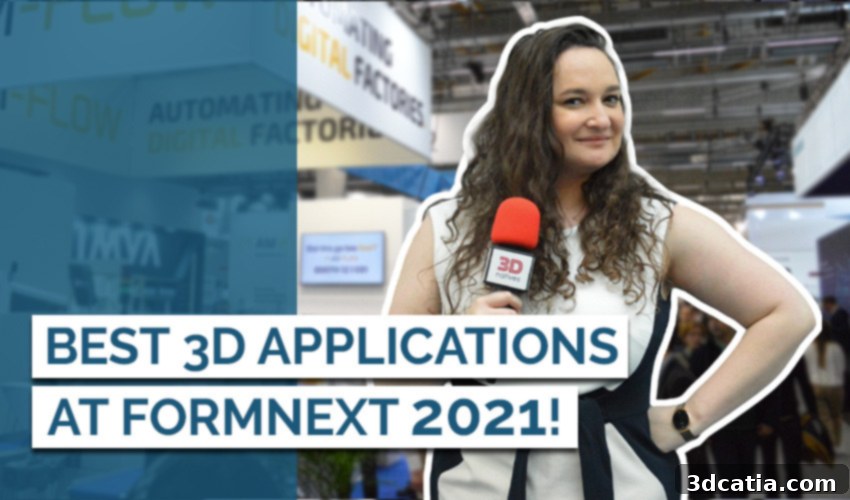
Formnext 2021: Unveiling the Top 3D Printing Applications Driving Industrialization and Sustainability
Last week, the vibrant halls of Formnext were alive with the spirit of innovation, showcasing a breathtaking array of cutting-edge technologies and groundbreaking applications in additive manufacturing. As one of the world’s leading trade shows for 3D printing, Formnext 2021 once again proved to be an indispensable platform for industry leaders, researchers, and enthusiasts to converge and witness the future unfold. While it was abundantly clear that sustainability and industrialization stood out as the dominant themes, permeating discussions and product demonstrations alike, the exhibition floor was also a treasure trove of diverse applications. From playful toys to intricate components for the food industry, and from avant-garde interior design elements to high-performance industrial parts, the versatility of additive manufacturing was on full display. The central question echoing through the convention center was: which applications truly captured the essence of innovation and forward-thinking design at Formnext 2021? To answer this, we embarked on a comprehensive journey across the trade show, meticulously sifting through the offerings of more than 600 exhibitors to identify the most compelling and impactful applications.
Join us as we recount our exploration of some of the most prominent booths, including those of Siemens, Massivit3D, Polymaker, Caracol, and BE-AM. Each presented unique visions and tangible demonstrations of additive manufacturing’s transformative power. From an impressively scaled metal wine jar that pushed the boundaries of material and size, to a thoughtfully designed concrete table challenging conventional construction, and a uniquely envisioned car inspired by the iconic David Bowie, the sheer diversity was astounding. We invite you to discover what we identified as the most exciting and forward-looking applications that defined the Formnext 2021 experience, highlighting how these innovations are poised to shape industries and lifestyles in the years to come.
Siemens: Powering the Digital Transformation of Manufacturing
Siemens, a titan in industrial automation and digitalization, showcased its comprehensive approach to additive manufacturing, demonstrating how its software and hardware solutions are accelerating the industrialization of 3D printing. Their booth highlighted the critical role of a seamless digital thread, from design and simulation through to production and post-processing. Exhibitions included complex, high-performance components for aerospace and automotive sectors, illustrating how their integrated platform streamlines workflows, reduces development cycles, and ensures quality control for mission-critical parts. Siemens emphasized the importance of their end-to-end solutions in enabling companies to move beyond prototyping to serial production with additive manufacturing, underscoring their commitment to making 3D printing a scalable and reliable manufacturing method for demanding industrial applications. Their focus on machine connectivity, data analytics, and artificial intelligence further solidified their position as a key enabler for the future of smart factories and advanced manufacturing.
Massivit3D: Redefining Large-Scale Additive Manufacturing
Massivit3D captivated visitors with their unparalleled capabilities in large-format, high-speed 3D printing. Known for their Gel Dispensing Printing (GDP) technology, the company presented massive, intricate structures that showcased the immense potential of additive manufacturing for creative and industrial applications where speed and size are paramount. The giant metal wine jar, mentioned earlier, was a testament to their technology’s ability to create imposing objects with remarkable detail and strength. This particular application highlighted their printers’ capacity to produce rapid prototypes for full-scale vehicle parts, eye-catching visual communication elements for retail, and even immersive props for the entertainment industry. Massivit3D’s presence at Formnext underscored how their solutions are enabling businesses to dramatically shorten production times and expand design possibilities for large components, offering a disruptive alternative to traditional manufacturing methods for bespoke and grand-scale projects.
Polymaker: Pioneering the Next Generation of Materials
Polymaker, a leader in advanced 3D printing materials, presented a fascinating array of innovative filaments and resins designed to push the boundaries of application. Their booth was a hub of material science, featuring everything from high-performance engineering plastics to aesthetically pleasing specialty materials. A strong emphasis was placed on sustainable solutions, with Polymaker showcasing recycled filaments and biodegradable options that align perfectly with the industry’s growing focus on environmental responsibility. Visitors were particularly impressed by new composite materials offering enhanced strength, flexibility, and unique thermal properties, opening doors for applications in medical devices, consumer electronics, and specialized tooling. Polymaker’s dedication to research and development was evident, demonstrating how material innovation is not just about performance, but also about expanding accessibility and versatility for the broader additive manufacturing community, empowering designers and engineers to create more functional and sustainable products.
Caracol: Unleashing Robotic Additive Manufacturing for Complex Geometries
Caracol brought the future of large-scale, robotic additive manufacturing to Formnext, demonstrating how industrial robots equipped with specialized extrusion heads can create incredibly complex and uniquely shaped objects. Their showcase included the much-talked-about David Bowie-inspired car, a vivid example of how their technology allows for artistic expression and intricate design beyond the constraints of traditional manufacturing. Caracol’s robotic systems offer unparalleled freedom in geometry and scale, making them ideal for producing large, custom parts for industries such as aerospace, marine, and construction. Their applications highlighted the ability to print directly from advanced materials, often composites, creating functional components with optimized structures and reduced material waste. This approach signifies a major leap forward, enabling rapid iteration and production of components that were previously impossible to manufacture, pushing the boundaries of what is achievable with additive manufacturing in terms of size, complexity, and material integration.
BE-AM: Building the Future with Additive Construction
BE-AM (Built Environment Additive Manufacturing) showcased the exciting advancements in 3D printing for architecture and construction. Their display, featuring a beautifully crafted concrete table, provided a tangible example of how additive manufacturing is revolutionizing the built environment. This application illustrated the precision and design freedom that 3D concrete printing offers, enabling architects to create bespoke furniture, intricate facade elements, and even structural components with unprecedented geometric complexity. Beyond the aesthetic appeal, BE-AM’s exhibits delved into the functional benefits of additive construction, such as reducing material waste, accelerating construction timelines, and enabling on-demand, localized production. The potential for creating sustainable housing solutions, resilient infrastructure, and energy-efficient building envelopes was a central theme, highlighting additive manufacturing as a critical technology for addressing global challenges in urban development and resource management.
Beyond the Booths: Broader Application Trends at Formnext 2021
While individual exhibitors like Siemens, Massivit3D, Polymaker, Caracol, and BE-AM presented remarkable innovations, Formnext 2021 also painted a broader picture of industry-wide shifts. The emphasis on **sustainability in practice** was undeniable. Many companies showcased solutions that reduce material consumption, utilize recycled or bio-based materials, and enable circular economies. This included printers designed for minimal waste, software optimizing material usage, and components engineered for extended lifecycles or easy recycling. From lightweight aerospace parts that improve fuel efficiency to customized medical implants that reduce resource use, sustainability was integrated into the very fabric of additive manufacturing’s progression.
The relentless march towards **industrialization** was equally prominent. Additive manufacturing is rapidly transitioning from a prototyping tool to a robust method for mass production. This was evident in the sophisticated automation solutions, advanced post-processing technologies, and quality assurance systems on display. The focus was on scalability, reliability, and cost-effectiveness for large-batch production, demonstrating how AM is becoming a viable alternative to traditional manufacturing for an increasing number of industrial applications. Customization at scale, improved supply chain resilience, and distributed manufacturing models were frequently discussed benefits.
Furthermore, Formnext 2021 revealed a host of **unexpected and creative innovations** across various sectors. The presence of specialized applications for the food industry, such as personalized confectioneries or nutrient-optimized meals, hinted at a future where food production is more tailored and efficient. In interior design, visitors saw intricate furniture pieces, decorative elements, and lighting fixtures produced with geometries impossible through conventional methods, offering new avenues for aesthetic expression and customization. Even in the realm of toys, additive manufacturing promised bespoke designs, greater personalization, and potentially more sustainable production methods, moving away from mass-produced plastic waste towards custom-made, durable items. These diverse applications collectively showcased the boundless potential of 3D printing to infiltrate and transform every facet of our daily lives, moving beyond industrial confines into consumer and artistic domains.
The Unforgettable Formnext Experience and Future Outlook
Formnext 2021 was an exhilarating testament to the dynamism and rapid evolution of additive manufacturing. It served as a powerful reminder that 3D printing is not just a technology but a transformative force, continuously pushing the boundaries of what is possible. The innovations displayed by over 600 exhibitors underscored the industry’s commitment to solving complex challenges, from creating highly functional industrial components to crafting objects of aesthetic beauty, all while striving for greater sustainability and efficiency. The palpable energy and groundbreaking developments witnessed at the event signal a bright future where additive manufacturing plays an increasingly central role in global industries, driving economic growth and fostering a more sustainable, industrialized, and creative world.
What do you think of our choices for the top applications at Formnext 2021? Did you see other innovations that particularly impressed you, or were you able to visit some of these incredible booths yourself? We’d love to hear your thoughts! Share your insights and experiences in a comment below or connect with us on our LinkedIn, Facebook, and Twitter pages! Don’t forget to sign up for our free weekly Newsletter here to get the latest 3D printing news delivered straight to your inbox. You can also find all our compelling videos and further insights on our YouTube channel.