
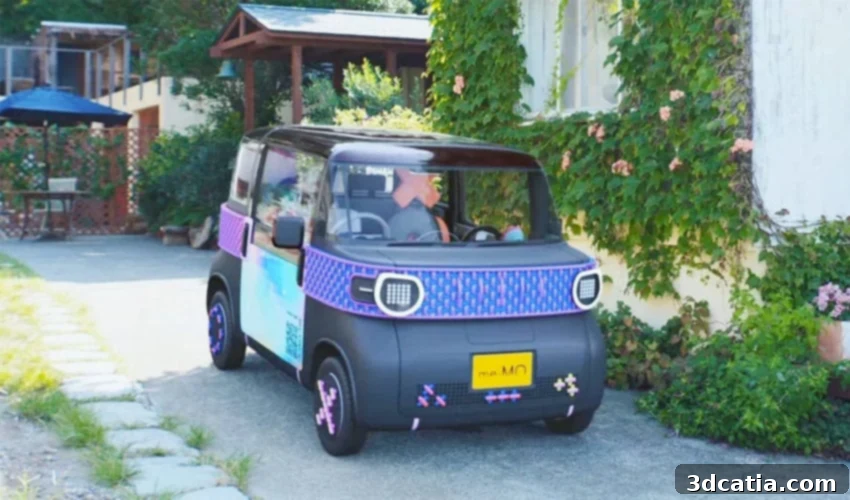
Daihatsu me:MO: Revolutionizing Personal Mobility with 3D Printing and Modular Customization
At the highly anticipated Japan Mobility Show held at the close of last year, the renowned carmaker Daihatsu Motor Co. captivated audiences with the unveiling of several innovative vehicles. Among these groundbreaking presentations was a particularly intriguing concept car dubbed me:MO. This compact electric vehicle stood out not only for its futuristic design but also for its pioneering integration of numerous 3D-printed components. The vision behind me:MO is to offer unparalleled personalization, allowing future owners to fully customize both its exterior aesthetics and interior comfort, creating a vehicle that truly reflects their individual style and personality. While the Japanese manufacturer has been somewhat reserved in releasing extensive technical specifications, the very existence of this prototype serves as a powerful testament to the transformative potential and myriad benefits that additive manufacturing brings to the forefront of the automotive sector. It marks a significant step towards a future where cars are not just modes of transport but extensions of our identity.
Daihatsu Motor Co., a prominent subsidiary of automotive giant Toyota, operates under a clear and compelling philosophy: “Staying Close to Our Customers and Enriching Their Lives.” This core principle deeply informs their approach to vehicle design and innovation, leading to the development of concept cars that directly address contemporary societal concerns. These concerns notably include a heightened respect for environmental sustainability and the increasing demand for enhanced urban mobility solutions. The me:MO, showcased in late November, epitomizes this philosophy. It is conceived as a mini electric car, distinguished by its remarkable 100% customizable battery system, a feature that underscores its adaptability to diverse user needs. Crucially, me:MO leverages advanced 3D printing technologies for the production of specific parts, offering an unprecedented degree of choice and personalization to the driver. This innovative manufacturing approach allows for flexible design iterations and bespoke component creation, moving away from the limitations of mass production towards a more user-centric model.
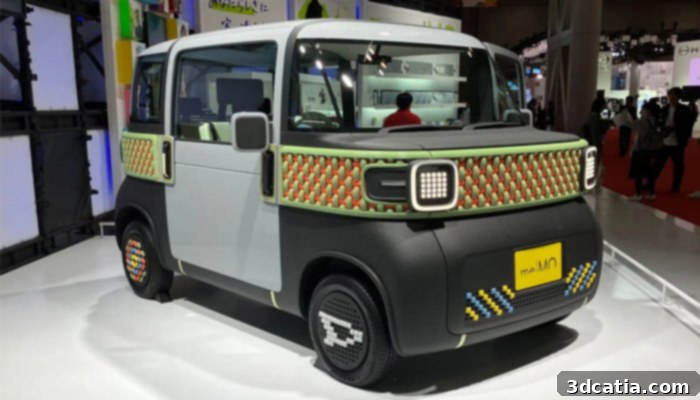
The electric concept car can be customized using 3D printing, showcasing its versatile design capabilities.
The manufacturer eloquently articulates the profound shift in their approach: “We changed the way cars were manufactured and made it possible to change not only the design but also the form of the vehicle by constructing a modular structure of interior and exterior parts with necessary and sufficient functionality. This enabled us to realize a sustainable car that can be used for a long time in response to changes in the customer’s stage of life and usage.” This statement highlights two critical pillars of the me:MO project: modularity and sustainability. By adopting a modular design strategy, Daihatsu is moving beyond superficial aesthetic changes. Instead, they are enabling fundamental alterations to the vehicle’s structure and configuration, ensuring it can evolve alongside its owner’s evolving needs and preferences. This could mean easily swapping out interior panels for different textures or colors, reconfiguring storage spaces, or even updating exterior elements to reflect new trends or functional requirements. Such adaptability not only fosters a deeper connection between the owner and their vehicle but also dramatically extends the car’s useful lifespan, thereby reducing the environmental impact associated with frequent vehicle replacements. The integration of 3D printing is fundamental to this modular approach, allowing for the rapid and cost-effective production of these interchangeable, customizable components.
As previously noted, specific details regarding the exact 3D printing processes employed or the materials utilized for me:MO’s customizable parts have not yet been disclosed by Daihatsu. However, industry experts and observers widely speculate that large-format fused deposition modeling (FDM) technology would be a highly probable choice for many of the external and larger interior components. This assumption stems from FDM’s well-established capabilities in producing substantial parts using a diverse array of thermoplastics, often available in a wide spectrum of colors. The cost-effectiveness, material versatility, and ability to handle large build volumes make FDM an attractive option for fabricating custom body panels, trim pieces, and structural elements that contribute to the modular design. For more intricate internal components or those requiring higher mechanical performance, other additive manufacturing technologies such as Selective Laser Sintering (SLS) or even Vat Photopolymerization (SLA/DLP) could also be selectively employed, demonstrating the multifaceted application of 3D printing in this concept. Regardless of the precise technology, the overarching focus remains squarely on hyper-customization, a defining characteristic that is increasingly becoming a crucial determining factor for a growing number of motorists today. Consumers are no longer satisfied with off-the-shelf solutions; they demand products that resonate with their individual preferences. Measuring approximately 3 meters in length, the me:MO’s compact footprint makes it an ideal canvas for personalized elements. This includes bespoke 3D-printed decorations seamlessly integrated into its exterior bodywork, as well as highly individualized features within the passenger compartment, such as custom dashboard inserts, unique storage solutions, or even ergonomically tailored seating components. This level of detail allows for an unprecedented degree of personal expression, transforming a vehicle into a personal statement.
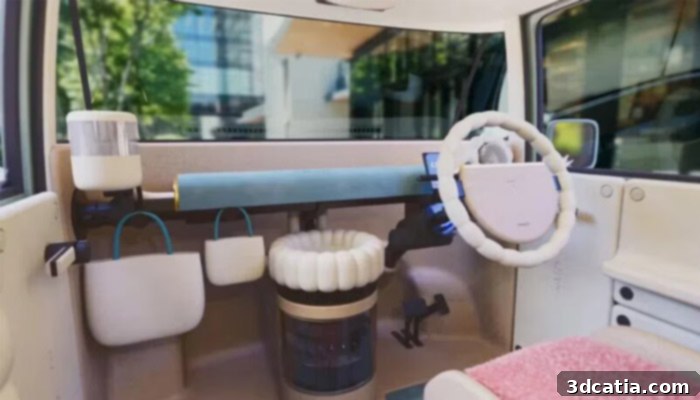
A glimpse inside me:MO reveals the potential for personalized 3D-printed interior elements, enhancing comfort and aesthetic appeal.
The integration of additive manufacturing in automotive design, as showcased by the Daihatsu me:MO, transcends mere aesthetic novelty; it heralds a paradigm shift in how vehicles are conceived, developed, and produced. Historically, car manufacturing has been characterized by mass production, where economies of scale dictated standardized designs and limited customization options. 3D printing dismantles these limitations, enabling the creation of intricate, complex geometries that are often impossible or prohibitively expensive to produce with traditional methods. This design freedom allows engineers to optimize parts for weight reduction, improved airflow, or enhanced structural integrity, all while maintaining the potential for personalization. For instance, topologically optimized parts can significantly reduce vehicle weight, leading to improved fuel efficiency for internal combustion engines or extended range for electric vehicles like me:MO. Furthermore, the ability to print parts on demand can revolutionize the automotive supply chain, reducing inventory costs and minimizing waste. Spare parts, for example, could be printed locally as needed, bypassing the need for extensive warehouses and lengthy shipping routes. This localized production model not only enhances efficiency but also aligns perfectly with the sustainable ethos embodied by the me:MO’s modular design, reducing carbon footprint throughout the product lifecycle.
Beyond the immediate benefits to manufacturing and design, the Daihatsu me:MO concept offers profound insights into the future of consumer engagement with automotive products. In an era where consumers increasingly value individuality and bespoke experiences, a car that can be truly personalized resonates deeply. It transforms the vehicle from a utilitarian object into a unique expression of its owner’s identity, much like personal fashion or home decor. This emotional connection can foster greater longevity and satisfaction with the product. Moreover, the modularity facilitated by 3D printing means that a car like me:MO could be updated or reconfigured over time, reflecting changes in personal taste, family size, or functional requirements without needing to purchase an entirely new vehicle. This could involve updating the infotainment system, changing seating configurations, or even refreshing the exterior styling – all through easily replaceable, 3D-printed modules. Such adaptability makes the me:MO not just a car for today, but a car designed to evolve with its owner through various stages of life, reinforcing its sustainable credentials. The project also subtly highlights Daihatsu’s position as an innovation leader within the Toyota group, pushing boundaries and exploring next-generation manufacturing techniques that could eventually trickle down into broader production models.
As exciting as the Daihatsu me:MO concept is, the crucial question that remains is whether this innovative concept car will remain confined to the conceptual stage, or if the Japanese manufacturer intends to transition it into a viable commercial model. The challenges of bringing such a highly customizable, 3D-printed vehicle to mass production are not insignificant. These include ensuring the cost-effectiveness of 3D printing at scale, certifying materials for automotive-grade performance and safety, and establishing robust supply chains for customizable components. However, the rapidly advancing capabilities of additive manufacturing, coupled with growing consumer demand for personalization and sustainability, suggest that the future is ripe for such innovations. We are keenly awaiting further announcements from Daihatsu regarding the me:MO’s potential journey from concept to reality, and we will certainly keep our readers informed of any significant developments. In the interim, for those eager to delve deeper into Daihatsu’s official communications regarding this fascinating project, more information can be found HERE.
What are your thoughts on this groundbreaking 3D-printed electric concept car and its potential to redefine personal mobility? We invite you to share your perspectives and comments below, or engage with our community on our vibrant LinkedIn, Facebook, and Twitter pages! To stay at the forefront of the latest advancements in the world of 3D printing and additive manufacturing, don’t forget to subscribe to our free weekly Newsletter here, delivering essential news directly to your inbox. You can also discover a wealth of insightful videos and demonstrations on our dedicated YouTube channel, offering a dynamic visual journey through the exciting innovations shaping our future.
*All Photo Credits: Daihatsu Motor Co