
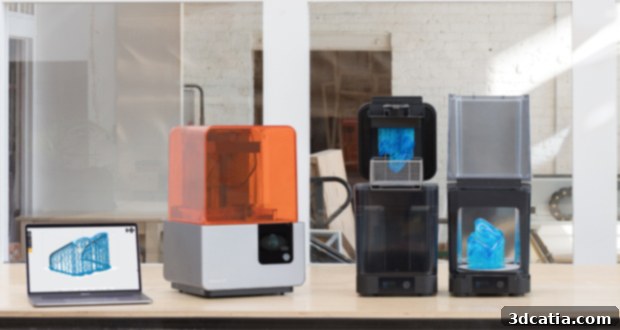
Formlabs Redefines SLA 3D Printing Workflow with Automated Form Wash and Form Cure Solutions
Formlabs, a pioneer and leading manufacturer in the stereolithography (SLA) 3D printing space, renowned for its accessible and high-performance machines like the Form 1+ and the highly popular Form 2, made a groundbreaking announcement this morning. During the prestigious RAPID + TCT conference held in Pittsburgh, Pennsylvania, the company unveiled two innovative new machines designed to significantly enhance and automate the post-processing phase of SLA 3D printing: the Form Wash and Form Cure. These additions represent Formlabs’ continued commitment to streamlining the entire 3D printing workflow, addressing critical bottlenecks, and empowering users to achieve more consistent, high-quality results with greater efficiency.
The introduction of the Form Wash and Form Cure marks a pivotal moment, as these dedicated machines aim to complete what Formlabs describes as “the SLA experience.” By integrating an automated system for both washing and post-curing, Formlabs is bringing the entire 3D printing process together into a cohesive ecosystem. This integration is engineered to make your 3D prints more consistent than ever before, dramatically reducing the time and effort traditionally associated with manual post-processing, which is often a messy and labor-intensive part of resin 3D printing.
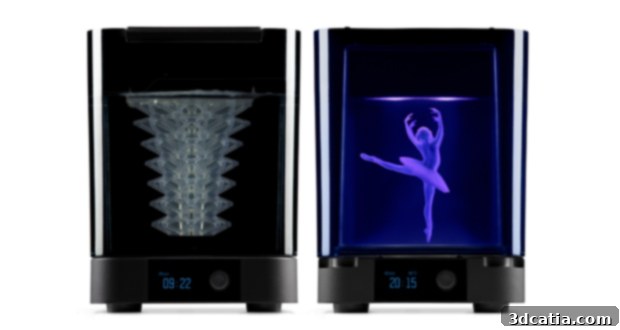
The Form Wash (left) and the Form Cure (right) working in harmony to perfect your SLA 3D prints.
Automated Cleaning: The Form Wash Revolutionizes Resin Post-Processing
The Form Wash machine is engineered to deliver a “uniform, consistent, and automated cleaning process,” transforming what was once a tedious task into a simple, hands-off operation. Ease of use is at its core: users merely set the desired cleaning time, and the machine handles the rest, allowing operators to focus on other tasks. The Form Wash system operates on a straightforward yet highly effective principle. Users can either place the Form 2’s entire build platform, complete with freshly printed parts, directly into the Form Wash, or they can detach the 3D printed items and place them into a basket provided within the unit. Once immersed, the Form Wash’s internal impeller activates, agitating the parts thoroughly in isopropyl alcohol (IPA), ensuring that all excess uncured resin is meticulously removed from every surface and intricate detail.
Upon the completion of the cleaning cycle, an ingenious mechanism within the Form Wash automatically raises the basket or build platform out of the IPA bath. This crucial feature prevents over-soaking and allows the parts to air-dry, leaving you with perfectly cleaned, crisp parts that are immediately ready for the next critical step: post-curing. Beyond its primary function, the Form Wash is designed with user convenience in mind. It includes a dedicated storage area to keep essential finishing tools neatly organized and readily accessible. Perhaps one of its most practical features for maintaining optimal cleaning performance is the integrated hydrometer. This clever device continuously monitors the saturation level of the IPA, providing a clear indication of when it’s time to replace the solvent, thus ensuring consistent cleaning quality and simplifying maintenance.
Optimizing Material Properties: The Form Cure Enhances Part Performance
Following the thorough cleaning provided by the Form Wash, the Form Cure machine takes your 3D printed parts to the next level by providing a “powerful method” for enhancing their post-curing properties. Post-curing is a critical step for many SLA resins, as it significantly improves the mechanical properties, strength, and overall performance of the printed object. Without proper post-curing, parts may remain brittle, soft, or exhibit suboptimal physical characteristics. The Form Cure addresses this by creating an ideal, controlled environment for resin solidification.
This advanced curing method combines two essential elements: uniform exposure to a 405 nm light source and a precise heating system. The 405 nm wavelength is specifically chosen because it effectively penetrates Formlabs’ proprietary resins, initiating and completing the polymerization process that was started during printing. Simultaneously, the integrated heating system provides and maintains the ideal temperature conditions, which is crucial for maximizing the material’s mechanical properties. By consistently applying both light and heat in a controlled manner, the Form Cure ensures that resin parts achieve their optimal strength, rigidity, and dimensional stability.
When used in conjunction with your Formlabs 3D printer(s), the Form Cure dramatically enhances the performance of all Formlabs materials. This leads to a significant increase in both the ultimate strength and the long-term durability of the printed parts. For engineers, designers, and manufacturers, this translates directly into more reliable prototypes, functional end-use parts, and applications where material integrity is paramount. Whether it’s for dental models, jewelry master patterns, or complex engineering components, consistent and optimal post-curing is key to unlocking the full potential of SLA technology. Furthermore, a representative at Formlabs elucidated that the Form Cure comes equipped with pre-defined settings meticulously calibrated for each of Formlabs’ diverse range of resins. This intelligent feature guarantees that every resin type is post-processed in strict accordance with its unique mechanical property requirements, eliminating guesswork and ensuring consistent, professional-grade results every time.
Bridging the Gap: Formlabs’ Vision for a Seamless 3D Printing Workflow
Dábid Lakatos, the Chief Product Officer at Formlabs, perfectly encapsulated the rationale behind these innovations, stating, “Anyone who’s used a 3D printer knows the dirty secret of the process: a lot happens in between hitting ‘print’ and holding a final product.” This candid observation highlights the often-overlooked and labor-intensive stages of post-processing that can deter new users and slow down professional workflows. Lakatos further elaborated on Formlabs’ user-centric philosophy: “We know our users’ time is better spent designing and creating, so we developed Form Wash and Form Cure to bridge that missing gap; making it easier than ever to go from finished print to ready-to-use part.” This statement underscores Formlabs’ commitment not just to producing advanced 3D printers but to cultivating a complete, efficient, and user-friendly ecosystem that spans the entire production cycle.
The integration of Form Wash and Form Cure into the Formlabs ecosystem significantly enhances the value proposition for both new and existing users. By automating the most tedious and inconsistent parts of resin 3D printing, Formlabs is effectively reducing the barriers to entry for high-quality SLA. Users can now expect a more predictable workflow, drastically cut down on manual labor, and free up valuable time that can be reallocated to design iterations, product development, and other high-value tasks. This seamless transition from printing to a final, ready-to-use part is crucial for professionals across various industries, including product design, engineering, dental, and jewelry, where consistent quality and efficient turnaround times are paramount.
Transforming Industries: The Impact of Automated Post-Processing
The launch of Form Wash and Form Cure has far-reaching implications for the broader 3D printing industry. By standardizing and automating post-processing, Formlabs is not only improving its own product line but also pushing the boundaries of what is achievable with desktop SLA technology. The ability to produce reliably cleaned and perfectly cured parts consistently opens up new avenues for applications that demand rigorous quality control and material performance. For rapid prototyping, this means quicker iteration cycles and more accurate functional testing. In fields like dentistry, where precision and biocompatibility are critical, consistent washing and curing can improve the safety and efficacy of printed guides, models, and appliances.
Moreover, the automation offered by these machines makes SLA 3D printing more scalable. Businesses and educational institutions can now manage larger batches of prints with fewer manual interventions, reducing operational costs and increasing overall throughput. This move by Formlabs reinforces the trend towards more integrated and automated manufacturing solutions in the additive manufacturing space, ultimately making advanced 3D printing more accessible, reliable, and powerful for a wider range of users and applications.
Availability and Live Demonstrations
For those currently attending the RAPID + TCT conference in Pittsburgh, Pennsylvania, the opportunity to witness these two groundbreaking machines in action is readily available. Attendees are encouraged to head over to the Formlabs booth, specifically booth number #1637, where live demonstrations and detailed explanations of the Form Wash and Form Cure are being showcased. The conference, which commenced today, will continue through May 11th, providing ample time for interested parties to experience the future of automated SLA post-processing firsthand.
However, for those who cannot attend the conference or who are already convinced of the value these machines bring to their workflow, Formlabs has made it incredibly convenient to acquire them. Preorders for both the Form Wash and Form Cure are available now, allowing users to secure their units ahead of the initial shipping phase. Formlabs has indicated that shipping for these highly anticipated automated post-processing solutions is set to begin in September of this year, ensuring that users won’t have to wait long to integrate these efficiency-boosting machines into their 3D printing setups.
Are you as excited as we are for these innovative new machines from Formlabs? How do you envision the Form Wash and Form Cure transforming your current 3D printing workflow? We invite you to share your thoughts and opinions in the comments section below or join the conversation on our vibrant Facebook and Twitter pages! Your insights are invaluable as the 3D printing community continues to evolve with such groundbreaking advancements.