
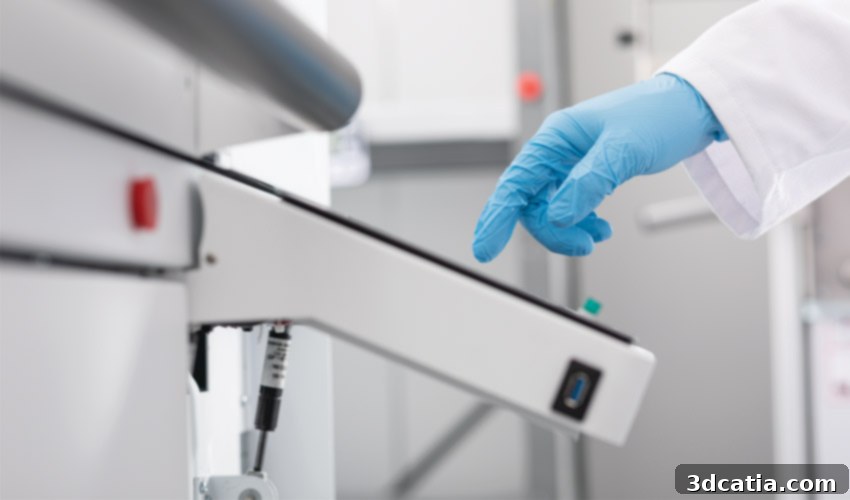
Stratasys Revolutionizes Industrial 3D Printing with Breakthrough SAF Technology: Introducing the H Series for High-Volume Production
A pivotal moment in the additive manufacturing industry has arrived as Stratasys, a venerable pioneer and long-standing leader in the field, officially announces its strategic entry into the competitive powder bed fusion market. This significant expansion is spearheaded by a novel, patented process dubbed Selective Absorption Fusion (SAF) technology. For the Israeli-American manufacturing giant, this marks an unprecedented diversification from its foundational and widely recognized FDM (Fused Deposition Modeling) and PolyJet solutions. More recently, Stratasys had already demonstrated its commitment to expanding its polymer 3D printing portfolio with the introduction of its V650 Flex stereolithography machine and the strategic acquisition of Origin. The new Stratasys H Series™ 3D printers, featuring the innovative SAF process, are slated for commercial availability starting in Q3 of the current year. These systems are engineered to empower high-volume manufacturing across a broad spectrum of industries, including fast-moving consumer goods, advanced automotive components, intricate electronics, and heavy-duty industrial equipment sectors. At its core, the SAF process employs specialized fluids designed to efficiently absorb infrared energy, facilitating the precise and rapid fusion of polymer powder particles to create robust and accurate 3D parts.
For anyone remotely familiar with the landscape of additive manufacturing, the name Stratasys resonates deeply. The company is historically renowned for filing the foundational patent for Fused Deposition Modeling (FDM) in the 1980s, a technology that revolutionized prototyping and continues to be a cornerstone of plastic 3D printing globally, extruding thermoplastic filaments layer by layer to construct final parts. Over the decades, Stratasys further cemented its reputation with the development of the PolyJet process, an advanced technology celebrated for its remarkable ability to produce multi-material objects with exceptional detail and a vast array of colors, simulating diverse material properties and aesthetics. Demonstrating a continuous drive for innovation and market expansion, Stratasys strategically ventured into the stereolithography (SLA) market, leveraging its expertise to address new application demands. The official unveiling of the SAF process, however, represents a culmination of nearly a decade of intensive research and development – a testament to Stratasys’ sustained investment in pushing the boundaries of additive manufacturing. Unlike conventional Selective Laser Sintering (SLS) machines, which meticulously fuse polymer powder point-by-point using a laser, SAF technology harnesses the power of precisely projected energy-absorbing liquids, promising enhanced speed, control, and part quality.
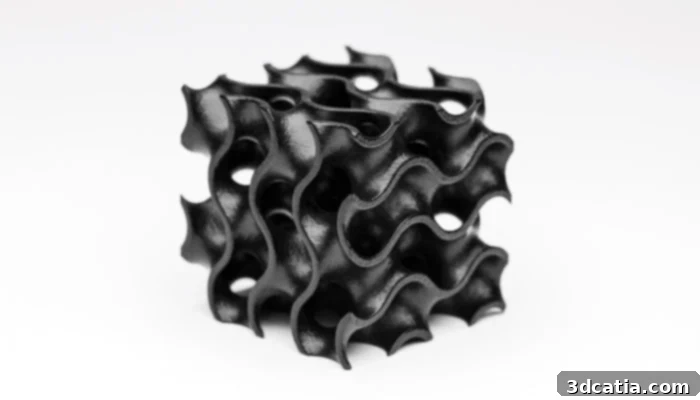
A robust PA 11 part 3D printed on the new Stratasys H Series System (photo credits: Stratasys)
Unveiling the Mechanics: How Selective Absorption Fusion (SAF) Technology Works
Stratasys leverages its extensive expertise in material jetting to introduce the truly innovative Selective Absorption Fusion process. At the heart of the H Series platform lies an array of advanced piezoelectric print heads. These sophisticated heads are capable of precisely ejecting one or multiple micro-drops of a highly specialized fluid, which possesses exceptional energy-absorbing properties. The build process begins with a roller meticulously spreading a uniform, thin layer of plastic powder across the print bed. Following this, the piezoelectric print heads precisely deposit the functional, high-specialty fluid onto the specific areas of the powder bed destined to form the 3D part. This intricate deposition is executed with remarkable accuracy, delineating the cross-section of the object layer by layer. Immediately after the fluid deposition, an infrared (IR) lamp sweeps across the entire print plate in a single, swift pass. Crucially, the deposited fluid efficiently absorbs the infrared energy, rapidly heating and fusing the polymer powder particles exclusively in the targeted regions. This selective fusion process transforms the loose polymer powder into the desired solid 3D model, layer by layer, with unprecedented speed and precision. A key advantage highlighted by Stratasys is the H Series system’s incredibly tight thermal control throughout the entire print process. This meticulous temperature management is vital for mitigating common issues such as part warping and ensuring a consistently high final part quality, making it ideal for demanding industrial applications.
Further enhancing the efficiency and cost-effectiveness of the H Series platform is its sophisticated powder management system. The 3D printer ingeniously employs a counter-rotating roller mechanism, ensuring the flawless and exceptionally even distribution of powder across the build tray. This proprietary technology, aptly named Big Wave™, plays a critical role in maintaining thermal stability within the powder layers. By carefully controlling the temperature, Big Wave™ technology prevents excessive or prolonged exposure of the powder to heat. This innovation not only contributes to superior part quality but also significantly reduces the amount of ‘fresh’ powder required for each print job. In traditional powder bed fusion systems, a considerable portion of unused powder often degrades due to heat exposure, becoming unsuitable for subsequent builds. By minimizing this degradation, SAF technology with Big Wave™ effectively lowers operational costs and enhances material utilization, offering a more sustainable and economically attractive solution for industrial production. This focus on material efficiency and reduced waste underscores Stratasys’ commitment to delivering high-performance additive manufacturing solutions that are also commercially viable and environmentally conscious.
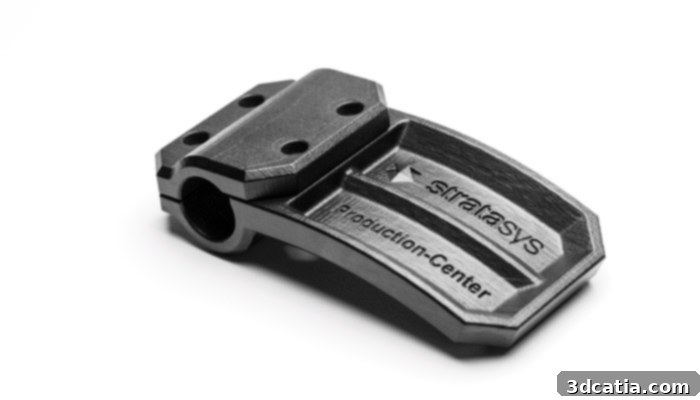
Advanced thermal control in SAF technology significantly reduces part deformations, ensuring high precision (photo credits: Stratasys)
SAF from Stratasys: Engineered for Mass Production of Functional Parts
The introduction of SAF technology, coupled with the H Series, represents a crucial strategic move for Stratasys, reaffirming its dedication to leading the polymer additive manufacturing sector. This follows its significant acquisition of Origin in December, a clear bet on advanced photopolymerization for high-precision applications. Now, by officially entering the powder bed fusion market, Stratasys is targeting a segment poised for explosive growth. According to a comprehensive study conducted by CONTEXT, the powder bed process market is projected to experience a robust compounded annual growth rate of 21% between 2020 and 2024. This burgeoning demand underscores the increasing industrial adoption of 3D printing for functional, end-use parts, driven by needs for design flexibility, faster iterations, and localized production. For Stratasys, the overarching goal with SAF is to provide a technology uniquely capable of mass-producing parts, thereby dramatically expanding the range of possible applications and addressing a wider spectrum of manufacturing requirements. This includes everything from sophisticated tooling and jigs to direct end-use components across diverse industries. The company is committed to developing and supporting a wide array of high-performance plastic materials for the H Series, with initial focus on versatile and robust polyamides (e.g., PA11, PA12) and advanced elastomers, opening doors for parts requiring flexibility and durability.
The implications of Stratasys’ bold move into powder bed fusion are far-reaching. Omer Krieger, Executive Vice President of Product Strategy and Development at Stratasys, eloquently summarized the company’s vision: “3D printing is increasingly transforming production in industries around the world as companies seek to move with more agility and efficiency, which is why we have put production parts at the heart of our business strategy. SAF technology represents a significant innovation that opens up new opportunities to address applications in industries such as automotive, consumer goods and electronics, and industrial equipment.” Krieger further emphasized the transformative potential, stating, “As a result, we will enable a shift of many applications from traditional manufacturing and also enable the creation of products that can only be produced additively.” This statement highlights a dual impact: first, the ability to make existing products more efficiently and cost-effectively through additive means, and second, the capacity to design and manufacture entirely new products that were previously impossible with conventional techniques. The SAF process, with its precise thermal control, rapid production cycles, and material versatility, positions Stratasys to become a dominant player in the industrial production landscape, empowering manufacturers to embrace the full potential of digital manufacturing. It promises not just incremental improvements but a fundamental paradigm shift in how products are designed, developed, and brought to market.
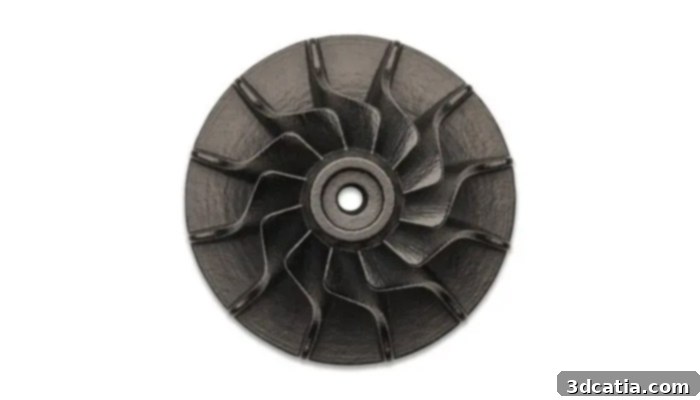
Showcasing the potential of Stratasys’ new Powder Bed Fusion technology (Photo Credits: Stratasys)
Stratasys’ entry into the powder bed fusion market with its innovative SAF technology and H Series platform is a game-changer for industrial additive manufacturing. This strategic expansion solidifies their position as a comprehensive solution provider for polymer 3D printing, now addressing a wider array of high-volume, end-use part applications than ever before. With promises of enhanced efficiency, cost reduction, and superior part quality, the H Series is poised to accelerate the adoption of additive manufacturing in demanding sectors and contribute significantly to the ongoing digital transformation of global manufacturing. The focus on robust materials like polyamides and elastomers ensures that SAF technology will enable the creation of durable, functional parts suitable for diverse and challenging environments. This move not only expands Stratasys’ technological footprint but also offers significant advantages to industries looking to innovate, streamline production, and achieve greater agility in their manufacturing processes. It represents a clear vision for the future of production, where additive manufacturing moves from prototyping to the forefront of industrial-scale output, creating complex geometries and custom solutions that drive progress across various sectors. The market is eager to see the full impact of this advanced technology as it becomes widely available.
What are your thoughts on Stratasys’ strategic move into the powder bed fusion market with SAF technology? How do you envision the H Series impacting industrial production? Share your insights and comments below, or engage with us on our Facebook, Twitter, and LinkedIn pages! Stay informed about the latest advancements in 3D printing by signing up for our free weekly Newsletter here, delivering the most important news straight to your inbox!