
FDA Approves World’s First 3D-Printed Talus Implant for Avascular Necrosis: A Game-Changer for Ankle Health
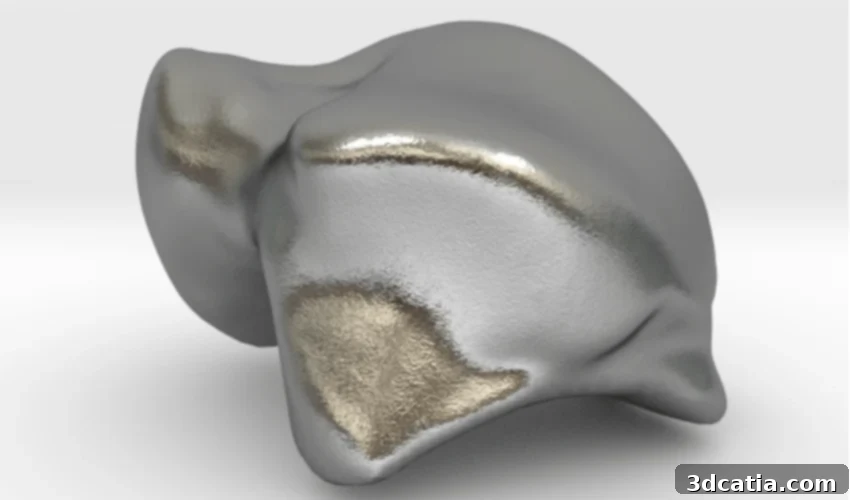
In a landmark decision that promises to revolutionize orthopedic treatment for a debilitating condition, the U.S. Food and Drug Administration (FDA) has officially approved the Patient Specific Talus Spacer. This innovative medical device stands as the world’s first implant specifically engineered to replace the talus bone, offering a beacon of hope for individuals suffering from talus avascular necrosis (AVN). This breakthrough represents a significant leap forward in personalized medicine, utilizing advanced manufacturing techniques to address a critical unmet need in patient care.
The Patient Specific Talus Spacer is a custom-designed, 3D-printed ankle implant meticulously crafted from a robust cobalt chromium alloy. Its truly remarkable feature lies in its bespoke nature: each spacer is individually modeled from high-resolution computed tomography (CT) imaging data of the patient’s affected ankle. This precise, patient-specific approach ensures an unparalleled fit, perfectly conforming to each individual’s unique anatomical structure. Such customization is pivotal in orthopedic surgery, where even minor discrepancies in implant fit can lead to complications and suboptimal outcomes. The ability to create an implant that is an exact replica of the patient’s native talus bone, tailored to their specific joint mechanics, is a testament to the power of combining medical imaging with additive manufacturing technologies.
To fully appreciate the impact of this invention, it’s crucial to understand the talus bone and the condition it aims to treat. The talus is a critical bone located in the ankle, serving as a vital bridge that connects the lower leg bones (tibia and fibula) to the foot. It plays an indispensable role in ankle articulation, facilitating complex movements like dorsiflexion and plantarflexion, and enabling the ankle’s remarkable range of motion. Its unique position and function mean it bears a significant portion of the body’s weight during movement, making its health paramount to mobility.
Avascular necrosis (AVN), also known as osteonecrosis, is a severe medical condition characterized by the death of bone tissue due to an interruption of its blood supply. In the context of the talus, if the blood flow to this vital bone is compromised or completely depleted, the bone cells begin to die, leading to the gradual collapse of the bone structure. Talus AVN most commonly arises from acute incidents such as severe dislocations, fractures, or other traumatic injuries that damage the delicate network of blood vessels supplying the bone. However, it can also be associated with long-term steroid use, excessive alcohol consumption, certain medical conditions like lupus or sickle cell disease, or even idiopathic causes where no clear origin is identified. Regardless of the cause, AVN is a progressive and agonizing condition. Without timely and effective intervention, the bone can partially or entirely collapse, leading to excruciating pain, significant loss of ankle function, and severe osteoarthritis of the ankle joint. The progressive nature of this disease means that early symptoms of pain and stiffness can escalate to chronic, debilitating pain and complete loss of ankle mobility, severely impacting a patient’s quality of life.
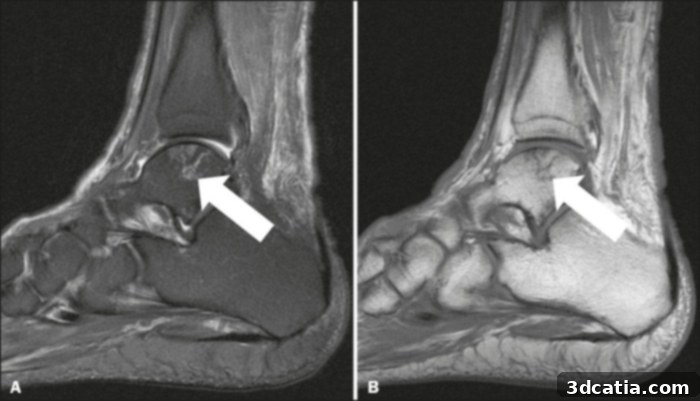
This picture shows avascular necrosis of the talus. (Credit: SciELO)
Before the advent of this 3D-printed implant, treatment options for talus AVN were drastic and carried significant long-term consequences. The two primary traditional approaches were:
- **Ankle Arthrodesis (Joint Fusion):** This procedure involves surgically fusing the bones in the foot and ankle together, effectively eliminating all motion in the affected joint. While fusion can alleviate pain by stabilizing the joint and preventing bone-on-bone friction, it comes at the cost of permanent loss of flexibility and greatly altered gait mechanics, often placing increased stress on adjacent joints and potentially leading to further degenerative issues over time.
- **Below-Knee Amputation:** In severe, end-stage cases where other treatments have failed, or the bone damage is too extensive, amputation below the knee was sometimes the only viable option to manage intractable pain and restore some level of functional mobility with a prosthetic limb. This is, understandably, a life-altering procedure with profound physical and psychological implications.
The Patient Specific Talus Spacer offers a revolutionary, joint-sparing alternative. Its potential to significantly improve a patient’s quality of life post-surgery, compared to the debilitating outcomes of traditional methods, cannot be overstated. By preserving the ankle joint and its natural motion, this implant promises not just pain relief, but a return to a more active and unencumbered lifestyle.
The significance of this approval was underscored by Capt. Raquel Peat, Ph.D., M.P.H., USPHS, director of the FDA’s Center for Devices and Radiological Health’s Office of Orthopedic Devices. “Avascular necrosis of the ankle, while a rare condition, is a serious and potentially debilitating one that causes pain and can lead to inhibited motion of the ankle joint, and in some cases, removal of part of the leg,” she stated. Dr. Peat further emphasized the positive implications of the new treatment: “Today’s action provides patients with a treatment option that could potentially reduce pain, retain range of motion of their joint and improve quality of life.” Her words highlight the FDA’s recognition of both the severity of the disease and the transformative potential of this innovative device.
The FDA’s approval was not granted lightly but was meticulously based on robust clinical data collected from a study involving 31 patients who underwent a total of 32 talus replacement surgeries. The results were remarkably promising. Prior to receiving the implant, the average patient reported experiencing “moderate to severe” pain, a common hallmark of progressive AVN. A follow-up conducted three years post-surgery revealed a dramatic improvement: the average pain experienced by these patients had significantly decreased to “mild.” This substantial reduction in pain alone represents a profound improvement in their daily lives. Beyond pain relief, patients also demonstrated an improved range of motion in their ankle joints, indicating restored functionality and mobility that traditional fusion surgery would negate. Crucially, the long-term data also showed a favorable safety profile; at the three-year mark, only three out of the 32 cases reported the need for additional surgeries, a low re-operation rate for such a complex orthopedic procedure. The most commonly reported side effects associated with the 3D-printed ankle implant were localized pain and scar tissue formation at the surgical site, which are typical complications for any surgical intervention.
The FDA approved the Patient Specific Talus Spacer as a Humanitarian Use Device (HUD). This designation is specifically reserved for medical devices intended to benefit patients in the treatment or diagnosis of a disease or condition that affects or is manifested in not more than 8,000 individuals in the United States per year. The HUD pathway is designed to encourage the development of devices for rare diseases where the potential market size might not justify the extensive research and development costs associated with typical device approvals. This designation underscores the rarity of talus AVN while acknowledging the critical need for effective treatment options for this small but significantly impacted patient population. It ensures that innovative solutions can reach patients suffering from less common conditions, preventing them from being overlooked by the medical device industry. You can read the full press release and delve deeper into the specifics of this groundbreaking approval by clicking the link HERE.
The approval of the Patient Specific Talus Spacer marks a pivotal moment in orthopedic surgery and the broader field of medical device innovation. It showcases the immense potential of additive manufacturing, or 3D printing, to create highly personalized, complex implants that can truly transform patient outcomes for rare and challenging conditions. This technology paves the way for future advancements in joint preservation, offering hope for individuals facing severe musculoskeletal issues. The ability to design and produce patient-specific solutions is a game-changer, moving us further into an era of personalized medicine where treatments are meticulously tailored to individual needs rather than a one-size-fits-all approach. This breakthrough not only provides a superior treatment option for talus AVN but also sets a precedent for how 3D printing can be leveraged to address other complex anatomical challenges, promising a brighter future for countless patients globally.
What are your thoughts on this revolutionary 3D-printed ankle implant and its implications for orthopedic medicine? We invite you to share your perspectives in a comment below or join the conversation on our Linkedin, Facebook, and Twitter pages! Don’t miss out on the latest advancements in medical technology and 3D printing; sign up for our free weekly Newsletter here, delivered straight to your inbox!