
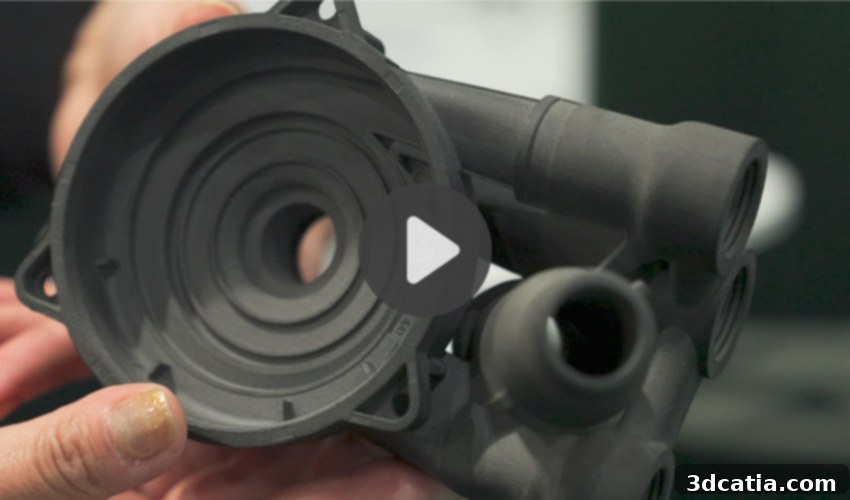
Evolve Additive Solutions Unveils STEP Technology: Bridging the Gap to Production-Grade Additive Manufacturing at RAPID + TCT 2024
As the leading event for the additive manufacturing industry, RAPID + TCT continues to be a crucial platform for showcasing groundbreaking innovations that are redefining industrial production. This year, we had the privilege of engaging with several prominent exhibitors, delving into their transformative technologies and understanding their vision for the future of additive manufacturing. Among these pioneers, Evolve Additive Solutions stood out significantly. The American company has carved a distinctive niche in the sector, drawing considerable attention with its revolutionary STEP (Selective Thermoplastic Electrophotographic Process) technology. This advanced process empowers users to produce parts that not only meet but often surpass the rigorous quality and performance standards traditionally associated with injection molding. The critical questions arise: How exactly does this groundbreaking process function? And what intrinsic qualities make STEP technology so uniquely special and impactful in the evolving landscape of industrial manufacturing?
At RAPID + TCT 2024, the atmosphere buzzed with excitement and anticipation for the latest advancements. It was amidst this vibrant backdrop that we secured an exclusive interview at booth 2645 with Jeff Blank, the distinguished CEO of Evolve Additive Solutions. Having taken the helm of the company earlier this year, Mr. Blank offered invaluable insights into the strategic direction and technological prowess that Evolve embodies. During our illuminating discussion, he meticulously guided us through the intricate mechanics and operational nuances of how STEP technology works, demystifying its complex yet highly effective principles. Furthermore, Jeff eloquently elucidated how STEP fundamentally distinguishes itself from established traditional additive manufacturing methods, such as Stereolithography (SLA), Selective Laser Sintering (SLS), and Fused Deposition Modeling (FDM). His emphasis was particularly on STEP’s inherently superior scalability, its remarkable material versatility, and its unparalleled rapid production capabilities—qualities that are essential for true industrial adoption. For a more comprehensive understanding and an immersive experience of our discussion, we invite you to check out the insightful video below!
Understanding Evolve’s STEP Technology: A Paradigm Shift in Production
The core innovation behind Evolve Additive Solutions lies in its Selective Thermoplastic Electrophotographic Process (STEP). This technology represents a monumental leap forward, marrying the principles of electrophotography – akin to what powers advanced 2D printers – with cutting-edge additive manufacturing. In essence, the STEP process works by depositing layers of thermoplastic material onto a build plate using a sophisticated imaging system. A fuser then solidifies each layer, creating a fully dense and robust part. This layer-by-layer deposition, controlled with micron-level precision, ensures exceptional part accuracy and repeatability. Unlike many other 3D printing technologies that rely on point-by-point or line-by-line deposition, STEP utilizes a broad area deposition approach, significantly accelerating the build process and enabling higher throughput. This methodology is critical for achieving production volumes that were previously out of reach for additive manufacturing, pushing the boundaries of what is possible in industrial applications.
Key Differentiators and Advantages of STEP Technology
STEP technology brings a host of advantages that position it as a formidable contender for production-grade additive manufacturing, directly addressing many of the limitations found in conventional 3D printing methods. Its ability to create parts that rival injection molding is perhaps its most compelling feature, opening doors for true end-use part production in various industries.
- Injection Molding Quality and Performance: One of STEP’s most significant achievements is its capacity to produce parts with isotropic mechanical properties, exceptional surface finish, and tight tolerances, mirroring the quality typically expected from injection molded components. This is largely due to the use of engineering-grade thermoplastics, precisely controlled thermal management during the build, and the unique layer fusion process. Parts created with STEP exhibit high strength, durability, and a smooth aesthetic, making them suitable for demanding functional applications where visual appeal is also important. This capability is pivotal for manufacturers looking to transition from traditional manufacturing methods without compromising on part integrity or appearance.
- Superior Scalability and Throughput: Scalability is often a bottleneck in additive manufacturing, but STEP technology overcomes this challenge impressively. Its broad area deposition approach allows for faster layer processing and the efficient production of multiple parts simultaneously, drastically increasing throughput. This means manufacturers can scale up production from prototyping to medium-volume series production with a single technology, significantly reducing lead times and accelerating time-to-market for new products. The ability to produce large batches of identical or varied parts efficiently makes STEP an economically viable solution for high-volume applications.
- Unmatched Material Versatility: Unlike many additive processes that are restricted to proprietary or limited material palettes, STEP technology is designed to work with a wide array of commercially available, engineering-grade thermoplastics. This includes materials like ABS, Nylon, and ULTEM, which are commonly used in traditional manufacturing. This material flexibility is crucial as it allows manufacturers to use materials with known performance characteristics, simplifying qualification processes and expanding the range of applications. The ability to process industry-standard thermoplastics also means that parts can possess specific properties required for end-use, such as chemical resistance, heat deflection, or impact strength, without needing to develop entirely new material formulations.
- Rapid Production Capabilities: Beyond raw speed, STEP’s rapid production capabilities encompass the entire manufacturing workflow. Its efficient process minimizes the need for extensive post-processing, which can be a time-consuming and costly aspect of other additive technologies. Parts emerge from the STEP system close to their final form, requiring minimal finishing, which contributes to faster overall production cycles. This speed, combined with its ability to scale, makes it an ideal solution for agile manufacturing strategies, allowing companies to respond quickly to market demands and product iterations.
- Cost-Effectiveness for Production: While the initial investment in advanced additive manufacturing systems can be significant, the cost-effectiveness of STEP becomes evident when considering total cost of ownership for production runs. By reducing material waste, streamlining post-processing, and achieving higher throughput, STEP can offer a lower cost per part compared to other 3D printing methods, especially for medium-volume production. Furthermore, its ability to bypass tooling costs associated with injection molding makes it highly attractive for bridge manufacturing, low-volume production, and customized parts.
- Robust Design Freedom with Industrial Standards: STEP technology marries the geometric complexity inherent in additive manufacturing with the robust quality demanded by industrial applications. While offering substantial design freedom for complex geometries, internal channels, and lightweighting structures, it maintains the necessary precision and material integrity for functional parts. This balance is critical for industries like aerospace, automotive, and medical, where innovative designs must also meet stringent performance and safety standards.
STEP Technology Compared to Traditional Additive Manufacturing Methods
To truly appreciate the transformative nature of Evolve’s STEP technology, it’s beneficial to compare it against more established additive manufacturing processes. While SLA, SLS, and FDM have revolutionized prototyping and niche applications, they often face limitations when it comes to true industrial-scale production of end-use parts, particularly concerning material choice, part quality, and scalability.
- Versus FDM (Fused Deposition Modeling): FDM is widely accessible and excellent for prototyping due to its simplicity and low cost. However, FDM parts typically exhibit anisotropy (weaker properties in one direction), visible layer lines, and can struggle with achieving high dimensional accuracy for intricate geometries. STEP, in contrast, provides isotropic properties, a much smoother surface finish, and significantly higher precision, making it suitable for production-grade functional components that FDM often cannot achieve.
- Versus SLA (Stereolithography): SLA offers excellent surface finish and fine details, making it popular for visual prototypes and intricate models. However, SLA uses liquid photopolymer resins, which often have limited mechanical properties compared to engineering thermoplastics. Parts also typically require extensive post-curing and cleaning, and the materials can be brittle. STEP leverages robust thermoplastics, leading to parts with superior mechanical strength and durability, with less post-processing required, aligning more closely with end-use product requirements.
- Versus SLS (Selective Laser Sintering): SLS is known for producing strong, functional parts from powdered polymers, often eliminating the need for support structures. While SLS offers good mechanical properties and design freedom, its parts typically have a porous surface finish that might require significant post-processing for aesthetic or sealed applications. Additionally, powder handling and removal can be cumbersome. STEP’s electrophotographic process results in fully dense parts with superior surface smoothness directly out of the machine, reducing post-processing steps and material waste, and offering better aesthetics for visible components.
In summary, while traditional AM methods have their strengths, STEP technology emerges as a compelling solution for industrial manufacturing by offering a unique combination of speed, material versatility, scalability, and part quality that brings additive manufacturing closer to the capabilities of traditional high-volume production techniques like injection molding. It is designed to bridge the gap between rapid prototyping and full-scale manufacturing, empowering businesses to innovate faster and more efficiently.
Applications and Future Impact of STEP Technology
The implications of Evolve’s STEP technology for various industries are profound. By delivering production-grade parts with the flexibility of additive manufacturing, STEP is poised to revolutionize several sectors. In the automotive industry, it can enable the rapid production of complex, lightweight components for electric vehicles, specialized interior parts, or even custom aftermarket accessories. For aerospace, the ability to produce strong, durable parts from high-performance thermoplastics rapidly can reduce lead times for critical components, allowing for faster iterations and certified parts for flight. The medical device sector stands to benefit immensely from the precision and material versatility for creating custom prosthetics, surgical guides, and patient-specific anatomical models, all while adhering to stringent material requirements. Beyond these, industries ranging from consumer electronics to industrial machinery can leverage STEP for bridge manufacturing, on-demand spare parts, and the production of innovative new products that were previously impossible or cost-prohibitive to manufacture using traditional methods. Evolve Additive Solutions is not just offering another 3D printer; they are presenting a new pathway to agile, scalable, and high-quality manufacturing that can fundamentally change how products are designed, produced, and brought to market.
What are your thoughts on Evolve’s STEP technology and its potential to reshape the manufacturing landscape? Did you have the chance to visit Evolve Additive Solutions at RAPID + TCT 2024 this year and experience their innovation firsthand? We’d love to hear your insights and experiences! Let us know in a comment below or join the conversation on our LinkedIn, Facebook, and Twitter pages! Stay ahead of the curve with the latest advancements in 3D printing technology by signing up for our free weekly newsletter here —delivering essential news directly to your inbox. You can also explore a wealth of compelling video content on our dedicated YouTube channel.