
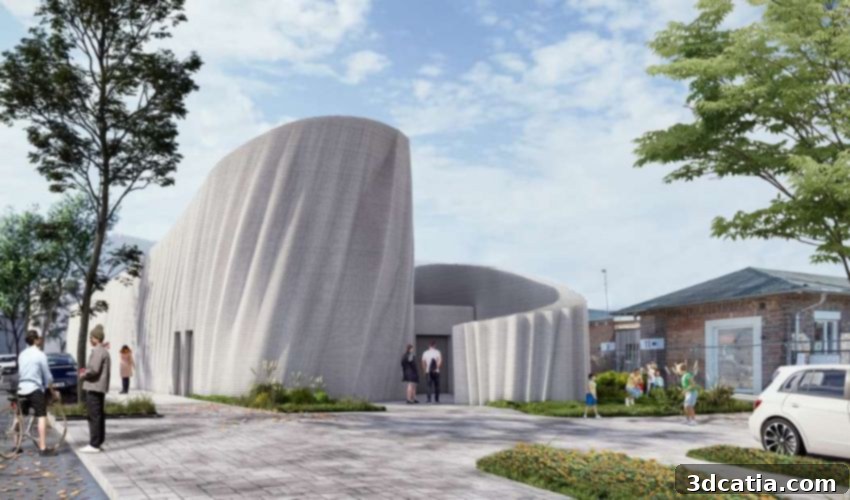
Europe’s Largest 3D Printed Building: Pioneering Sustainable Construction with Advanced Additive Manufacturing
Additive manufacturing, commonly known as 3D printing, is revolutionizing various industries, and its impact on the construction sector is particularly profound. This innovative technology offers unparalleled design flexibility, allowing architects and engineers to create complex, customized structures that were once impossible or prohibitively expensive to build using traditional methods. Beyond aesthetic and functional freedom, 3D printing plays a critical role in promoting sustainability within construction. By optimizing material usage, it significantly reduces waste and contributes to a more environmentally friendly building process with a notably lower carbon footprint. Consequently, a growing number of forward-thinking companies are embracing additive manufacturing to execute ambitious projects, pushing the boundaries of what’s possible in modern construction.
A prime example of this accelerating trend is the groundbreaking initiative led by the Kraus Group, who recently unveiled plans for Europe’s largest 3D printed building. This ambitious undertaking is a collaborative masterpiece, bringing together the expertise of three industry leaders: the Kraus Group as the visionary developer, PERI 3D Construction as the technology and printing specialist, and Heidelberg Materials as the innovative material supplier. Together, they are setting a new benchmark for scale, sustainability, and technological integration in the European construction landscape, demonstrating the immense potential of large-scale 3D printing.
This monumental structure, designed to measure an impressive 54 meters in length, 11 meters in width, and 9 meters in height, will be strategically located in the Campbell Heidelberg area. Its primary function will be to serve as an IT server hotel for Heidelberg iT Management GmbH & Co, a prominent provider of data center and cloud services. The robust and efficient construction method offered by 3D printing is particularly well-suited for such a critical facility, where structural integrity, precise environmental control, and rapid deployment are paramount. The printing process commenced in late March and is anticipated to reach completion within approximately four months, a testament to the speed and efficiency that additive manufacturing brings to large-scale projects.
Sustainable Innovation at the Core: Materials and Environmental Impact
From its inception, sustainability has been a fundamental consideration for this pioneering venture. Heidelberg Materials, a crucial partner in the project, is supplying a specially formulated 3D printed mineral concrete that boasts full recyclability. This commitment to circularity is a significant step towards reducing construction waste and promoting resource efficiency. Furthermore, the innovative material incorporates a specialized binder that yields a remarkable 55% reduction in CO2 emissions compared to conventional Portland cement, a widely used but carbon-intensive material in the construction industry. This substantial reduction in embodied carbon directly addresses the urgent need to decarbonize the built environment and combat climate change.
Dr. Jörg Dietrich, Director of Engineering and Innovation at Heidelberg Materials Germany, elaborated on the exceptional properties of this advanced concrete, stating, “The material exhibits excellent extrusion properties and is easily pumpable, which are crucial characteristics for successful large-scale 3D printing. Additionally, its specific strength development ensures precise dimensional accuracy in the printed structure, guaranteeing the structural integrity and stability required for such an important facility as a server hotel.” This advanced material formulation not only supports environmental goals but also meets the rigorous performance demands of additive manufacturing, enabling the construction of complex and precise structures layer by layer.
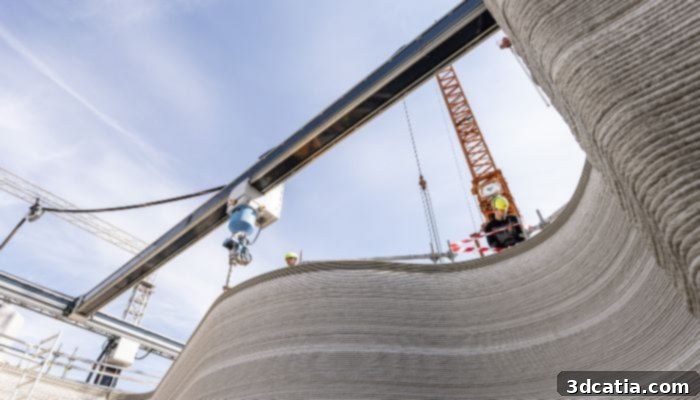
The building is manufactured with a concrete 3D printer (photo credits: PERI 3D Construction)
Advancing Construction with 3D Printing Technology
PERI 3D Construction, a leader in the field of automated construction, is utilizing COBOD’s state-of-the-art BOD2 concrete 3D printer to fabricate the structural and vertical components of this expansive edifice. The BOD2 is renowned for its speed, precision, and ability to handle large-scale projects, making it an ideal choice for constructing Europe’s largest 3D printed building. This gantry-based printer operates by extruding concrete layer by layer, meticulously building up walls and structural elements directly from digital designs. This method not only accelerates the construction timeline but also enables the creation of intricate designs and geometries that would be cumbersome or impossible with conventional formwork and manual labor.
Dr. Fabian Meyer-Brötz, CEO of PERI 3D Construction, expressed his profound pride and excitement regarding their involvement in this landmark project, stating, “We are extremely proud to realize our largest building yet through this endeavor. The utilization of 3D printing showcases the immense design freedom afforded by this technology, allowing us to create structures with unparalleled efficiency and innovation. With the upcoming construction of Germany’s inaugural public 3D printed building in North Rhine-Westphalia, we are thrilled to witness the increasing momentum of 3D printing in the construction industry. These projects are not just buildings; they are beacons demonstrating the transformative power of additive manufacturing in shaping the future of how we build.“ His statement underscores PERI’s commitment to pushing technological boundaries and the growing acceptance of 3D printing as a viable and preferred construction method for diverse applications.
Addressing Industry Challenges and Fostering Innovation
The Kraus Group, in close collaboration with its esteemed partners, has wholeheartedly embraced 3D printing as a pivotal strategy to foster innovation within the construction sector in Heidelberg and beyond. This approach is not merely about adopting new technology; it represents a commitment to redefining construction methodologies for efficiency, precision, and sustainability. While demonstrating their dedication to local employment and project sustainability through the engagement of two local workers, the project also highlights a broader industry challenge.
Like many other manual trades, the construction industry globally grapples with an increasing scarcity of skilled labor. This shortage poses significant hurdles to project timelines, costs, and overall industry growth. In response to this inherent and pressing challenge, additive manufacturing presents a powerful and scalable solution. By automating large portions of the construction process, 3D printing mitigates the intense demand for personnel, allowing existing skilled workers to focus on more complex, value-added tasks such as quality control, equipment operation, and finishing work. This strategic shift not only optimizes human resources but also enhances safety on construction sites and ensures a higher degree of consistency and quality in the final structure. The Kraus Group’s adoption of 3D printing is a testament to its potential to future-proof the construction industry against labor shortages while simultaneously driving innovation.
The Future of Construction: A Global Perspective
The construction of Europe’s largest 3D printed building in Heidelberg is more than just a single project; it is a significant milestone that heralds a new era for the construction industry worldwide. This initiative by the Kraus Group, PERI 3D Construction, and Heidelberg Materials demonstrates the incredible potential of additive manufacturing to deliver not only on scale but also on crucial aspects like sustainability and efficiency. The integration of advanced materials with reduced carbon footprints, combined with the rapid and precise capabilities of concrete 3D printers, sets a precedent for future developments. It showcases how collaboration across different sectors – from material science to automated construction – can lead to groundbreaking achievements that benefit both industry and the environment.
Looking ahead, the successful completion of this server hotel is expected to inspire more widespread adoption of 3D printing technologies in various construction applications, from residential and commercial buildings to infrastructure projects. The advantages of faster construction times, reduced labor costs, minimal material waste, and the ability to create bespoke architectural designs are becoming increasingly undeniable. As regulations become stricter regarding environmental impact and as the demand for efficient, high-quality, and cost-effective construction continues to grow, additive manufacturing is poised to become a standard rather than an exception. Projects like the one in Heidelberg are crucial in demonstrating the viability and immense value of this technology, paving the way for a more innovative, sustainable, and resilient built environment for generations to come.
What do you think of the largest 3D printed building in Europe and its implications for the future of construction? We would love to hear your thoughts! Let us know in a comment below or join the conversation on our LinkedIn, Facebook, and Twitter pages! Don’t forget to sign up for our free weekly Newsletter here to receive the latest 3D printing news straight to your inbox. You can also find all our videos on our YouTube channel for more insights into the world of additive manufacturing.
*Cover photo credits: Kraus Group