
Advancing Additive Manufacturing: The Revolutionary Potential of 3D Glass Printing
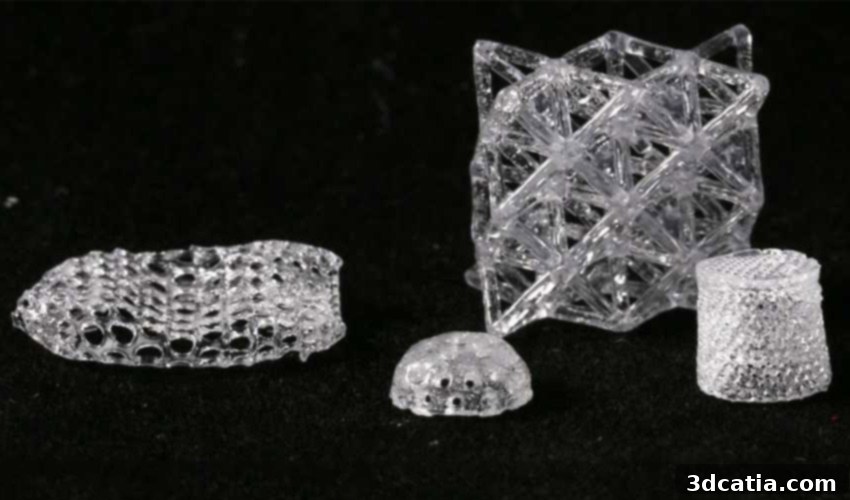
Additive manufacturing, commonly known as 3D printing, has transformed countless industries by enabling the creation of complex geometries from a diverse range of materials. However, among the vast spectrum of printable substances, glass has historically presented a formidable challenge. Its unique properties—including extreme melting temperatures, high viscosity, and susceptibility to thermal shock—have made it notoriously difficult to manipulate with conventional 3D printing techniques. Despite these hurdles, a dedicated global community of researchers has been tirelessly working to overcome these limitations, pushing the boundaries of what’s possible in advanced materials manufacturing. Pioneering institutions like MIT have made significant strides, notably with their G3DP2 system, which showcased the potential to fabricate intricate and customized glass objects. Commercial entities, such as Glassomer, have also emerged, developing proprietary glass 3D printing technologies that promise to democratize access to this unique material. This month marks another groundbreaking development, as researchers from ETH Zurich have unveiled an innovative technique based on stereolithography, poised to unlock unprecedented applications for 3D printed glass.
Historically, the quest to 3D print glass has seen two primary approaches. One method involved the direct printing of molten glass, a technique that necessitates incredibly high temperatures, often exceeding 1,000°C. This approach inherently demands specialized, highly heat-resistant equipment, significantly increasing manufacturing complexity and cost, while also posing considerable safety challenges. The extreme temperatures and material handling difficulties often limit the geometric complexity and resolution that can be achieved. Another common strategy involved using powdered ceramic particles, which could be printed at room temperature and subsequently sintered at high temperatures to form a glass-like material. While this method circumvented the immediate high-temperature printing challenge, it frequently struggled to produce objects with the desired level of detail and intricate shapes, often resulting in porous or less optically clear structures. These existing techniques, while foundational, highlighted a critical need for a new process that could combine precision, design freedom, and material integrity without the prohibitive drawbacks of their predecessors. The recent breakthrough from ETH Zurich directly addresses these limitations, leveraging stereolithography—a widely established 3D printing method known for its high resolution—through the development of a novel resin formulation. This specialized resin ingeniously incorporates a blend of plastic and organic molecules, to which carefully selected glass precursors are chemically bonded, paving the way for a more accessible and versatile approach to 3D glass manufacturing.
Credits: ETH Zurich
Revolutionizing Glass Manufacturing: ETH Zurich’s Stereolithography-Based 3D Printing Process
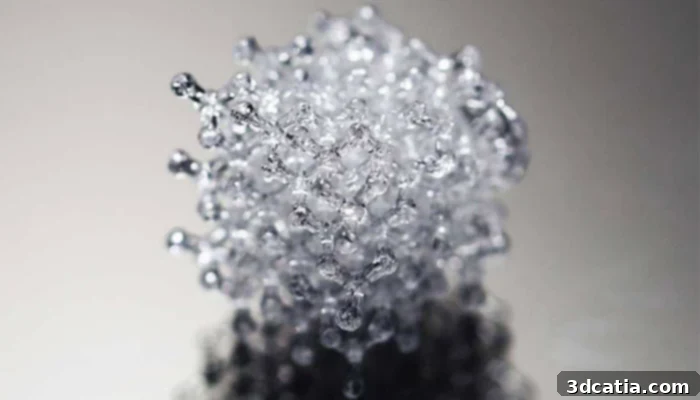
The innovative glass 3D printing process developed by the ETH Zurich team harnesses the power of stereolithography (SLA), specifically tailored for Digital Light Processing (DLP) systems. DLP 3D printing operates on the principle of projecting a complete image of each layer onto a vat of photopolymer resin, curing it rapidly with UV light. This method offers distinct advantages, including high resolution, exceptional surface finish, and significantly faster print speeds compared to traditional laser-based SLA, making it ideal for fabricating intricate and detailed structures. The cornerstone of the ETH Zurich technique is its specially formulated resin, a sophisticated composite material that combines a photopolymerizable plastic with organic molecules, acting as a binder, and, crucially, glass precursors. These precursors, typically silicon-based compounds, are uniformly dispersed and chemically integrated within the resin matrix. When exposed to UV light, the plastic and organic components solidify, encapsulating the glass precursors and forming a precise, green-state object layer by layer.
A key aspect of this breakthrough is the resin’s compatibility with commercially available DLP systems, which democratizes access to this advanced glass fabrication method. During the printing process, the ETH Zurich researchers demonstrated remarkable control over various parameters for each individual layer. This includes the ability to precisely adjust the pore size within the printed object by manipulating the intensity of the UV light. For instance, employing a weaker light intensity during curing results in larger, more interconnected pores, offering a pathway to tailor the material’s final properties—such as porosity, optical scattering, or even mechanical strength. Furthermore, the versatility of the resin system allows for the incorporation of different glass compositions. By mixing silica with other glass-forming oxides like borate or phosphate and adding them to the resin, the researchers can construct complex objects from various types of glass. This opens up possibilities for creating multi-material glass components or even functionally graded structures, where different regions of an object exhibit distinct optical or thermal properties. Such capabilities are unprecedented in glass additive manufacturing, promising innovative applications in micro-optics, advanced sensors, and high-performance microfluidic devices, where precise control over material properties and geometric complexity is paramount.
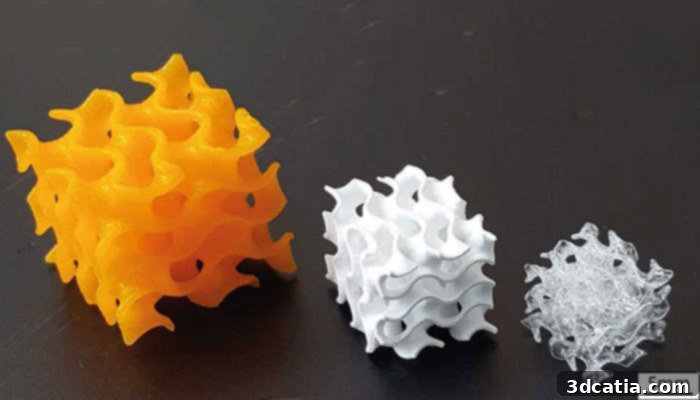
The three step process, object before being fired at 600˚C (left), after being heated (middle), after being further heated at 1000˚C (right). The object shrinks significantly, but becomes hard like window glass | Credits: ETH Zurich
Following the precise DLP printing stage, the resulting “green” object undergoes a crucial two-step thermal post-processing procedure to transform the precursor-laden polymer structure into solid, transparent glass. This firing process is meticulously controlled to ensure the desired material transformation and optical clarity. The first heating phase involves firing the object at approximately 600°C. At this temperature, the organic polymer framework and binder components within the printed object are carefully burned off through pyrolysis. This step is critical; it removes all non-glass-forming elements, leaving behind a fragile, porous ceramic structure composed primarily of the glass precursors. Careful control of the heating rate during this stage is essential to prevent cracking or deformation of the delicate structure as the organic binders decompose and gases escape.
Once the polymer framework has been eliminated, the object proceeds to the second, higher-temperature firing step, where it is heated to around 1000°C. This intense thermal treatment is where the magic happens: the ceramic structure densifies and consolidates into a solid, non-crystalline glass. During this sintering process, the individual glass precursor particles fuse together, and any remaining porosity is largely eliminated, resulting in a dense, transparent material. A remarkable characteristic of this stage is the significant shrinkage that the objects undergo. As the material densifies, its volume can decrease by a considerable amount, which must be accounted for during the initial design phase. Despite this shrinkage, the final product emerges transparent and hard, akin to conventional window glass, with its intricate details and geometric complexity preserved. While this groundbreaking technique excels in producing highly detailed and geometrically complex objects, it currently exhibits a limitation in scale. It is primarily beneficial for manufacturing small objects, making it less suitable for large-scale items such as bottles, drinking glasses, or expansive window panes. The challenges associated with uniformly heating and cooling larger glass objects during the firing process, coupled with managing stress-induced cracking due to significant shrinkage, currently present hurdles for upscaling. Nevertheless, the unparalleled level of detail and geometric freedom achieved with this stereolithography-based approach positions it as a game-changer for micro-scale glass components, micro-optics, lab-on-a-chip devices, and custom scientific instrumentation, where precision and complexity are far more critical than sheer size. The rigorous scientific underpinning of this research is further highlighted by its publication in the esteemed journal *Nature Materials*, underscoring its significant contribution to the field of additive manufacturing and materials science. More detailed information can be found HERE.
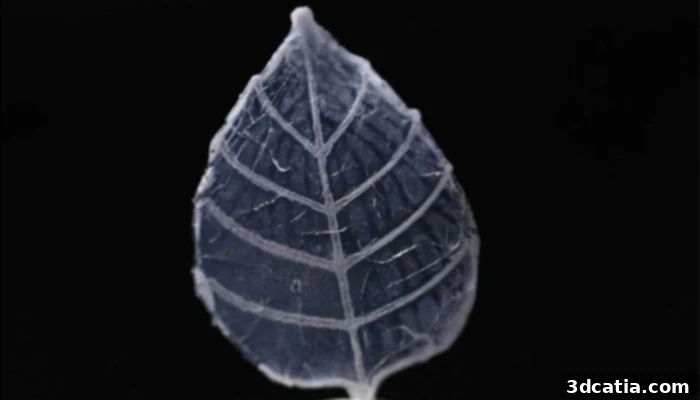
Objects with a high level of detail and geometric complexity can be produced as seen above | Credits: ETH Zurich
The advent of this novel stereolithography-based 3D glass printing technique from ETH Zurich represents a monumental step forward in additive manufacturing. By addressing many of the long-standing challenges associated with processing glass, this method opens up a vast array of possibilities for creating highly detailed, geometrically complex, and optically clear glass components. Imagine microfluidic devices with custom-designed internal channels, bespoke optical lenses with tailored properties, or intricate biomedical implants that leverage the biocompatibility and transparency of glass. While the current limitations regarding object size are a factor, the precision and material versatility offered by this technology are particularly impactful for industries requiring miniaturized, high-performance glass parts.
The future of 3D glass printing looks incredibly bright, with ongoing research likely to focus on scaling up the process, exploring even more diverse glass compositions, and optimizing post-processing to reduce shrinkage and internal stresses. The commercial adoption of such advanced manufacturing processes could revolutionize sectors from aerospace and telecommunications to medical devices and high-end consumer electronics. This breakthrough not only highlights the ingenuity of materials scientists and engineers but also underscores the continuous evolution of additive manufacturing as a key driver of innovation. We are eagerly anticipating how companies will integrate this groundbreaking technology into their production workflows, transforming design concepts into tangible, functional glass objects. What are your thoughts on this revolutionary new technique for 3D glass printing emerging from ETH Zurich? Share your insights and predictions for its impact in a comment below, or engage with us on our Facebook and Twitter pages! Don’t miss out on the latest advancements and news in the world of 3D printing; sign up for our free weekly Newsletter to have all the cutting-edge updates delivered directly to your inbox!