
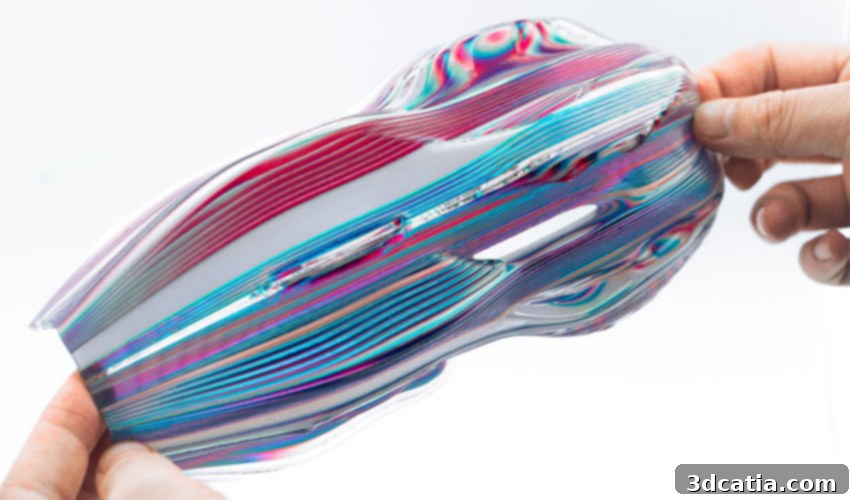
Illusory Material: Redefining Product Design with Multi-Material 3D Printing
The additive manufacturing sector is a crucible of innovation, constantly pushing the boundaries of what’s possible in design and production. A shining example of this relentless pursuit of novelty is the Illusory Material project. This groundbreaking initiative, conceived by industrial designer Jiani Zeng and computational designer Honghao Deng during their tenure at MIT, sought to unlock entirely new possibilities for product design through the advanced capabilities of multi-material 3D printing. While many conventional 3D printing technologies are limited to single-material fabrication, a select few excel in creating intricate parts with diverse material properties. Among these, Material Jetting—known commercially as PolyJet and developed by industry leader Stratasys—stands out as a pivotal enabler for such complex multi-material applications. The ingenuity of Illusory Material did not go unnoticed, earning the prestigious Strategy & Research Award at the Core77 Design Awards 2020, a testament to its truly beautiful and transformative creations.
This wasn’t Stratasys’ first foray into pioneering design projects; their 3D printers have consistently been at the forefront of innovation. What set Illusory Material apart was the designers’ ambitious goal: not merely to redefine the aesthetic appearance of various products, but to engineer dynamic designs capable of interacting with users in novel ways, entirely devoid of electronic or robotic components. Zeng and Deng articulated their vision compellingly: “We propose to get away from surface obsession in object and industrial design, by adding another dimension to the material interface. By embedding information into three-dimensional matter, we introduce illusory material: a new material organization that responds directly to the user intervention or the environment. With multi-material 3D printing, we envision a future in product development where the design of surface detail, texture, reflexivity can finally be merged with the overall product composition from the beginning of the design process.” This statement underscores a profound shift from merely decorating surfaces to intrinsically integrating interactive properties within the material itself. It’s a departure from the traditional linear design process, where material selection often follows form design, towards a holistic approach where material characteristics are integral to the product’s core functionality and user experience from conception.
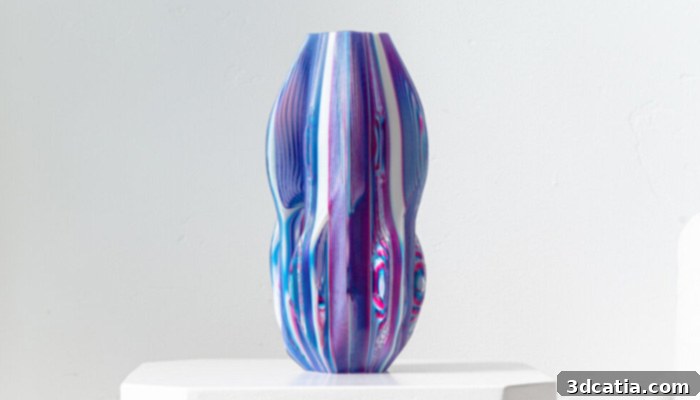
A captivating daytime artifact that transforms into a dynamic night lamp, showcasing different colors based on the viewing angle, created using the innovative Illusory Material method.
To demonstrate their concept, the designers unveiled a series of remarkable products, each showcasing unique interactive properties. Among these were a minimalist perfume bottle that ingeniously reveals hidden information only when viewed from specific angles, a multi-functional artifact designed to serve as both a daytime ornament and a night lamp, displaying a spectrum of colors depending on the observer’s viewing angle, and an engaging interactive lollipop. In each instance, the design—encompassing everything from subtle color shifts to pronounced changes in shape or pattern—dynamically transformed based on the viewing perspective. Achieving such fluid, angle-dependent variations presents immense challenges for traditional manufacturing techniques, which typically produce static forms. Even within the realm of conventional 3D printing, replicating these complex optical effects is incredibly difficult, often requiring post-processing or assembly of multiple parts. The breakthrough of Illusory Material lies in embedding these dynamic properties directly into the material during the printing process itself. To accomplish this, Zeng and Deng embarked on extensive research, meticulously studying optical effects and conducting rigorous testing of various lenticular arrays to engineer a truly dynamic object. Their persistent experimentation and computational design expertise ultimately led them to select Stratasys’ J8 series 3D printer. This choice was critical, as the J8 series, powered by PolyJet technology, is renowned for its unparalleled multi-material capabilities, allowing for the precise deposition of different photopolymers in a single build, layer by layer, thus enabling the creation of these intricate, angle-responsive designs.
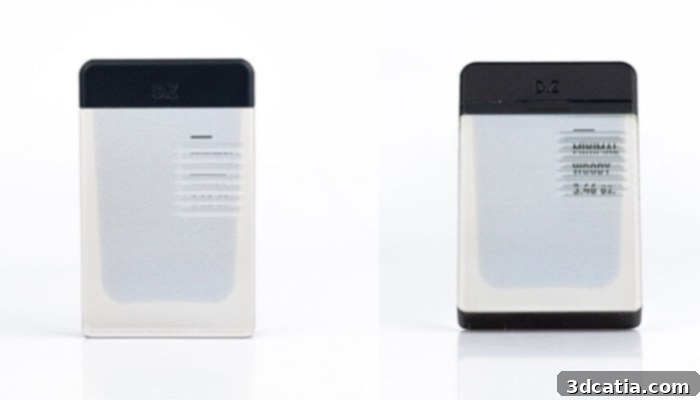
A sleek perfume bottle featuring an inscription that elegantly appears and disappears, contingent on the viewing angle, demonstrating the subtle interactivity of illusory materials.
Beyond creating these captivating individual products, the designers engineered a comprehensive computational pipeline throughout their development process. This sophisticated system is capable of automatically calculating the ideal lens geometry for any given input design, effectively streamlining the creation of complex optical effects. This powerful tool significantly democratizes the creation of such dynamic designs, meaning that other industrial and product designers can now readily leverage this cutting-edge technique. They can, in turn, create their own ‘otherworldly’ products adorned with constantly shifting patterns, embed interactive messages that respond to viewing conditions, or even integrate touch-sensitive visual effects that react to user interaction. The implications for customizability and personalized products are vast, allowing designers to move beyond static aesthetics. Zeng and Deng eloquently summarize the paradigm shift brought forth by their work: “We foresee the opportunity in material creation instead of material collection for product designers and agencies, using multi-material 3D printing. So that material creation does not separate from the object design, and the material itself does not have to be a single layer of a separate entity that only exists uniformly on a product surface. By assigning different material properties to each voxel in multi-material printing, designers can create object interfaces with various material distributions that can display unique material expressions.” This vision points to a future where material properties are not fixed attributes of pre-existing substances, but rather dynamic, programmable elements integrated directly into the object’s digital blueprint. The ability to control material properties at a voxel level—the volumetric pixel—allows for unprecedented granularity in design, enabling designers to blend and vary properties like transparency, rigidity, color, and texture within a single continuous object. This fundamentally redefines how products are conceived and manufactured, moving from a selection-based approach to a creation-based one, unlocking truly unique material expressions that were previously unimaginable. For more in-depth information about this transformative project, interested readers can explore further HERE.
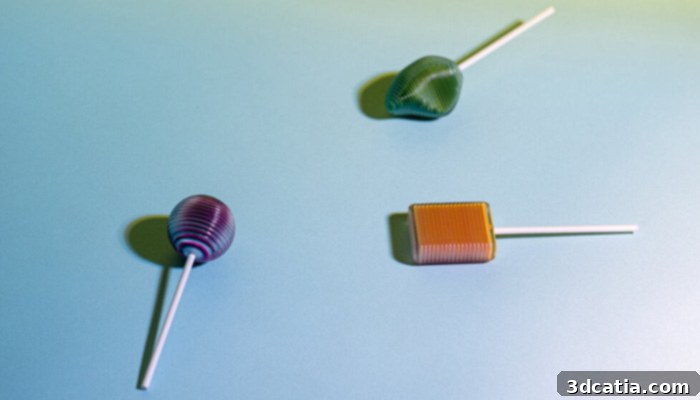
An innovative interactive multicolor lollipop, demonstrating how illusory materials can create engaging, dynamic visual effects that respond to touch or angle.
The Illusory Material project represents a significant leap forward in the capabilities of additive manufacturing and multi-material 3D printing. It not only showcases the artistic potential but also the functional advantages of embedding complex information directly into matter. What are your thoughts on this innovative project? Can you envision other groundbreaking applications for these illusory materials and dynamic design principles across various industries? We invite you to share your perspectives and creative ideas by leaving a comment in the section below. You can also join the conversation and connect with us on our social media channels, including our Facebook page and Twitter feed! For those eager to stay abreast of the latest developments and breakthroughs in the rapidly evolving world of 3D printing, we encourage you to sign up for our free weekly Newsletter and receive all the essential news straight to your inbox!