
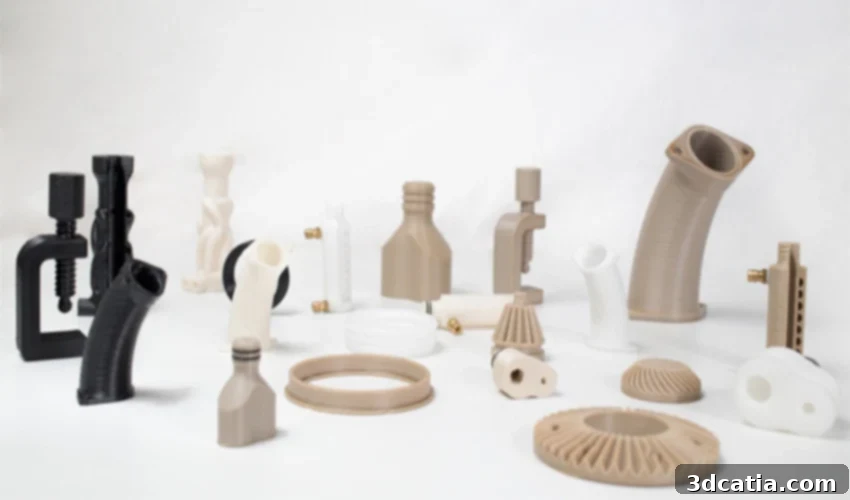
High-Performance Polymers in 3D Printing: A Comprehensive Guide to PAEK, PEI, PEEK, PEKK, and ULTEM
Over the past few years, the landscape of additive manufacturing has been significantly reshaped by the emergence and rapid growth of high-performance thermoplastics. These advanced materials, often referred to as HPPs, have become a widely discussed and highly sought-after topic in 3D printing due to their exceptional properties, making them indispensable for demanding industrial applications. Their unique combination of strength, lightweight characteristics, and resistance to extreme conditions makes them tremendously attractive, offering transformative possibilities across various sectors. This comprehensive guide delves into the world of high-performance polymers, focusing specifically on the Polyaryletherketone (PAEK) family and Polyetherimide (PEI), commonly known as ULTEM. We will explore their distinctive attributes, the intricacies of 3D printing with them, prominent manufacturers, and their impactful applications, providing everything you need to know about these groundbreaking materials.
Understanding High-Performance Polymers: Characteristics and Production
While all high-performance polymers share a common thread of superior properties, it is crucial to recognize that they are not monolithic. Each material within this class possesses a unique profile of characteristics that dictates its suitability for specific applications. However, generally speaking, high-performance thermoplastics, particularly those within the PAEK family like Polyether Ether Ketone (PEEK) and Polyetherketoneketone (PEKK), are renowned for their incredible strength-to-weight ratio. They are often cited as being as strong as steel but remarkably 80% lighter than metal, a property that makes them profoundly desirable in industries where weight reduction is paramount, such as aerospace and automotive. Beyond their mechanical prowess, PAEK materials exhibit exceptional thermal resistance, capable of continuous operation at temperatures up to 250 °C (482 °F), with some variants withstanding even higher intermittent peaks. Unlike many conventional plastics, PAEK materials are also highly resistant to dissolution in oils, fuels, and a wide array of other aggressive chemical substances, ensuring durability in harsh environments. Furthermore, in the event of fire, these materials demonstrate excellent flame retardancy, releasing minimal gas or noxious fumes, a critical safety advantage in enclosed or sensitive applications.
Despite their increasing prevalence in additive manufacturing today, their widespread adoption in 3D printing was initially slower compared to other, more common polymers. The truth is, high-performance polymers have been in existence for over three decades, primarily utilized through conventional manufacturing methods like injection molding or machining. The challenge for additive manufacturing lay in developing printers capable of handling the extreme temperatures required to melt and process PAEK and PEI polymers effectively. Historically, Stratasys was one of the pioneering companies that successfully developed printers capable of reaching the necessary processing temperatures. However, as the additive manufacturing market matured and technological barriers began to weaken, more companies recognized the immense potential of these materials. This led to a surge in research and development, culminating in the mass commercialization of specialized 3D printing systems. Today, we observe an accelerating trend of new manufacturers entering the field, continuously innovating and producing printers specifically designed to process high-performance PAEK thermoplastics and PEI, making these advanced materials more accessible than ever before.
Polyetherimide (PEI), another critical high-performance thermoplastic often known by its trade name ULTEM, boasts a fascinating history. It was initially developed by General Electric’s plastics department in the late 1980s. A significant shift occurred in 2007 when SABIC, one of Saudi Arabia’s largest public companies, acquired GE Plastics, thereby gaining the rights to the coveted ULTEM brand. From a financial perspective, PEI immediately garnered substantial interest as a more affordable, yet highly capable, alternative to PEEK. Its compelling physical properties include exceptional high heat resistance, excellent solvent resistance, impressive flame resistance (often meeting stringent aerospace flammability standards), superior dielectric strength, and notable thermal conductivity. These attributes collectively position ULTEM as an outstanding solution for a myriad of demanding engineering projects. Perhaps most notably, ULTEM has solidified its reputation as the preferred material for highly challenging engineering applications, particularly within the aerospace industry, where its balance of performance and cost-effectiveness provides a distinct advantage.
Photo Credits: ApiumTec
Mastering 3D Printing with High-Performance Polymers
The advanced properties of PAEK and PEI polymers necessitate specialized additive manufacturing techniques, primarily Fused Deposition Modeling (FDM) and Selective Laser Sintering (SLS). However, it is imperative to understand that processing these materials is far from ordinary. The high-temperature capabilities of these polymers directly translate to stringent requirements for the 3D printers used. A dedicated PAEK/PEI 3D printer must be equipped with an extruder nozzle capable of reaching and sustaining temperatures well over 300 °C (572 °F), as this is the minimum melting point required for proper extrusion and layer adhesion. Furthermore, the heated build plate is equally critical; it must be able to reach at least 150 °C (302 °F) to prevent warping and ensure optimal adhesion of the initial layers, allowing for successful part removal once printing is complete. Beyond these, a fully enclosed and actively heated build chamber is essential to maintain a stable, elevated ambient temperature around the printed part, crucial for controlling thermal stresses and preventing delamination. Finally, robust cooling mechanisms are required to ensure precise temperature management within the closed chamber, striking a delicate balance to achieve desired material properties and dimensional accuracy.
Post-processing is an integral and often challenging aspect of working with high-performance thermoplastics, particularly for FDM printed parts. As with most complex FDM geometries, support structures are typically indispensable during the printing process to prevent overhangs from collapsing. However, due to the inherent stiffness and mechanical strength of PAEK and PEI, removing these supports can be a significantly more challenging and time-consuming task compared to conventional plastics. The brittle nature of some support materials, combined with the toughness of the final object, often necessitates the use of a specialized selection of tools, ranging from pliers and scalpels to more advanced chemical dissolution baths, to meticulously finalize the part without damaging its intricate features. This intensive post-processing can add a considerable amount of time and labor to the overall production cycle, influencing cost and efficiency.
Photo Credits: ApiumTec
In contrast, when utilizing Selective Laser Sintering (SLS) for high-performance polymers, the need for auxiliary support structures is virtually eliminated. This is because the un-sintered powder bed itself acts as a natural support for the part during printing, allowing for the creation of incredibly complex geometries without the post-processing burden of support removal. However, SLS printing of PAEK and PEI introduces its own unique challenge: warping. After the sintering process is completed and the temperature within the build chamber gradually decreases, these polymers tend to undergo a noticeable reduction in size, which can lead to internal stresses and deformation if not properly managed. Consequently, PAEK and PEI have historically been most popular for printing smaller objects, where the warping effect is less pronounced. While optimizing key printing parameters such as laser power, scanning speed, and chamber temperature can significantly mitigate warping, it remains a critical factor to consider, especially when attempting to produce larger, high-precision components. Continuous research is focused on developing new algorithms and material formulations to minimize this challenge and expand the size capabilities of SLS for these materials.
It’s important to acknowledge that the utilization of high-performance thermoplastics in 3D printing, while highly advanced, is by no means a perfected science. There are ongoing efforts to refine various aspects of the manufacturing process, with new innovations constantly emerging to enhance the experience and expand capabilities. For instance, numerous companies are actively developing FDM solutions that incorporate dissolvable or breakaway support materials, allowing for quicker and cleaner removal once the printing has concluded. This addresses a significant pain point for many users and can drastically reduce post-processing time. Moreover, pioneering organizations like Kimya are focusing on offering sophisticated material combinations, leveraging the synergistic properties of multiple materials. This approach enables the creation of hybrid end products, for example, a composite material comprising 70% PEEK and 30% carbon fiber. Such composites not only enhance existing properties like strength and stiffness but also introduce new functionalities, opening doors to even more demanding applications that require tailor-made material solutions.
Transformative Applications Across Diverse Industries
As one would anticipate, a family of materials boasting such an extraordinary array of significant features finds invaluable utility across a vast spectrum of industries. The automotive sector, for example, has swiftly embraced the unique abilities of PAEK and PEI for a variety of critical applications. One of the areas where these materials have proven most disruptive is in the rapid, cost-effective production of tooling. This includes intricate injection molding tools, thermoforming molds, and highly precise jigs and fixtures. By enabling companies to produce low to medium volumes of parts at a significantly reduced cost, without the need for massive upfront investments in traditional tooling, HPPs facilitate agile manufacturing and rapid prototyping. Furthermore, the ability to produce highly customized parts is increasingly in demand. PAEK and PEI allow for components to be precisely altered to fit specific functional requirements, incorporating complex geometric changes that fundamentally enhance their structural integrity, performance, or even aesthetics. This level of customization is challenging and expensive to achieve with conventional manufacturing methods.
Following the trend of many other advanced 3D printing materials, the PAEK and PEI families are extensively employed within the medical field, where their biocompatibility and robust properties are paramount. PEEK, in particular, is famously utilized for its inertness and excellent radiolucency, making it ideal for the shielding of magnetic resonance imaging (MRI) devices, where metallic components would cause artifacts. More impressively, PEEK is recognized as an advanced biomaterial for permanent medical implants, including spinal fusion devices and reinforcement rods. Its ability to withstand repeated sterilization cycles involving boiling water and superheated steam (autoclaving) makes it perfectly suited for objects that must adhere to the most stringent hygiene standards. This biocompatibility, combined with its mechanical properties that closely mimic human bone, ensures long-term stability and patient safety, driving innovation in implantable medical devices.
Photo Credits: ApiumTec
High-performance thermoplastics are also experiencing widespread adoption in the highly regulated aerospace industry. Their superior chemical resistance, exceptional strength-to-weight ratio, and critical low Fire, Smoke, and Toxicity (FST) ratings make these polymers the ideal substitute for traditional metals that have long dominated spacecraft parts and tooling. By replacing heavier metallic components with HPP equivalents, aerospace engineers can achieve substantial weight reductions, often by as much as 70%, directly translating to significant fuel savings and increased payload capacity. Specific examples of components where PAEK and PEI are increasingly utilized include thermal acoustic insulations, structural brackets, clamps and stand-offs, various fasteners, electrical connectors, and complex tubing systems. The ability to customize these parts for specific aerodynamic or functional requirements, coupled with their resilience in extreme operational conditions, firmly establishes HPPs as key enablers for next-generation aerospace designs. Beyond these prominent examples, other industries profoundly disrupted by advanced thermoplastics include marine (due to corrosion resistance), nuclear (for radiation shielding and high-temperature applications), and the challenging oil & gas sector (for components exposed to corrosive chemicals and high pressures), among many others, all benefiting from their robust performance characteristics.
Leading Manufacturers and Material Pricing Insights
As one would anticipate, many of the world’s largest and most innovative chemical companies have keenly observed the transformative shift occurring with high-performance thermoplastics in the additive manufacturing sector. Consequently, it is no surprise to encounter prominent names like Arkema, Lehmann & Voss, and Solvay—among others—when discussing the leading producers of PAEK materials. These companies invest heavily in R&D to continually refine and expand their portfolios of high-performance polymers, offering various grades and formulations tailored for specific 3D printing processes and applications. However, in the realm of PEI, the ULTEM brand, originating from SABIC, currently holds a near-monopoly, being the primary and most recognized source of this versatile polymer filament on the market. This consolidated supply chain for PEI highlights its unique historical development and the strategic acquisitions that have shaped its commercial availability.
The advanced nature of these materials also demands specialized 3D printing equipment. In terms of printers capable of reliably processing PAEK and PEI, several manufacturers have distinguished themselves. The Chinese manufacturer INTAMSYS has garnered significant attention for its comprehensive range of professional and desktop 3D printers meticulously engineered for high-performance polymers, offering accessible solutions for various industrial needs. Concurrently, the Dutch company Tractus3D is rapidly gaining popularity, known for its robust and precise large-format HPP printers. Not to be outdone, the German additive manufacturing giant EOS recently introduced a new High-Temperature Laser Sintering (HTLS) printer specifically designed to handle these demanding materials, further expanding the capabilities of SLS for industrial-scale production of PAEK and PEI parts. These manufacturers are at the forefront of developing the necessary hardware infrastructure to unlock the full potential of high-performance thermoplastics in additive manufacturing.
Photo Credits: ApiumTec
However, as one might reasonably expect, the superior performance of these advanced polymers comes with a higher price tag. PEEK, ULTEM (PEI), and PEKK are consistently ranked among the most expensive 3D printing materials available on the market. While ULTEM generally offers a slightly more economical alternative compared to PEEK or PEKK, a 1 kg spool of this high-performance filament typically starts at over $200 and can often cost considerably more, depending on the brand, specific grade, and specialized properties (e.g., carbon fiber filled). PEEK, meanwhile, is significantly more premium, frequently costing upwards of $300 and reaching over $700 for a 1 kg spool of material. PEKK, another high-performance variant, usually averages between $400 and $500 for the same quantity. These elevated costs reflect the complex synthesis processes, stringent quality control, and specialized processing required to produce these high-grade materials, along with their unparalleled performance characteristics.
The investment doesn’t stop at the material itself. If you are keen on leveraging these advanced filaments, it is crucial to understand that they cannot be processed by just any 3D printer. As previously emphasized, you must invest in a machine specifically designed and optimized to handle high-performance polymers, featuring specialized heating elements, robust extruders, and precise temperature control. These specialized printers are, understandably, also significantly more expensive than entry-level FDM models. Many professional-grade HPP printers start over $5,000, with industrial systems often reaching tens or even hundreds of thousands of dollars. Despite these substantial initial investments, the industry has observed a positive trend over the years: as the market for high-performance polymer 3D printing expands, so do the choices available to consumers and businesses. It is a reasonable expectation that in the near future, we will see a gradual reduction in prices for both specialized printers and the materials themselves, as manufacturing efficiencies improve and applications for high-performance polymers become even more widespread and integrated into mainstream additive manufacturing workflows.
What are your thoughts on the evolving role of high-performance thermoplastic polymers in 3D printing? Do you foresee other industries being significantly disrupted by these materials in the near future? We invite you to share your insights and comments below, or connect with us on our Facebook and Twitter pages! Don’t miss out on the latest advancements; make sure to sign up for our free weekly Newsletter, delivering all the essential 3D printing news directly to your inbox!
*Cover Photo Credits: ApiumTec