
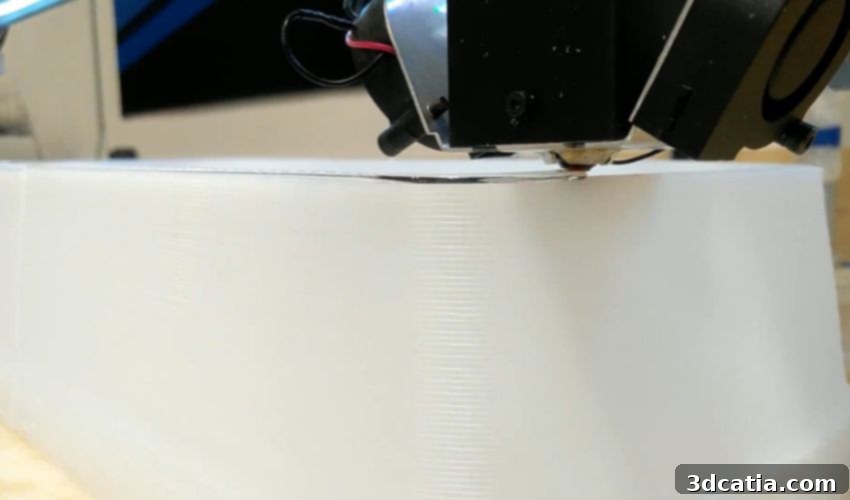
The landscape of 3D printing is experiencing unprecedented growth, with advancements continually pushing the boundaries of what’s possible. As 3D printers themselves become increasingly reliable, precise, and significantly faster, the focus has naturally shifted to core components such as extruders, hotends, and nozzles. These elements, once standard, are now recognized as critical limiting factors that determine a printer’s ultimate capabilities and throughput. In this evolving market, Canadian innovator Dyze Design has emerged as a leader, committed to delivering cutting-edge solutions tailored for a diverse array of machines. The company has meticulously engineered a suite of high-performance extruders, prominently featuring their acclaimed Pulsar and Typhoon models, which span the spectrum from standard FFF (Fused Filament Fabrication) desktop units to advanced professional pellet-based systems. By providing state-of-the-art, high-speed printheads equipped with sophisticated anti-leakage mechanisms, Dyze Design’s overarching goal is to guarantee a 3D printing process that is not only exceptionally fast but also highly accurate and consistently repeatable across FDM applications. To delve deeper into these innovations, we recently had the opportunity to speak with Xavier Geremia, Sales Representative & Account Manager at Dyze Design. Our conversation explored the intricate world of high-speed 3D printing and the transformative impact of pellet-based extrusion in today’s additive manufacturing ecosystem.
Introducing Dyze Design: A Powerhouse in 3D Printing Components
Dyze Design is a dynamic, Montreal-based company that stands at the forefront of innovation in additive manufacturing. Our core business revolves around the development, manufacturing, and marketing of specialized components for 3D printers. This includes a comprehensive range of products, with a primary focus on advanced heating heads, robust extruders, precision sensors, and various other accessories crucial for the accurate control of raw material supply and deposition. Our fundamental mission, which serves as the driving force behind all our endeavors, is to “empower people to create tools and things they need, where and when they want.” We fulfill this mission by tirelessly developing and refining products that dramatically enhance the reliability, versatility, and overall usability of 3D printers. A key aspect of this commitment involves enabling the seamless printing of a broader spectrum of materials, thereby unlocking new applications and possibilities for our users.

Beyond its acclaimed extruders, Dyze Design offers a diverse array of essential accessories, such as this high-precision filament sensor (photo credits: Dyze Design)
In essence, Dyze Design aspires to become the “Intel Inside” of the 3D printing industry. Our strategic vision is to solidify our position as the preeminent supplier of extrusion systems for all printers that operate on the principle of material extrusion (MEX). This focus extends particularly to the very high-throughput industrial applications, catering to both advanced manufacturing sectors and robotics. By providing the foundational extrusion technology, we aim to be an indispensable partner for companies seeking robust, reliable, and high-performance additive manufacturing solutions that can meet the rigorous demands of modern industrial production.
Filament vs. Granule: Understanding Market Dynamics and Applications in 3D Printing
The 3D printing market has historically been dominated by filament-based systems, a trend significantly bolstered by the widespread adoption of FDM technology, particularly through the influential RepRap movement. This has led to filament becoming the standard raw material for both consumer-grade and many industrial 3D printers. However, the use of plastic pellets, while relatively new to the additive manufacturing scene, is a long-established and common practice in the broader plastics industry, especially in high-volume processes like injection molding. This distinction highlights a crucial shift. While filament remains prevalent, the advantages offered by pellets are increasingly compelling, particularly for specific niches within 3D printing. These benefits become especially pronounced when considering large-format printing applications and those requiring exceptionally high extrusion rates. The introduction of raw plastic pellets into 3D printing offers a promising pathway to overcome some of the inherent limitations of filament, paving the way for more cost-effective, material-flexible, and scalable additive manufacturing solutions.
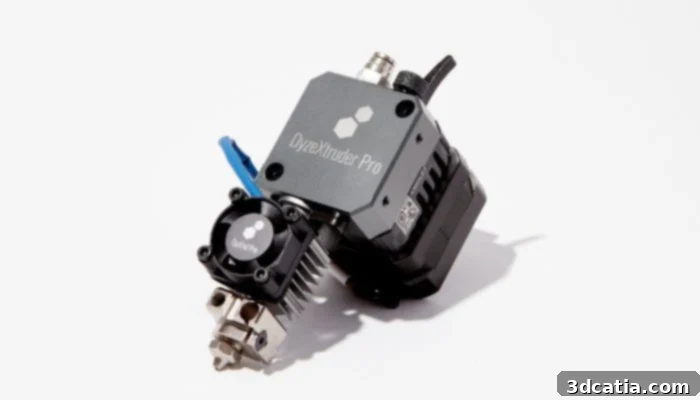
Pellet-based 3D printing is gaining traction in industrial applications (Photo Credits: Dyze Design)
Unlocking Efficiency: The Advantages of Granules in Additive Manufacturing
The transition to pellet 3D printing presents a multitude of significant advantages, particularly when juxtaposed with traditional filament-based systems. Foremost among these is the dramatic reduction in material cost. On average, plastic pellets are 3 to 4 times more affordable than an equivalent amount of filament. This cost efficiency is a game-changer, especially for industrial applications that demand high material consumption. For instance, Dyze Design’s Pulsar extruder, engineered for very large industrial high-speed printers, boasts an impressive extrusion rate of 2.5 kilograms of material per hour. Such high throughput, when combined with the lower cost of pellets, translates into substantial operational savings over time. Furthermore, the logistical challenges associated with filament spools, particularly those exceeding 1 kilogram, are a notable constraint. High-flow filament systems, like our Typhoon, necessitate frequent spool changes, disrupting continuous operations. Pellets, on the other hand, can be fed in much larger bulk quantities, allowing for extended, uninterrupted printing cycles.
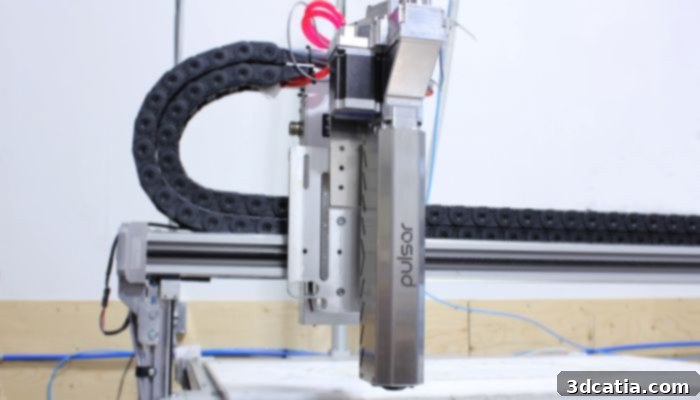
The Pulsar, a flagship product from Dyze Design, exemplifies a high-speed pellet extruder designed for industrial demands (photo credits: Dyze Design)
Beyond cost, pellets offer a more ecological and flexible solution that resonates deeply with industrialists and manufacturers. The ability to produce your own pellets, particularly from recycled materials (often referred to as “repro”), significantly reduces waste and promotes circular economy principles within manufacturing processes. This environmental benefit aligns with growing corporate sustainability objectives. Finally, and perhaps most critically for advanced applications, pelletizing provides unparalleled flexibility in material selection. A wide range of high-performance polymers, which due to their inherent properties cannot be reliably processed into filament form, can still be readily extruded as pellets. This opens up entirely new possibilities for creating parts with specialized mechanical, thermal, or chemical characteristics, expanding the material palette available for additive manufacturing far beyond the limitations of conventional filament offerings. This flexibility allows industries to utilize materials perfectly suited for their specific application, unconstrained by format restrictions.
Essential Precautions When Utilizing Granules in 3D Printing
While the advantages of pellet 3D printing are clear, certain precautions are essential to ensure optimal print quality and machine performance. Many of these considerations are similar to those for filament, but with heightened importance, particularly regarding moisture sensitivity. Pellets, due to their increased surface area relative to their volume compared to a spooled filament, are often more susceptible to absorbing ambient moisture. This moisture can cause significant print defects, including bubbling, delamination, inconsistent extrusion, and even nozzle clogs, leading to failed prints. Therefore, it is paramount to store certain types of hygroscopic materials (such as nylon, PETG, or ABS) in carefully controlled, moisture-free environments. This typically involves using sealed containers equipped with effective drying agents, such as desiccant packets or automated dehumidifiers, to maintain very low humidity levels. Proper moisture management is unequivocally the number one factor in preventing print failures and ensuring consistent material flow.
Furthermore, for efficient and continuous operation, especially in industrial settings, it is highly advisable to implement a robust granule delivery system. Manually refilling the extruder’s hopper can be tedious, labor-intensive, and introduces potential for contamination or inconsistent feeding. Automated delivery systems, which can continuously supply pellets from a bulk container to the extruder, ensure an uninterrupted material flow, crucial for large-scale and long-duration prints. Such systems not only reduce manual intervention but also enhance overall print reliability and consistency, making pellet printing a truly streamlined process for manufacturing environments. Neglecting these precautions can severely undermine the benefits offered by pellet extrusion technology.
The Transformative Advantages of Dyze Design’s High-Speed Extruders
In recent years, the 3D printing industry has witnessed a pronounced trend towards accelerating printer speeds, with many manufacturers boasting impressive travel rates around 300mm/s or even higher. While rapid printer movement is certainly beneficial, its true impact on print time is significantly limited if the extrusion system cannot keep pace. A high-speed printer with an inadequate extrusion rate is akin to a race car with a restricted fuel line – its potential remains untapped. This is precisely where Dyze Design’s high-speed extruders offer a distinct advantage. Our systems are engineered to overcome this bottleneck, ensuring that the printer can consistently extrude material at rates commensurate with its travel speed.
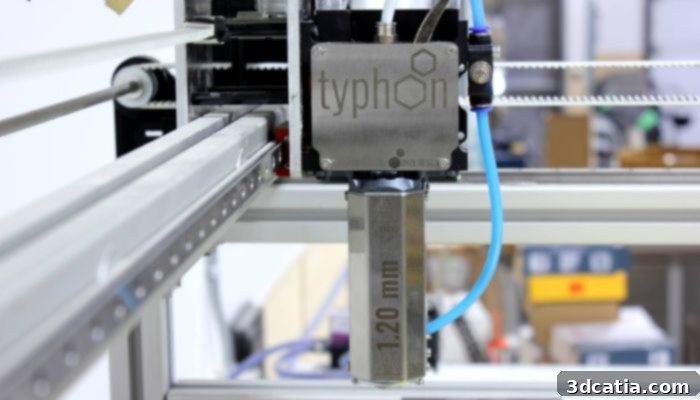
The Dyze Design Typhoon extruder is engineered to enable exceptionally fast filament-based printing, optimizing throughput (photo credits: Dyze Design)
A high-speed extrusion system, even when integrated into a printer operating at medium travel speeds, can dramatically reduce overall printing time. This is because such systems are capable of depositing significantly more material per second. This capacity becomes even more impactful when combined with larger nozzle diameters, a common practice in high-speed, large-format printing. By using bigger nozzles, printers can lay down wider and thicker lines and layers, covering a greater area with each pass. This combination of increased material flow and larger deposition characteristics is ideal for rapidly manufacturing substantial parts on the increasingly popular large-format printers from brands like BigRep, Modix, and 3D Platform. Dyze Design’s extruders effectively transform these high-speed printers from mere fast-moving machines into true high-throughput production workhorses, making large-scale additive manufacturing faster and more economically viable.
Key Precautions for Operating High-Speed Extruders Effectively
Employing high-speed extruders, while immensely beneficial for increasing throughput, introduces a unique set of considerations that must be addressed to ensure successful and high-quality prints. The most significant challenge arises from the sheer volume of molten material being deposited rapidly. In high-speed and especially large-format printing, parts have an increased propensity to warp. This phenomenon occurs because each newly extruded layer does not have sufficient time to cool and solidify adequately before the next hot layer is deposited. This can lead to internal stresses and deformation of the printed part. To mitigate this, an effective active cooling system is not just recommended, but absolutely critical. Such systems help manage the thermal dynamics of the print, allowing layers to cool consistently and reduce internal stresses. Beyond cooling, adopting a robust “Design for Additive Manufacturing” (DfAM) approach is essential. This involves carefully considering the geometry and structure of the part to ensure that layers are well-supported by those beneath them, maximizing adhesion and minimizing warpage potential.
A common inherent disadvantage found in many high-speed pellet extrusion systems is their limitation to printing predominantly in “vase mode.” This is due to the nature of screw extrusion principles, where material flow can be difficult to precisely stop or retract, leading to persistent oozing or leaking during non-printing movements (retractions or travels). This oozing makes multi-part printing or complex geometries requiring frequent toolpath changes problematic, often resulting in stringing or blobs on the print surface. However, Dyze Design has engineered a breakthrough solution for this challenge with our Pulsar extruder. The Pulsar incorporates an innovative anti-leakage system directly integrated into its nozzle. This proprietary technology effectively halts material flow when commanded, allowing for clean, precise movements in X and Y axes. Consequently, the Pulsar is not restricted to vase mode and can confidently execute multi-part prints, complex geometries, and intricate designs without the typical oozing issues, significantly expanding the versatility and application range of high-speed pellet printing.
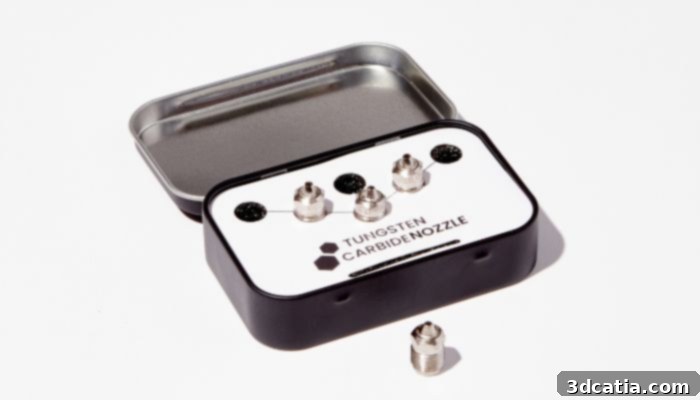
Dyze Design is dedicated to developing and marketing its own high-performance nozzles, ensuring seamless integration and superior print quality (photo credits: Dyze Design)
What Sets Dyze Design’s Extruders and Hotends Apart in the Market?
In today’s dynamic 3D printing landscape, specialists in extrusion technology are increasingly offering products that are not only exceptionally reliable but also highly adaptable to the diverse and demanding constraints faced by users. This trend is a testament to the surging interest in additive manufacturing and highlights the industry’s agility in responding to new challenges and evolving requirements within a booming market. Dyze Design proudly positions itself within this paradigm, offering products that are recognized as very high-end and are meticulously engineered to meet the sophisticated needs of industrial users and those with advanced manufacturing and engineering challenges. Our commitment to excellence is reflected in the superior design and construction of our extruders and hotends.
Our extruders are constructed entirely from 100% metal, a choice that confers unparalleled durability and resilience, enabling them to withstand severe shocks and vibrations often encountered in industrial environments. This robust construction ensures long-term reliability and consistent performance. Furthermore, our systems are designed to reach extrusion temperatures of up to 500°C. This exceptional thermal capability allows for the seamless printing of virtually any polymer available on the market, including high-performance engineering plastics and composites that demand extreme processing temperatures. Beyond the heated zone, our systems are built to operate reliably in elevated ambient temperatures, capable of enduring hot environments up to approximately 80°C. This makes them perfectly suited for integration into enclosed, heated build chambers, common in industrial printers that process advanced materials requiring controlled thermal conditions. The combination of reliability and durability means our products consistently deliver peak performance even under the most rigorous operating conditions.
Another cornerstone of our philosophy is the commitment to offering products that thrive in an open-source environment. We believe in empowering each user to integrate our components seamlessly into their existing ecosystem, providing them with the flexibility and control to tailor their 3D printing setup precisely to their unique needs and challenges. This open approach fosters innovation and expands the possibilities for customization and integration. Finally, a significant differentiator for Dyze Design is our vertically integrated production process. Almost all the critical components for our high-speed industrial extruders, the Typhoon and the Pulsar, are directly designed and precision-machined by our in-house production team at our Montreal facility. This hands-on approach to manufacturing allows us to maintain the highest possible quality control standards, ensuring every part meets our stringent specifications. Moreover, it grants us exceptional agility and responsiveness, enabling us to quickly adapt to specific customer requirements and address any constraints with rapid iterations and superior support. To explore our innovative solutions further, please visit our website HERE.
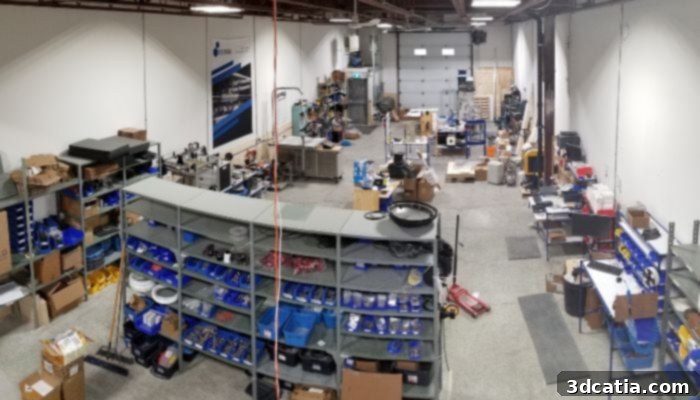
Dyze Design prides itself on manufacturing the majority of its products in-house at its Montreal facility, ensuring superior quality control and rapid response to market needs (photo credits: Dyze Design)
What are your thoughts on the innovative solutions offered by Dyze Design? Share your insights in a comment below or connect with us on our LinkedIn, Facebook, and Twitter pages! Don’t miss out on the latest 3D printing news; sign up for our free weekly Newsletter here, delivered straight to your inbox! You can also find all our engaging videos and content on our YouTube channel.