
Revolutionizing Industrial 3D Printing: Stratasys and DyeMansion Unveil Production-Scale Reference Architecture
The additive manufacturing (AM) industry is characterized by relentless innovation and continuous advancement. This dynamic nature has once again been underscored by Stratasys and DyeMansion, two leading innovators in the 3D printing ecosystem. Following their respective recent announcements of groundbreaking new machines and solutions, these industry titans have now revealed a strategic collaboration aimed at defining the future of production-scale additive manufacturing. DyeMansion, a premier provider of post-processing solutions for industrial polymer 3D printing, captivated the industry in March with the unveiling of its cutting-edge Powershot Performance Series, featuring three innovative new machines. Not to be outdone, Stratasys made waves just last week by presenting three new high-end polymer 3D printing solutions: the Stratasys H350™ 3D printer, the Stratasys Origin One, and the Stratasys F770™ 3D printer. This powerful synergy between two established industry leaders is now set to culminate in the creation of a definitive reference architecture, designed to streamline and optimize additive manufacturing processes for true production scalability. To delve deeper into the implications of this exciting partnership, we had the privilege of sitting down with DyeMansion co-founder and CEO, Felix Ewald, for an insightful conversation.
A Partnership Forged for Clarity and Efficiency in Additive Manufacturing
The genesis of this strategic collaboration began in the spring of last year, when Stratasys embarked on a proactive search for a robust partner in the crucial post-processing sector. Recognizing the intricate interplay between printing technology and final part quality, Stratasys understood the necessity of an integrated, end-to-end solution. By the fall of 2021, after a series of successful joint tests validating various processes and technologies, the formal partnership between Stratasys and DyeMansion was solidified. A critical aspect of this alliance is its global reach; DyeMansion’s established presence, including a branch in East India and a vast network of worldwide partners and resellers, perfectly complements Stratasys’s expansive market footprint. This ensures that the jointly developed reference architecture will be accessible and supported across diverse geographical regions.
The primary objective of this co-created reference architecture is to illuminate concrete possibilities for the additive series production of functional end-use parts. In an industry often perceived as complex and fragmented, this initiative aims to demystify the adoption process and significantly simplify purchasing decisions for businesses considering 3D printing. The sheer breadth of choices available today can be overwhelming: which 3D printer aligns best with specific needs? What processes are truly viable for production? Which materials are compatible with particular printers? And critically, what post-processing methods are essential for various 3D printing technologies to achieve desired part properties? These questions often leave companies and individuals grappling with uncertainty. Stratasys and DyeMansion are addressing this very challenge head-on by providing a clear, comprehensive framework. Felix Ewald elaborates on this vision, stating, “It’s about creating transparency. It’s about the customer knowing, ‘What do I get and what does it cost me?’ – Without having to show 100,000 options.” The ultimate goal is to present customers with clear, validated workflows that outline precise outcomes and associated costs, eliminating guesswork and accelerating adoption.
Unlocking New Possibilities: Cost Savings, Customization, and Complex Geometries
Beyond simplifying the purchasing journey, the reference architecture brings forth a host of special features that redefine the value proposition of additive manufacturing. In the long term, AM inherently offers significant cost savings by mitigating the need for extensive supply chains, reducing inventory, and enabling rapid, on-demand manufacturing closer to the point of need. This agility translates directly into economic advantages, especially for small-batch or highly customized production runs. Furthermore, AM excels in producing incredibly complex structures, such as intricate shoe soles or biomedical implants, which are simply unattainable through conventional manufacturing methods. The design freedom afforded by 3D printing opens up new frontiers for product innovation and functional optimization.
The true power of this collaboration becomes even more pronounced when considering individualized series production. The integrated 3D printing solutions from Stratasys and DyeMansion are engineered to deliver unparalleled reproducibility at competitive prices, making bespoke products scalable. Felix Ewald highlights the exemplary case of the Swiss eyewear manufacturer Götti. He explains that Götti “now offers well over 50 models in 12 different colors in 3 different standard sizes [as well as] the option to customize the whole thing.” Additive manufacturing empowers Götti to process an individualized pair of glasses, from order to production-ready, within a single week. This level of mass customization, offering an expansive range of variants and personalized options, would be logistically and economically unfeasible with traditional manufacturing processes. It underscores the transformative potential of AM for consumer goods, healthcare, and beyond.
Integrated Workflow: From Print to Perfect Product with SAF™ Technology
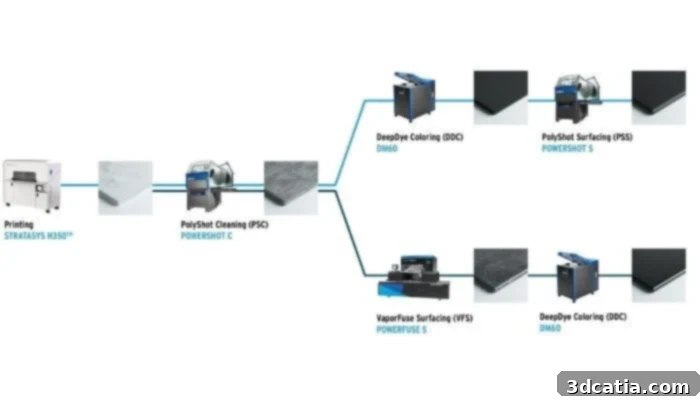
At the core of this innovative architecture lies the powerful synergy between Stratasys’s new H Series™ Production Platform and DyeMansion’s industry-leading Print-to-Product post-processing platform. This integrated workflow ensures a seamless journey from digital design to a high-quality finished part. A prime example within this framework is the Stratasys H350 printer, which leverages the revolutionary SAF™ technology. This technology offers unprecedented control and consistency for the efficient production of thousands of parts, ensuring superior thermal uniformity and part quality across the build platform. Once an object is printed, the next critical step involves thoroughly cleaning the part from its powder bed. This is expertly handled by DyeMansion’s Powershot C, a state-of-the-art cleaning solution designed for maximum efficiency and minimal material waste.
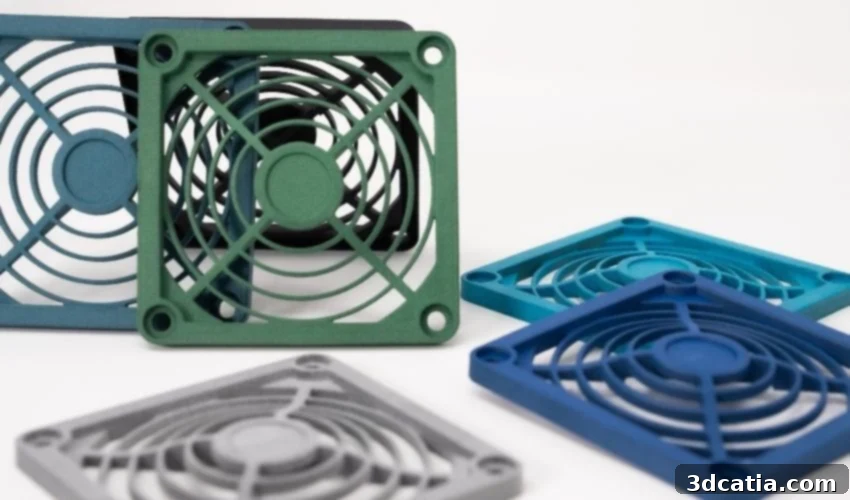
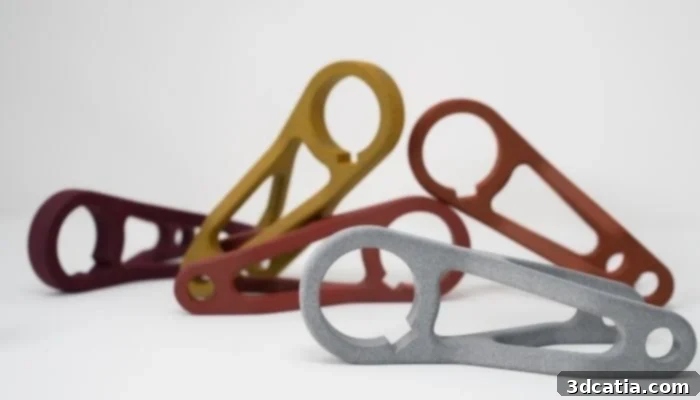
After the initial cleaning, users gain significant flexibility. They can then seamlessly transfer the part into subsequent DyeMansion machines for advanced surface treatment and precision coloring. This modular approach allows for tailored finishes depending on application requirements, whether it’s achieving a smooth, injection-molded like surface, enhancing mechanical properties, or applying vibrant, consistent colors for branding or functional differentiation. This end-to-end integration is a testament to the comprehensive nature of the reference architecture, ensuring that every step, from printing to final finish, is optimized for industrial production.
Driving Sustainability and Innovation in Additive Manufacturing
A fundamental pillar of this collaborative project is a strong commitment to sustainability, an increasingly critical factor in modern manufacturing. CEO Felix Ewald underscored the paramount importance of two major components in their approach. Firstly, the use of PA11 for 3D printing with the Stratasys machine. PA11 is a unique, high-performance bio-based polyamide derived from renewable castor seeds. This material choice significantly reduces the environmental footprint associated with traditional fossil-fuel-based polymers, aligning with global efforts towards greener manufacturing. Secondly, the collaboration emphasizes the use of non-hazardous solvents within the post-processing machines. This is a crucial advancement, as many conventional post-processing methods rely on toxic chemicals to achieve optimal part smoothing and surface finishes. By employing safer, non-hazardous alternatives, Stratasys and DyeMansion are not only protecting the environment but also enhancing workplace safety for operators, setting a new standard for responsible manufacturing practices in the additive industry.
Global Reach and Future Vision for Additive Manufacturing
Looking ahead, Stratasys and DyeMansion are poised to leverage their extensive global networks to make their comprehensive, end-to-end solutions available to a worldwide audience. This strategic deployment will democratize access to advanced additive manufacturing capabilities, enabling more businesses across diverse sectors to capitalize on the benefits of industrial 3D printing. Furthermore, to continually enhance and complement the reference architecture, both companies are actively developing a joint go-to-market strategy. This collaborative approach will ensure that customers receive tailored solutions for a wide array of applications, supported by expert guidance and seamless integration.
The process chain itself is not static; it is designed to be continuously updated and enriched with new cutting-edge technology emerging from both Stratasys and DyeMansion. This commitment to ongoing innovation ensures that the reference architecture remains at the forefront of additive manufacturing capabilities, adapting to evolving industry demands and technological advancements. The future holds immense promise for this partnership, and we eagerly anticipate the further developments and breakthroughs that will undoubtedly emerge from this exciting collaboration. For those interested in exploring DyeMansion’s offerings in greater detail, further information can be found by clicking HERE.
The partnership between Stratasys and DyeMansion represents a significant milestone in the journey towards fully industrialized additive manufacturing. By providing a clear, efficient, and sustainable pathway from digital design to final product, their reference architecture is set to empower businesses worldwide to embrace the transformative potential of 3D printing for production at scale. This alliance is not just about integrating machines; it’s about integrating visions to build a more transparent, efficient, and sustainable future for manufacturing.
What are your thoughts on DyeMansion and Stratasys’ Reference Architecture and its potential impact on industrial 3D printing? We invite you to share your insights in a comment below or engage with us on ourFacebook,Twitter andLinkedIn pages! Don’t miss out on the latest 3D printing news and innovations – sign up for our free weeklyNewsletter here, delivered straight to your inbox!
*All image credits: DyeMansion