
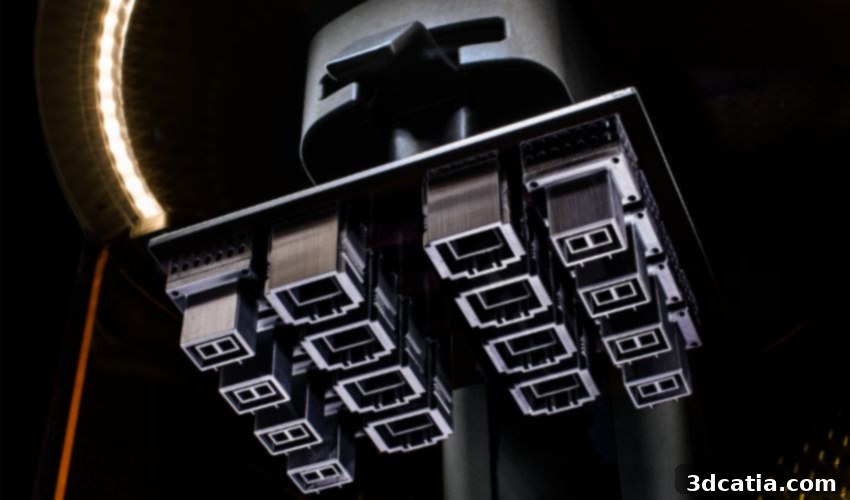
Protolabs and Carbon DLS: Pioneering Additive Manufacturing for Aerospace Innovation
Protolabs has long been a frontrunner in the manufacturing industry, consistently pushing the boundaries of what’s possible. Beyond mastering traditional production processes such as injection molding and CNC machining, the company stands as a recognized expert in additive manufacturing, leveraging a diverse portfolio of advanced technologies. From processing robust metals to high-performance polymers, Protolabs serves a wide array of sectors, with aerospace emerging as a pivotal market for 3D technologies. While additive manufacturing initially found its strongest foothold in prototyping, the industry has witnessed a significant shift towards the production of end-use parts. Protolabs is at the forefront of this evolution, particularly excelling with Carbon’s innovative resin process, Digital Light Synthesis (DLS). While some might question the suitability of resin technology for the demanding aerospace sector, Protolabs decisively demonstrates its profound advantages. To delve deeper into this, we engaged in an insightful discussion with Dr. Philipp Amend, Director Operations PZB & Director Engineering 3DP at Protolabs.
3DN: Could you briefly introduce yourself and Protolabs?

Philipp Amend
Hello, my name is Philipp Amend, and I oversee 3D printing production at Protolabs’ Putzbrunn (PZB) site in Germany. Our mission at Protolabs is to empower our customers throughout their manufacturing projects. We collaborate closely with them to pinpoint the most effective production method, whether it’s state-of-the-art 3D printing, precision CNC machining, or robust injection molding. This comprehensive approach ensures that we provide the optimal solution for every stage of a product’s life cycle, always with a sharp focus on customer needs and product specifications.
Among our advanced manufacturing capabilities, we are proud to host Carbon solutions, including a large-scale Carbon L1 3D printer. This powerful machine allows us to produce a vast number of small, intricate parts as well as larger components, with dimensions up to 300 mm. While Carbon’s Digital Light Synthesis (DLS) technology has traditionally been recognized for its exceptional capabilities with elastomer materials, we have expanded its application significantly. We are now uniquely positioned in the market to print rigid, high-performance parts—from minute details to substantial components—for full-scale production. This capability is particularly transformative and holds immense interest for the aerospace industry, where precision, material integrity, and scalability are paramount.
3DN: Why is Carbon’s DLS process uniquely suited to the aerospace market?
Carbon’s Digital Light Synthesis (DLS) technology offers a multitude of compelling advantages that make it exceptionally well-suited for the rigorous demands of the aerospace sector. Firstly, it delivers unparalleled high resolution, allowing for the creation of incredibly intricate geometries and fine details essential for complex aerospace components. This is coupled with remarkable design flexibility, empowering engineers to push the boundaries of innovation and create optimized structures that would be impossible with traditional manufacturing methods. Furthermore, DLS ensures the production of fully-dense parts, which is critical for structural integrity and performance, complemented by an excellent surface finish that often reduces the need for extensive post-processing.
Aerospace applications inherently demand materials that can withstand extreme conditions, necessitating high-performance resins. Carbon addresses this critical need by offering a portfolio of specialized resins that are rigorously tested, validated, and specifically developed for production in regulated industries. Crucially, these materials come with all the necessary certification and extensive documentation, a non-negotiable requirement for aerospace components. This aspect presents a significant advantage over conventional stereolithography (SLA), where such comprehensive documentation for production applications in regulated industries is almost non-existent. Moreover, traditional SLA resins often fall short in terms of UV stability and long-term durability, properties which are absolutely vital for parts exposed to the harsh environments of aerospace operations. Carbon DLS, therefore, provides not just a manufacturing process, but a complete solution engineered for reliability and compliance.
3DN: Could you give us some application examples?
We have seen excellent results with parts printed on Carbon DLS machines for aerospace applications. A prime example is a Flow Distribution Unit, meticulously designed for advanced fluid and airflow management within aircraft systems. Carbon’s DLS technology proved instrumental here, enabling the creation of highly optimized internal circuits that efficiently convey fluids and gases. It also facilitated the integration of lightweight, high-performance cooling channels, designed with intricate geometries impossible to achieve with traditional methods. The final component is fully dense and leak-proof for both gas and liquid, notably approved for hydrogen flow, and significantly lighter than its conventionally manufactured counterparts. Printed with Carbon’s EPX 82 resin, this part exhibits exceptional strength and rigidity, boasting a tensile strength of approximately 82 MPa, alongside excellent heat resistance, maintaining integrity at 125°C at 0.45 MPa. This not only enhances performance but also contributes to overall fuel efficiency and operational longevity.
Another compelling application is a sophisticated battery holder, engineered to securely store and actively cool battery components. This particular project highlighted DLS’s efficiency in material utilization, resulting in minimal waste generation and an impressive material yield of 75%. Such efficiency is crucial in aerospace, where material costs are significant and sustainability initiatives are gaining traction.
More broadly, Carbon DLS technology empowers us to design and produce a range of superior aerospace components. This includes lighter, higher-performance ducts and structural elements for drones, which can achieve extended flight times and increased payload capacities. We also produce extremely heat-resistant and more durable satellite components, vital for enduring the extreme thermal cycling and radiation in space. Furthermore, the speed and accuracy of DLS allow us to rapidly 3D print functional structural prototypes, accelerating the development cycles for new aerospace designs and bringing innovative concepts to market much faster than ever before.
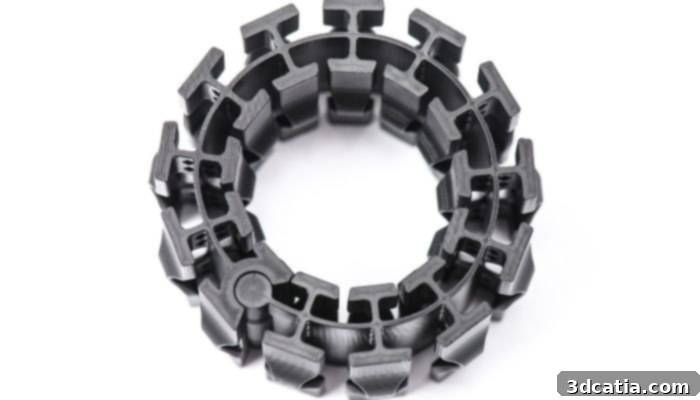
DLS 3D printing technology is ideal for aerospace parts
3DN: How do you see the impact of Carbon’s DLS process on the aerospace industry’s overall manufacturing strategy and supply chain?
The impact of the DLS process on the aerospace industry’s manufacturing strategy and supply chain is profound and multifaceted. I foresee several transformative effects:
- Firstly, DLS significantly accelerates innovation through rapid prototyping and enables true on-demand production, eliminating the need for costly and time-consuming tooling. This flexibility allows for numerous design iterations to be easily handled and implemented, drastically reducing development cycles and fostering a more agile approach to engineering and product development. Aerospace companies can now test and refine designs with unprecedented speed, gaining a substantial competitive edge.
- Secondly, it dramatically reduces manufacturing lead times from several weeks or even months—typical for traditional methods—to just a few days. This newfound speed grants manufacturers unparalleled flexibility, allowing them to adapt their production schedules efficiently to market demands, unforeseen challenges, or supply chain disruptions. This shift leads to reduced inventory holding costs and a more responsive supply chain.
- The technology reduces costs in a multitude of ways. Beyond reducing material waste inherent in subtractive manufacturing, DLS offers significant lightweighting opportunities through the creation of complex lattice structures or internal channels, leading to lower fuel consumption in flight. Furthermore, the elimination of expensive tooling, reduced labor for assembly due to part consolidation, and enhanced supply chain resilience all contribute to substantial cost savings across the product lifecycle.
- Crucially, we can integrate multiple functions into a single part. The ability to create complex, consolidated designs reduces the need for numerous individual components and their associated fasteners or welds. This not only significantly lowers assembly costs and time but also improves overall reliability by reducing potential points of failure, which is paramount in safety-critical aerospace applications.
- Last but not least, DLS technology ensures consistent print quality and repeatability, making it viable for both small-scale specialized production and large-scale manufacturing runs. This consistency is essential for meeting stringent aerospace standards and enables manufacturers to confidently scale production without compromising on part integrity or performance.
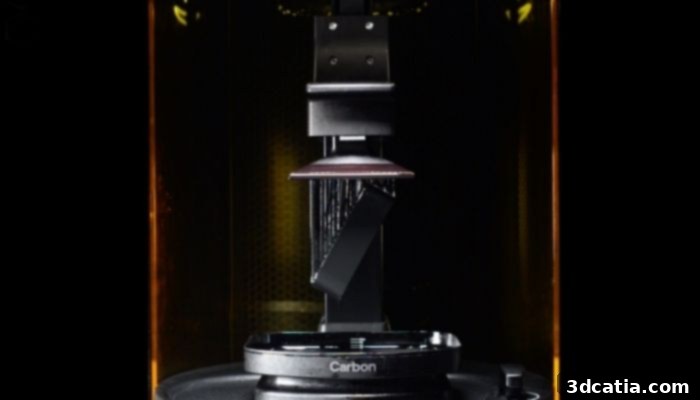
The DLS technology has a strong impact on the aerospace industry
3DN: Why choose Protolabs to design parts for the aerospace industry?
Choosing Protolabs for designing and producing parts for the aerospace industry means partnering with a company dedicated to your success. One of the key factors contributing to the triumph of any project, especially in a sector as critical as aerospace, is proactive and collaborative engagement with our customers. We prioritize gathering all specific requirements, meticulously managing expectations, and then leveraging our extensive expertise to identify and implement the best possible manufacturing solution. This collaborative approach ensures that the final product not only meets but often exceeds the most stringent aerospace standards.
At Protolabs, we have a specialized Customer Production Success (CPS) team. This dedicated team provides continuous support to our customers throughout the entire product life cycle, from initial concept to final production and beyond. They act as a crucial interface, ensuring seamless communication and problem-solving, always striving to find the optimal solution tailored to each unique challenge. Furthermore, our engineers at Protolabs possess profound expertise in optimizing designs specifically for the Carbon DLS process. This optimization focuses on several critical aspects: maximizing performance, ensuring cost-effectiveness, and guaranteeing superior manufacturability. We transform innovative designs into tangible, high-quality aerospace components that leverage the full potential of DLS technology, ensuring both efficiency and excellence.
3DN: Any last words for our readers?
Our strong and close collaboration with Carbon is a cornerstone of our success. This partnership is absolutely essential, allowing us to remain at the cutting edge of materials science and process development within additive manufacturing. Our deep expertise in 3D printing empowers us to continually push the boundaries, transitioning seamlessly from rapid prototyping to full-scale production of highly complex, high-performance parts. We invite you to contact us to discover how Protolabs and Carbon DLS can transform your aerospace manufacturing projects. We are ready to help you innovate and achieve your most ambitious goals.
What are your thoughts on the transformative use of Carbon’s DLS technology for the aerospace sector? We encourage you to share your insights and comments below, or engage with us on our LinkedIn, Facebook, and Twitter pages! Don’t forget to sign up for our free weekly Newsletter here to receive the latest 3D printing news directly in your inbox! You can also find all our engaging videos on our YouTube channel. For more in-depth 3D printing news specifically within the aerospace and defense sectors, be sure to explore our dedicated page HERE.
*Photo Credits: Carbon