
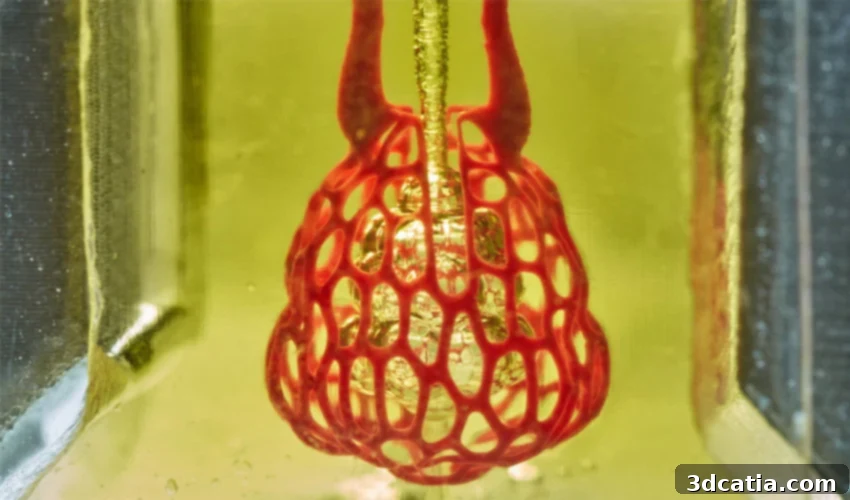
Revolutionizing Regenerative Medicine: 3D Printed Organs and Intricate Vascular Networks
The pioneering generative design studio, Nervous System, has achieved a monumental milestone in the field of bioengineering through its collaboration on groundbreaking 3D printed organ research, prominently featured on the cover of Science Magazine. This esteemed studio has consistently operated at the fascinating intersection of science, art, and technology – three disciplines inherently intertwined and mutually reinforcing. Their innovative approach involves leveraging sophisticated computer simulations to generate designs inspired by the complex patterns found in nature, which are then brought to life through advanced digital fabrication techniques. For the past three years, as revealed on their official blog, Nervous System has been diligently working alongside Jordan Miller, a distinguished bioengineer at Rice University. Their collective ambition has been to develop intricate vascular networks, a critical component for the successful creation of viable 3D printed organs. This pivotal research, which garnered the prestigious cover story in Science Magazine, was spearheaded by Jordan Miller at Rice University and Kelly Stevens at the University of Washington, benefiting from the invaluable contributions of a diverse team of 13 additional collaborators, highlighting the interdisciplinary nature of modern scientific breakthroughs.

Science, 03 May 2019: Vol. 364, Issue 6439, pp. 458-464 | Credits: Science Magazine
The genesis of this impactful partnership can be traced back to 2016. Jordan Miller was profoundly captivated by Nervous System’s acclaimed ‘growing objects’ exhibit, a mesmerizing display of branching sculptures that mimicked natural growth patterns. Recognizing the inherent scalability and adaptability of the skills employed to create such intricately structured forms, Nervous System quickly grasped the potential for applying these principles to a vastly different, yet equally complex, scientific domain. As explained by the studio, “He [Jordan Miller] proposed that our skills could be put to an epic task: ‘Perhaps we could work together to make open-source software that the world could use to design synthetic living tissues and organ replacements for human patients’”. This visionary proposition marked the inception of a collaborative endeavor, uniting the studio’s unparalleled generative design capabilities with the urgent need to create functional, living biological structures, setting the stage for a paradigm shift in regenerative medicine. The ambition was not merely to replicate nature’s forms but to harness its underlying algorithms to engineer viable biological solutions.
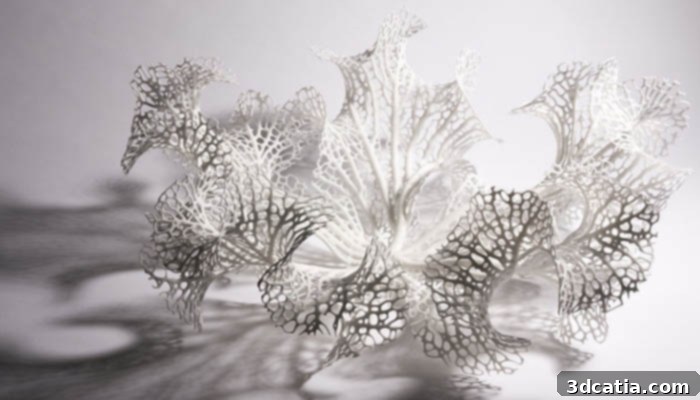
The hyphae crispata 1 from the ‘Growing Objects’ exhibition that inspired Jordan Miller | Credits: Nervous System
While numerous advanced laboratories around the globe are making significant strides in creating artificial tissues, a pervasive and formidable challenge remains: ensuring the long-term viability and survival of these engineered structures. The fundamental issue lies in adequately feeding and supporting the billions of cells that constitute these tissues. Much like natural organs, artificial tissues require intricate and extensive vascular networks to function properly. These networks are indispensable for the continuous supply of vital nutrients and oxygen to every cell, while simultaneously facilitating the efficient removal of metabolic waste products. Without such a robust circulatory system, artificial tissues are unable to sustain themselves and rapidly deteriorate. Addressing this critical bottleneck, Nervous System has embarked on a mission to develop sophisticated software. This revolutionary tool is designed to empower scientists with the ability to precisely design highly customized, multi-vascular structures specifically tailored for 3D printed organs. This innovative approach aims to overcome the limitations of current bioprinting techniques, which often struggle to replicate the complex vascularization found in natural tissues. In a remarkable demonstration of their collaborative prowess, the design studio, working hand-in-hand with the Miller Lab, successfully designed and fabricated complex multi-vascular networks. These intricate structures were masterfully materialized within soft hydrogels, marking a significant leap forward in the quest to engineer functional, living organ replacements.
3D Printing Vascular Networks: A New Era in Tissue Engineering
The Miller Lab’s contribution to this groundbreaking research has been instrumental, focusing on the development of cutting-edge bioengineering principles, advanced 3D printing technology, and refined cell-culturing techniques, all meticulously engineered to transform complex designs into tangible biological structures. At the heart of their innovation lies the creation of the SLATE (Stereolithography Apparatus for Tissue Engineering) 3D printer. This bespoke printer represents a significant leap forward in bioprinting capabilities, uniquely designed to precisely inject living cells into soft hydrogels. What makes this particularly remarkable is the printer’s ability to create incredibly small and intricate blood vessel networks within these gels, mimicking the delicate vascularization found in natural biological systems. As articulated in Nervous System’s blog, “Hydrogels printed in only minutes by SLATE can function as lung-like networks with entangled air/blood networks. This new printing method allows for new and dramatic architectural freedoms in the living tissues we can design and fabricate. Bioengineers don’t have tools at their disposal to generate these complex architectures that are crucially needed to keep living tissues alive.” This statement underscores the profound impact of the SLATE printer, enabling the rapid creation of functional biological structures that were previously unattainable, thereby addressing a critical need in regenerative medicine and significantly advancing the feasibility of creating complex, living tissues.
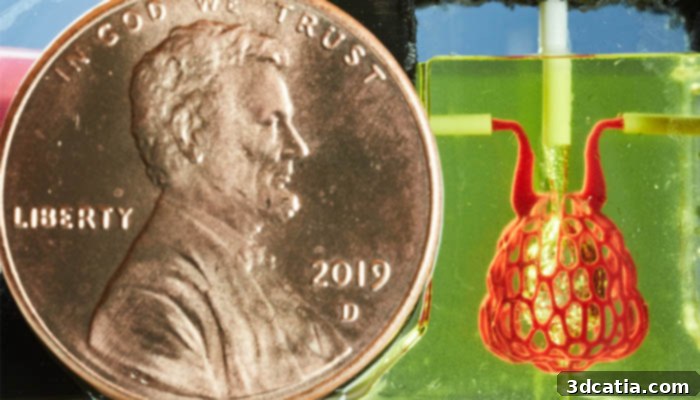
Credits: Jordan Miller – Rice University
The sophisticated software developed through this collaboration plays a crucial role in the entire process, serving as the brain behind the intricate biological designs. This innovative software is engineered to generate “entangled vessel networks within any user-defined volume and connect these networks to inlets and outlets so air and blood can flow through the intertwined networks.” This level of control allows researchers to custom-design the exact vascular architecture required for specific tissue types or organ replacements, ensuring optimal functionality. The precision achieved is astounding, with the individual vessels created being incredibly narrow, measuring only 300 microns wide – a dimension comparable to the smallest capillaries in the human body. While the initial tests have focused on smaller, yet functionally critical, structures – for instance, alveolar subunits, which are fundamental to lung function, were successfully printed and rigorously tested – the long-term vision is much more expansive. The next phase of research will involve scaling up these designs to create much larger, more complex networks, testing their efficiency and assessing their potential as full-scale lung replacements or components for other vital organs. This progression from micro-scale precision to macro-scale application is a testament to the ambitious nature of the project. However, the journey from design conceptualization to tangible fabrication presents its own unique set of challenges. As one of the researchers candidly admitted, “It took us three days to generate the lung-mimicking architecture but it took about a year until it was possible to fabricate it.” This statement highlights the significant hurdles in translating advanced biological designs into physical reality, emphasizing the ongoing need for advancements in both software and hardware for 3D bioprinting. Overcoming these fabrication challenges is key to unlocking the full potential of this revolutionary technology in clinical applications.
The profound implications of this research extend far beyond the laboratory, promising to reshape the future of regenerative medicine, organ transplantation, and even drug discovery. By enabling the creation of complex, vascularized tissues, this technology could reduce the reliance on animal testing for new pharmaceuticals, allowing for more accurate human-specific drug efficacy and toxicity studies. Furthermore, it brings us closer to a future where patient-specific organs could be 3D printed on demand, dramatically reducing transplant waiting lists and eliminating the risk of immune rejection. The collaborative spirit, particularly the open-source ethos proposed by Jordan Miller for the software, suggests a future where this powerful design tool could be accessible to researchers worldwide, accelerating innovation across the biomedical landscape. Nervous System expresses immense gratitude and enthusiasm for their involvement in such a groundbreaking endeavor. As stated on their blog, “We feel very lucky to have had the chance to participate in this ground breaking research and are excited to keep working with Jordan Miller and his team on this project going forward.” This sentiment reflects the shared commitment to pushing the boundaries of what is possible in bioengineering and generative design. For those interested in delving deeper into the specifics of this remarkable work, the full text of Nervous System’s blog post can be accessed HERE, and the comprehensive research paper itself is available through Science Magazine’s portal HERE. These resources provide an invaluable opportunity to explore the technical details and the broader scientific context of this pioneering achievement, offering insights into the methodologies and future directions of advanced bioprinting and tissue engineering.
What are your thoughts on this incredible new research and its potential to transform healthcare? We’d love to hear your perspective! Let us know in a comment below or join the conversation on our Facebook and Twitter pages. Stay informed about all the latest advancements in 3D printing and related fields by signing up for our free weekly Newsletter, delivered straight to your inbox with curated news and updates!