
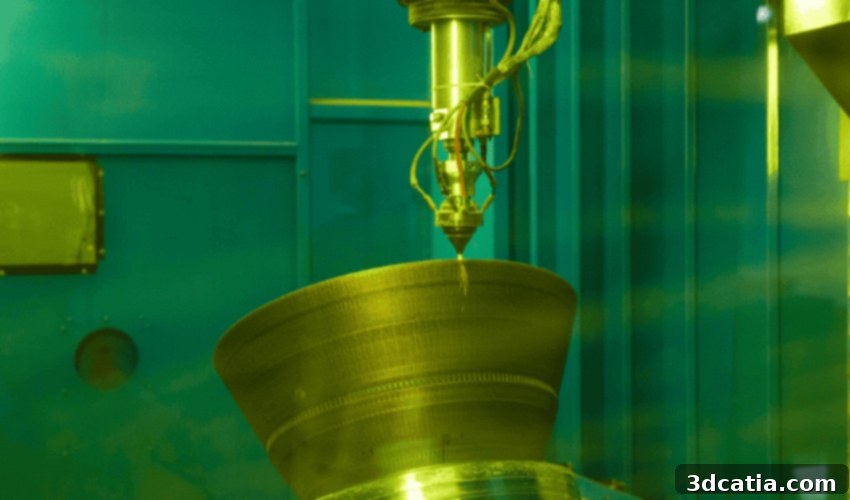
Pioneering Space Propulsion: How DED Additive Manufacturing and Inconel® are Revolutionizing Rocket Nozzle Production
The aerospace sector stands at the forefront of technological innovation, constantly seeking advancements to enhance performance, reliability, and cost-efficiency. Within this dynamic landscape, additive manufacturing (AM), often known as 3D printing, has emerged as a truly transformative force. It has profoundly reshaped the entire lifecycle of aerospace component development, from initial design and rigorous testing to final production. This paradigm shift offers not only significantly reduced production times but also enables the creation of parts with unparalleled characteristics, pushing the boundaries of what’s possible in flight and space exploration.
In a remarkable demonstration of this potential, SAB Aerospace has successfully developed the first demonstration model of one of its cutting-edge rocket nozzles. This groundbreaking achievement was made possible through the innovative application of Prima Additive’s DED (Directed Energy Deposition) technology. This collaboration signifies a major leap forward, promising to redefine the manufacturing of critical components for future space missions and rocket propulsion systems.
Embodying Prima Additive’s inspiring philosophy, “Crafting the Future of Space One Layer at a Time,” this advanced nozzle design represents more than just a component; it’s a testament to a new era in space mission conduct. Rocket nozzles are unequivocally an essential and highly critical part of any propulsion engine. Their primary function is to efficiently channel the extremely hot, high-pressure gases generated during fuel combustion, converting thermal energy into kinetic energy to produce thrust. The integration of DED technology brings a monumental improvement to the entire nozzle manufacturing process. What used to be an incredibly complex, labor-intensive, and often time-consuming endeavor involving numerous individual parts and intricate assembly steps is now significantly more streamlined and efficient thanks to this innovative additive manufacturing method. The question naturally arises: why specifically choose DED technology for such a demanding application?
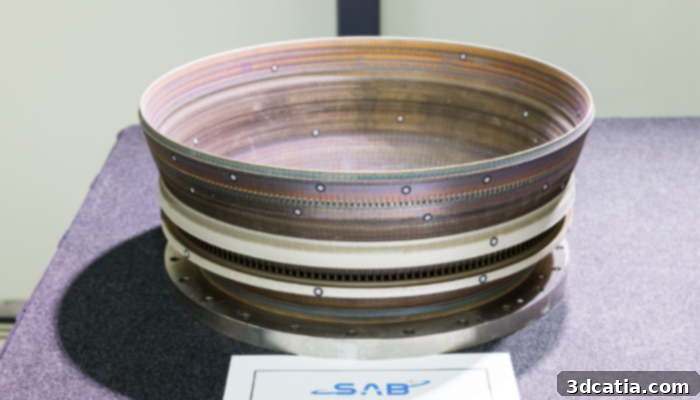
SAB Aerospace Leverages Inconel® and DED 3D Printing for Advanced Rocket Nozzles
SAB Aerospace’s strategic adoption of DED technology is rooted in its inherent ability to simplify the manufacturing of large, high-performance metal parts, which are commonplace in the aerospace industry. Unlike powder bed fusion processes such as Selective Laser Sintering (SLS) or material extrusion methods like Fused Deposition Modeling (FDM), which typically require a closed processing chamber and are inherently limited by its internal dimensions, DED offers unparalleled freedom. This ground-breaking technology enables the production of impressively large components without being constrained by the physical size of the machine’s build envelope, making it ideal for the scale often required by rocket components.
Directed Energy Deposition (DED) operates by melting a material – typically metal wire or powder – with a focused energy source, such as a laser or electron beam, as it is deposited onto a substrate. This process allows for precise control over the material’s microstructure and density, creating fully dense parts with superior mechanical properties. The capability to add material onto existing structures also opens doors for repair and customization, offering significant advantages over traditional manufacturing techniques that often involve subtractive methods and extensive post-processing for large components. The high deposition rates of DED further contribute to its efficiency, making it suitable for manufacturing components like rocket nozzles that demand both size and structural integrity.
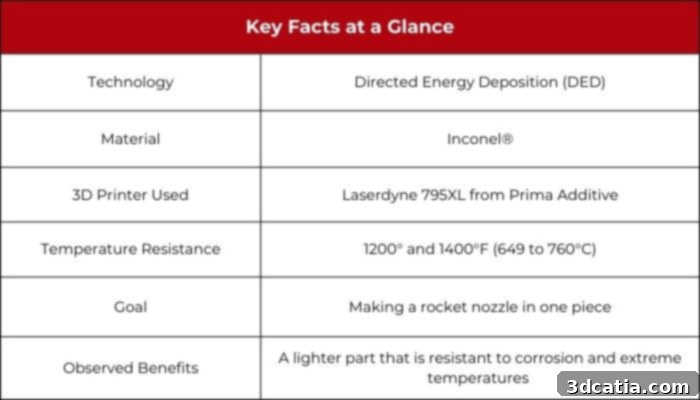
For the intricate and demanding task of manufacturing this rocket nozzle, SAB Aerospace has deployed Prima Additive’s state-of-the-art Laserdyne 795XL metal printer. This industrial-grade machine is specifically engineered with DED technology at its core, boasting an impressive manufacturing volume that exceeds one cubic meter. Such capabilities are crucial for producing the large, highly complex parts essential for aerospace applications. The Laserdyne 795XL combines exceptional speed, pinpoint precision, and remarkable efficiency, allowing for the creation of components that would be virtually impossible or economically unfeasible through conventional means.
Traditionally, the manufacturing of a rocket nozzle is a monumental feat of engineering, often requiring the laborious assembly of thousands of individual parts, each meticulously machined, welded, and inspected. This process is not only incredibly time-consuming but also introduces potential points of failure at every joint and weld. However, thanks to the transformative power of DED 3D printing, SAB Aerospace can now manufacture this entire complex nozzle as a single, monolithic piece. This radical simplification of the design and manufacturing process drastically reduces both lead times and overall production costs, while simultaneously enhancing the structural integrity and performance of the final component. This shift from multi-part assembly to single-piece fabrication is a game-changer for aerospace manufacturing, opening new avenues for design optimization and rapid iteration.
The choice of material is as critical as the manufacturing process itself, particularly for components operating under extreme conditions like rocket nozzles. SAB Aerospace has opted for Inconel®, a superalloy renowned for its exceptional strength and resilience. This nickel-based superalloy, meticulously alloyed with chromium and iron, is a registered trademark of Special Metals Corporation and represents the pinnacle of high-performance materials. The use of Inconel® enables the production of a rocket nozzle that is not only significantly lighter but also demonstrably more efficient than those manufactured using conventional alloys and methods. This weight reduction is an absolutely essential factor for long-distance space missions, where every gram saved translates directly into reduced launch costs and increased payload capacity. In the relentless pursuit of space exploration, optimizing the weight of every single component is paramount for mission success and efficiency.
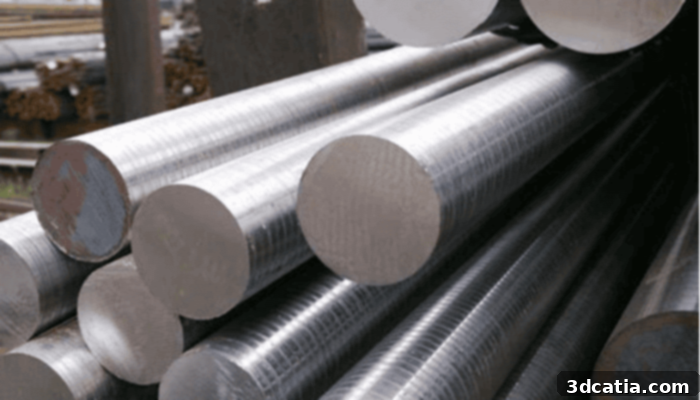
Inconel® material
Beyond its impressive strength-to-weight ratio, Inconel® is highly valued in the demanding aerospace sector for a suite of other critical properties. These include its outstanding resistance to corrosion, especially from aggressive propellants and exhaust gases, and its remarkable ability to withstand extreme variations in temperature and pressure. These properties are not merely beneficial; they are absolutely essential for any material used in the harsh vacuum and fiery environment of space. The specific metallurgical composition of Inconel® allows it to maintain its structural integrity and mechanical properties even when exposed to environments that would cause conventional alloys to deform, degrade, or fail. Its superior thermal properties mean Inconel® can endure temperatures up to 40% higher than many traditional high-temperature alloys, providing an unparalleled safety margin and performance envelope for rocket propulsion systems.
Indeed, Inconel® excels in the most challenging high-temperature environments. While it demonstrates exceptional performance between 500° to 600°F (260° and 316°C), its true strength lies in its ability to withstand even more extreme temperatures, ranging from 1200° to 1400°F (649° to 760°C) and even higher for short durations. These capabilities are crucial for rocket nozzles, which must endure the incandescent heat of combustion products at thousands of degrees. By strategically choosing DED 3D printing as the manufacturing technology and adopting these latest-generation superalloys like Inconel®, pioneering initiatives such as SAB Aerospace’s are actively paving the way for groundbreaking advances across the entire space industry. This combination of advanced material and manufacturing technique allows for designs that were previously theoretical to become a tangible reality.
A particularly innovative feature integrated into the SAB Aerospace nozzle is the inclusion of internal micro-channels directly within its structure. These intricate channels are not merely aesthetic; they provide a sophisticated thermal regulation system crucial for preventing the risk of catastrophic overheating, even under the most extreme propulsion conditions. This regenerative cooling system works by circulating a cryogenic fuel or oxidizer through these channels before it enters the combustion chamber. As the coolant flows, it absorbs heat from the nozzle walls, effectively cooling the structure while simultaneously preheating the propellant, thereby increasing engine efficiency. The ability of DED 3D printing to create such complex, internal geometries in a single, homogeneous part is a testament to its revolutionary potential, offering an engineering solution that would be extraordinarily difficult, if not impossible, to achieve with traditional manufacturing methods. This advanced thermal management significantly extends the nozzle’s operational lifespan and enhances overall engine reliability, critical factors for long-duration space missions.
The fusion of Directed Energy Deposition with high-performance materials like Inconel®, as demonstrated by SAB Aerospace and Prima Additive, signifies a pivotal moment for the future of space propulsion. This approach not only streamlines manufacturing but also unlocks new possibilities for design optimization, enabling engineers to create lighter, stronger, and more efficient components. As the demand for space exploration and commercial satellite deployment continues to grow, such innovative manufacturing techniques will be instrumental in making space access more affordable and reliable. This advancement underscores the critical role of additive manufacturing in shaping the next generation of rockets and spacecraft, pushing humanity further into the cosmos.
What are your thoughts on the groundbreaking use of DED technology for manufacturing rocket nozzles and its broader implications for space exploration? We invite you to share your insights and opinions in a comment below or join the conversation on our LinkedIn, Facebook, and Twitter pages! Don’t miss out on the latest advancements in additive manufacturing—remember to sign up for our free weekly Newsletter here, delivering the freshest 3D printing news straight to your inbox! You can also find all our compelling videos and interviews on our YouTube channel, offering deeper dives into the world of 3D printing innovation.
*All Photo Credits: SAB Aerospace