

3D Printed CORAL Capsule: Revolutionizing Small Intestine Microbiome Research and Diagnostics
The human gut microbiome represents an incredibly intricate and dynamic ecosystem, housing trillions of bacteria, viruses, fungi, and other microorganisms primarily within the intestines. This diverse community, uniquely shaped by an individual’s diet, lifestyle, geographical location, and environmental exposures, plays a pivotal role in maintaining overall health. Its profound interactions extend beyond mere digestion, deeply influencing the immune system, nervous system (the gut-brain axis), and endocrine system. However, despite growing recognition of its importance, many of these complex relationships remain only partially understood, largely due to the challenges in accessing specific regions of the gastrointestinal tract for comprehensive sampling. Addressing this critical research gap, a pioneering team from NYU Abu Dhabi has developed an innovative 3D printed capsule known as CORAL (Cellularly Organized Repeating Lattice). This state-of-the-art device is specifically engineered to passively collect microbial samples directly from the small intestine as it navigates the digestive tract, offering an unprecedented tool for researchers to delve deeper into how the small intestine microbiome profoundly influences human health and disease.
Traditional gut microbiome studies have predominantly relied on analyzing fecal samples. While valuable for understanding the microbial composition of the large intestine, this method provides a limited and often skewed view of the entire gastrointestinal ecosystem. The small intestine, a crucial site for nutrient absorption and host-microbe interactions, has largely remained an underexplored frontier in microbiome research due to the technical difficulties and invasive nature of conventional sampling methods like endoscopy. The NYU Abu Dhabi team recognized this significant limitation and targeted the small intestine for their research, acknowledging its vital role in metabolism, immunity, and overall physiological balance. As co-author Hanan Mohammed eloquently articulated, “The bacterial communities throughout the gut profoundly influence immunity, metabolism, aging, and overall health. CORAL’s potential lies in enabling earlier disease detection, tracking how therapies are working, and ultimately developing new microbiome-based treatments that restore balance where it’s lost.” This highlights CORAL’s promise not just for fundamental research but also for transforming clinical diagnostics and personalized therapeutic strategies by providing a more complete picture of the gut’s microbial landscape.
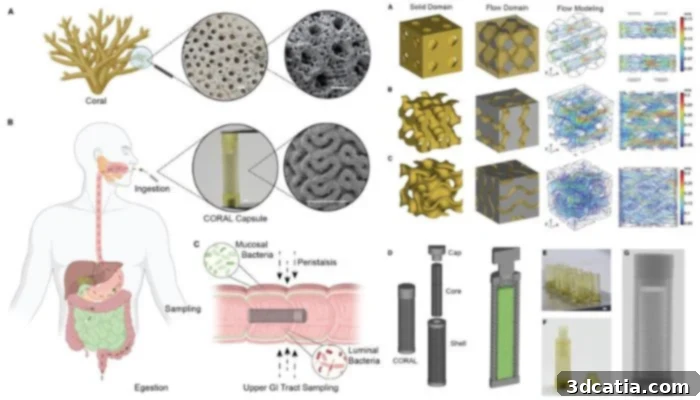
Conceptual design of the CORAL capsule for microbial sampling in the small intestine (left) and design and fabrication of CORAL capsules (right)
CORAL: Biomimicry and the Ingenuity of Marine Corals
The design philosophy behind the CORAL capsule draws profound inspiration from the natural world, specifically from marine corals. These magnificent underwater structures are renowned for their highly porous architecture, which serves as a natural habitat supporting incredibly diverse and thriving microbial ecosystems. Mimicking this biological marvel, the CORAL capsule is crafted from an inert, biocompatible resin and features a sophisticated texture reminiscent of its marine counterparts. This biomimetic design is not merely aesthetic; the porous, intricate structure significantly increases the capsule’s surface area, making it exceptionally effective at passively capturing and retaining microbial samples as it traverses the small intestine. The research team meticulously engineered a geometric Triply Periodic Minimal Surface (TPMS) pattern for CORAL, a complex three-dimensional scaffold specifically optimized to maximize microbial trapping efficiency.
The realization of this intricate, coral-inspired design was made possible only through the transformative capabilities of 3D printing, also known as additive manufacturing. Traditional manufacturing techniques would simply be incapable of producing such microscale structures with the required precision and complexity. As noted in the study, “Fabricating microscale TPMS-based structures is a challenge. However, recent advancements in additive manufacturing (3D printing) have enabled the production of intricate, self-supporting TPMS architectures at nanoscale resolutions.” This highlights how cutting-edge 3D printing technology is essential for pushing the boundaries of medical device innovation, allowing researchers to create highly functional and miniaturized tools that can perform specialized tasks within the human body. The ability to precisely control the internal geometry and surface characteristics at a microscopic level is what gives CORAL its unique sampling capabilities, marking a significant leap forward in targeted gut microbiome research.
Advanced Fabrication: Unpacking CORAL’s Multi-Component Design and PμSL Technology
The CORAL capsule is ingeniously composed of three distinct yet interconnected components: an external shell, an internal core, and a cap that securely encloses the core prior to retrieval. This thoughtful, multi-part design serves a critical purpose: to effectively isolate the microbial contents sampled from the small intestine from any subsequent contamination or alteration by microbial communities encountered further down the gastrointestinal tract, particularly in the large intestine. This ensures the integrity and specificity of the collected small intestine microbiome sample, providing researchers with accurate and reliable data that was previously unobtainable through less targeted methods. The careful engineering of these components highlights the meticulous attention to detail required for precision medical diagnostics.
Remarkably, despite its complex multi-component architecture and microscopic features, the CORAL capsule was fabricated in a single, streamlined additive manufacturing step. The NYU Abu Dhabi team utilized projection micro stereolithography (PμSL), a sophisticated 3D printing technology, employing a machine from Boston MicroFab. PμSL is a high-resolution vat photopolymerization technique that uses a digital micromirror device (DMD) to project UV light patterns onto a photopolymer resin, curing it layer by layer to build highly precise and intricate structures. This advanced method is particularly suited for creating objects with sub-micron features, making it ideal for the delicate TPMS patterns and the overall miniaturization required for the CORAL capsule. Measuring a mere 2.1 mm in diameter and 8.2 mm in length (including its cap), the capsule is designed for easy swallowing and passage through the digestive system, ensuring patient comfort and compliance.
The use of PμSL for single-step fabrication offers substantial advantages in terms of both efficiency and cost. By eliminating the need for multiple manufacturing stages or assembly processes, it significantly reduces production time and expenses, making this passive sampling method highly attractive for scalability. This cost-effectiveness and rapid production capability are crucial for enabling larger clinical studies and, eventually, widespread clinical adoption. Furthermore, the precision offered by PμSL ensures consistent quality and reproducibility of the capsules, which is paramount for reliable scientific research and diagnostic applications. The integration of cutting-edge 3D printing techniques like PμSL is undeniably paving the way for a new generation of sophisticated, patient-friendly, and highly effective medical devices.
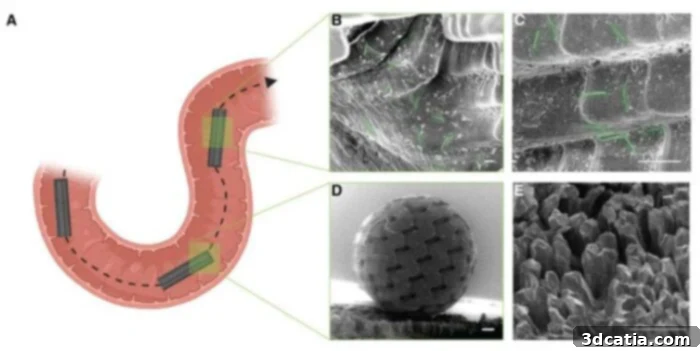
Schematic showing CORAL core capsule passing through an ex vivo section of small intestinal tissue (left) and SEM images of the capsule capturing bacteria (right)
Operation and Promising Results: Unveiling Hidden Microbial Insights
The operational mechanism of the CORAL capsule is elegantly simple, designed for maximum patient convenience and minimal invasiveness. Once swallowed, the capsule embarks on a natural journey through the gastrointestinal tract. As it passively travels through the small intestine, its intricately designed porous surface, inspired by marine corals, gently captures and retains microbial communities present in that specific environment. There are no active components or power sources required within the capsule itself, ensuring a straightforward and safe passage. After completing its journey, the capsule is naturally excreted with stool. Researchers can then easily retrieve the intact capsule and proceed with advanced genetic and microbial analysis to identify and characterize the previously elusive small intestine microbiome.
The NYU Abu Dhabi team rigorously tested the CORAL capsule in both ex vivo settings, using isolated animal tissues, and in vivo animal models, specifically live rats. These comprehensive tests were critical to validate the capsule’s safety, efficacy, and ability to traverse the digestive system without complications. The results were highly encouraging: in all conducted tests, the capsule passed safely through the body, demonstrating its excellent biocompatibility and non-toxic nature, further underscoring its potential for human use. More importantly, subsequent genetic analysis of the retrieved capsules yielded groundbreaking findings. CORAL successfully collected microbial communities that are consistently missed by conventional fecal sampling methods, including notable genera such as Streptococcus, Enterococcus, and Curtobacterium. The presence and specific ratios of these microorganisms in the small intestine could offer crucial insights into various digestive conditions, metabolic disorders, and immune system responses, providing a more localized and accurate understanding of gut health than ever before possible.
Future Impact: Transforming Diagnostics and Personalized Treatment Strategies
The simple yet highly effective design of CORAL was a deliberate choice, intended to minimize potential failure points and maximize its overall utility and reliability in both research and clinical settings. This robust functionality is a key factor in accelerating its path from laboratory innovation to practical application. The research team is now poised to embark on patient trials, a critical next step that will evaluate CORAL’s performance, safety, and diagnostic potential in human subjects. These trials are anticipated to usher in a new era of non-invasive diagnostics for a wide range of gastrointestinal conditions, potentially revolutionizing how we detect, monitor, and treat diseases related to the small intestine microbiome.
As co-author Aashish Jha passionately concluded, “We see CORAL as a transformative tool for unlocking parts of the gut that have long been inaccessible. In research, it will allow scientists to study microbial communities in the small intestine with unprecedented detail. Clinically, we envision it supporting non-invasive diagnostics and personalized treatment strategies for gut-related conditions.” This encapsulates the profound impact CORAL is expected to have. For researchers, it offers the ability to conduct studies with unparalleled resolution, unraveling the complex interactions of specific microbial populations within the small intestine and their link to health and disease. For clinicians and patients, CORAL holds the promise of non-invasive, early detection of conditions like Small Intestinal Bacterial Overgrowth (SIBO), inflammatory bowel disease (IBD) affecting the small intestine, and other functional gut disorders, without the need for cumbersome and invasive procedures like endoscopy or biopsies. Furthermore, by providing precise, localized microbial data, CORAL can facilitate the development of highly personalized treatment strategies, including targeted dietary interventions, specific probiotic or prebiotic formulations, and even precision drug delivery tailored to an individual’s unique small intestine microbiome profile, ultimately leading to more effective and patient-centric healthcare solutions.
What do you think of the 3D printed CORAL capsule and its potential to revolutionize small intestine microbiome research and diagnostics? Let us know your thoughts in a comment below or on our LinkedIn or Facebook pages! Plus, don’t forget to sign up for our free weekly Newsletter to get the latest 3D printing news straight to your inbox. You can also find all our videos on our YouTube channel. Interested in more medical and dental 3D printing news? Visit our dedicated page HERE.
*Cover Photo: Hanan Mohammed and Khalil B. Ramadi look at CORAL. All Photo Credits: Hanan Mohammed et al.