
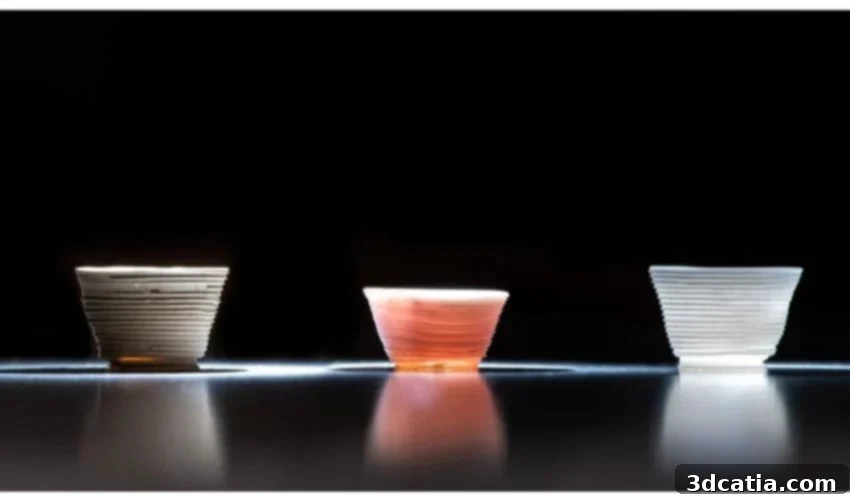
Unlocking the Future of Glass 3D Printing: Lincoln Lab’s Low-Temperature Breakthrough
Glass, an omnipresent material in our daily lives, transcends its common perception to offer an extraordinary array of properties crucial for countless advanced applications. Its inherent transparency, exceptional chemical inertness, superior electrical insulation, remarkable heat resistance, and environmental friendliness through recyclability make it a highly sought-after material in diverse industries, from optics and electronics to biomedicine and construction. Despite these compelling advantages, glass has historically presented significant challenges for additive manufacturing, largely due to its demanding processing requirements. Traditional methods for forming glass often necessitate extremely high melting temperatures, typically exceeding 1,000°C, alongside a precisely controlled thermal environment to prevent cracking and ensure structural integrity. These stringent conditions limit material choices, increase energy consumption, and complicate the manufacturing of complex geometries. Consequently, the adoption of glass in 3D printing has remained niche, often relying on specialized, high-cost equipment and processes that are not widely accessible. However, this long-standing barrier to innovation is now being systematically dismantled by groundbreaking research. A recent project undertaken at Lincoln Laboratory has unveiled a revolutionary approach that promises to transform the landscape of glass 3D printing. A dedicated team of researchers has successfully developed a technique capable of producing intricate glass objects at significantly lower temperatures than previously thought possible. Their innovative method, known as direct ink printing, enables the initial stages of the printing process to commence at ambient room temperature, followed by a remarkably mild heat treatment at just 250°C. This substantial reduction in processing temperatures represents a pivotal advancement, opening new avenues for glass additive manufacturing and making it more accessible to a broader range of applications and industries.
The direct ink printing technique developed by the Lincoln Laboratory team is distinguished by its meticulous control and novel material science. At its core is a specially engineered, tailor-made ink, carefully formulated to facilitate low-temperature processing. This proprietary ink is primarily composed of a silicate solution, which forms the foundational glass precursor, combined with precisely integrated nanoparticles of other inorganic substances. These nanoparticles play a critical role, acting as nucleation sites or binders that facilitate the low-temperature formation of a solid glass structure. By carefully controlling their size, concentration, and distribution, the researchers can manipulate the rheological properties of the ink, ensuring it flows smoothly during extrusion while retaining its shape after deposition. The printing process itself involves the precise extrusion of this advanced ink, layer by painstaking layer, through an ultra-fine 410-micron nozzle. This exceptional level of control over material deposition is paramount, ensuring that each layer is placed with extraordinary accuracy, which is essential for achieving high-resolution, complex geometries that are characteristic of advanced additive manufacturing. The fine nozzle size allows for intricate detailing and the creation of delicate structures with high fidelity. A key advantage of this method is its versatility regarding the printing substrate; the ink can be reliably deposited onto a wide variety of materials, including plastic, metal, pre-existing glass, or silicone. This broad compatibility further enhances the technique’s utility for multi-material integration and hybrid component manufacturing. Crucially, this deposition occurs entirely at room temperature, eliminating the thermal stress and distortion often associated with high-temperature processes that can compromise the structural integrity or dimensional accuracy of the printed object. As the ink is extruded and layered, the silicate particles within the solution begin to react with each other and with the silica particles, initiating a chemical transformation that gradually forms the three-dimensional part. This room-temperature curing initial phase is critical for preserving fine details and preventing unwanted thermal expansion or contraction that could compromise the part’s integrity.
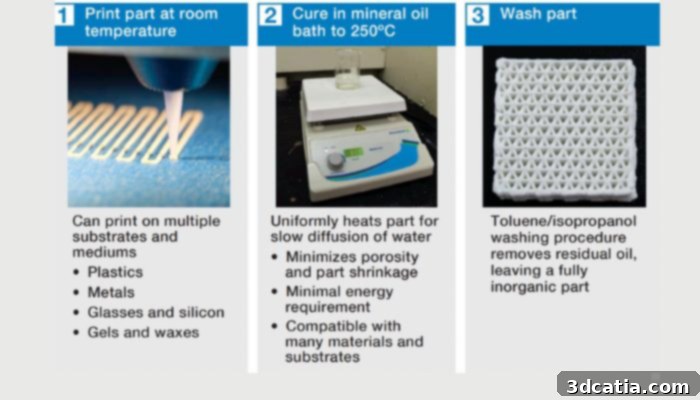
The 3D printing glass process in three steps
Following the initial room-temperature printing stage, where the intricate geometry of the glass object is formed, the Lincoln Laboratory team proceeds to a crucial post-processing phase designed to ensure the structural stability, mechanical robustness, and overall integrity of the part. This post-processing is a meticulously controlled thermal treatment that solidifies and densifies the glass structure. The newly printed “green” part, still somewhat fragile from the initial curing and containing residual solvents, is carefully immersed in a bath of mineral oil. This mineral oil serves as an ideal thermal transfer medium, allowing for uniform and controlled heating of the delicate glass structure. Uniform heating is vital for preventing thermal shock and internal stresses that could lead to defects such as cracks or micro-fractures during the densification process. The bath is then heated to a precisely maintained temperature of 250°C. At this relatively low temperature, a significant transformation occurs: the remaining silicate and inorganic particles undergo further chemical reactions, polycondensation, and densification, causing the material to fully harden into a stable, solid glass form. This controlled heating facilitates the removal of any remaining volatile components and promotes the formation of strong covalent bonds, leading to a robust, homogenous glass matrix. The choice of 250°C is particularly significant; it is dramatically lower than the melting point of conventional glass, which often requires temperatures upwards of 1,000°C for shaping and processing. This reduced temperature not only saves substantial energy and reduces operational costs but also minimizes the risk of warping, cracking, or other thermally induced deformities, allowing for the creation of more complex and precise structures that would otherwise be unattainable with high-temperature methods. Once the hardening process is complete and the part has cooled to room temperature, it undergoes a final cleaning stage. The glass object is submerged in an organic solvent, typically a carefully balanced mixture of toluene and isopropanol. This solvent mixture effectively dissolves and removes any residual mineral oil or other organic contaminants that might have adhered to the surface during the thermal treatment, ensuring a pristine and optically clear finish. The result is a clean, fully densified glass component, characterized by its mechanical strength and ready for advanced applications. The preliminary tests conducted by the Lincoln Laboratory team have yielded highly encouraging results, demonstrating the technique’s capability to produce structures with very high resolution, remarkable dimensional accuracy characterized by minimal shrinkage, and excellent thermal stability. These properties are critical for applications demanding precision and reliability, especially where optical clarity and structural integrity are paramount.
The initial results emanating from Lincoln Laboratory are unequivocally promising, suggesting a paradigm shift in the realm of glass additive manufacturing. The prospect of 3D printing glass at significantly lower temperatures holds immense potential to broaden its accessibility and application across various sectors that have traditionally been limited by the challenges of glass processing. While it is true that the post-processing steps, including the mineral oil bath and subsequent cleaning, add to the overall length of the manufacturing process, this must be weighed against the monumental advantage of the considerably reduced processing temperatures. The ability to avoid extreme heat not only drastically lowers energy consumption and operational costs but also mitigates numerous engineering challenges associated with high-temperature environments, such as material stress, equipment wear, and the need for specialized, costly high-temperature furnaces. This breakthrough could catalyze innovation in fields requiring bespoke glass components, from advanced optical lenses and waveguides in telecommunications to microfluidic devices in medical diagnostics, and even intricate architectural elements. The low-temperature approach potentially allows for the integration of glass structures with heat-sensitive materials, opening up novel hybrid component designs previously unattainable. Imagine electronic components encapsulated in custom glass housings, or biomedical implants with tailored glass surfaces, all manufactured with unprecedented precision. Moreover, the enhanced control over shrinkage and achieved resolution could lead to the production of high-performance glass components with unprecedented precision and fidelity, expanding the horizons for engineers and designers.
The researchers at Lincoln Laboratory are not resting on their laurels; they are actively pursuing further enhancements to refine and expand the capabilities of this exciting technology. A primary area of current focus involves improving the optical clarity of the produced glass. While the mechanical and structural properties are already impressive, achieving perfect optical transparency is crucial for applications such as high-precision lenses, optical fibers, and display technologies, where any imperfection can degrade performance. This involves meticulous refinement of the ink formulation and post-processing parameters to eliminate microscopic scattering centers, ensure homogeneous material density, and achieve a flawless surface finish. Simultaneously, the team is dedicated to developing a diverse array of new inks. These future inks are envisioned to offer a spectrum of different chemical and electrical properties, allowing for the fabrication of multi-functional glass components. Imagine glass structures that are not only transparent but also exhibit semiconducting properties, or specialized chemical resistances tailored for harsh industrial environments. Such developments would unlock a vast range of possibilities, from smart windows with integrated sensors to advanced insulators for high-voltage applications, and custom glassware for complex chemical reactions in laboratories or industrial settings. The long-term vision includes scaling up the process for industrial production, further reducing costs, and exploring the potential for integrating embedded functionalities directly during the printing process. This could involve incorporating sensors, electrodes, or optical elements within the glass matrix as it is being printed, creating truly smart materials and devices. The ongoing research at Lincoln Laboratory continues to push the boundaries of materials science and additive manufacturing, promising a future where custom-designed, high-performance glass components are not only feasible but also widely attainable. In the meantime, you can find out more about their innovative low-temperature glass printing project and other related research directly from their official resources HERE.
This pioneering work from Lincoln Laboratory marks a significant stride in the journey towards making glass additive manufacturing a more practical and widespread reality. The implications for industries relying on precision glass components are profound, offering new avenues for design freedom, functional integration, and cost-effective production. As this technology matures, we can anticipate a surge in innovative applications that harness the unique attributes of glass in ways previously unimaginable, pushing the boundaries of what is possible in various high-tech sectors. What are your thoughts on this groundbreaking method developed by Lincoln Laboratory? Have you had any personal experience with 3D printing glass, perhaps using other existing techniques that you’d like to share? We encourage you to share your insights and experiences by leaving a comment below, or by engaging with us on our vibrant social media platforms, including our LinkedIn and Facebook pages! Furthermore, to stay abreast of the very latest developments and news in the dynamic world of 3D printing, remember to sign up for our free weekly Newsletter and have the most relevant updates delivered directly to your inbox. You can also discover a wealth of educational and informative content by exploring all our videos available on our dedicated YouTube channel, where we regularly feature breakthroughs and insights from the additive manufacturing community, helping you stay connected to the forefront of innovation.
*All Photo Credits: Lincoln Laboratory