
Revolutionizing Seafood: The Dawn of 3D Printed Plant-Based Fish
The global appetite for seafood continues to surge, yet the environmental implications of traditional fishing and aquaculture practices present a formidable challenge. From overfishing leading to depleted marine ecosystems to the pollution and habitat destruction associated with fish farming, the current trajectory is unsustainable. Despite these concerns, fish remains a staple in diets worldwide, and its consumption is projected to grow significantly. According to projections from the Food and Agriculture Organization of the United Nations (FAO), a staggering 140 million tons of fish are expected to be consumed globally by the year 2050. This escalating demand, coupled with the urgent need to mitigate environmental damage, has spurred intense innovation in the food technology sector. A promising solution emerging from this critical intersection is 3D printed fish.
In recent years, numerous companies and research institutions have dedicated considerable resources to developing viable 3D printed seafood alternatives. These efforts aim to replicate the taste, texture, and nutritional value of real fish without the ecological footprint. A significant breakthrough in this innovative field was achieved recently in China, where a dedicated team successfully 3D printed plant-based simulated yellow croaker meat tissues. This September, their pioneering work demonstrated not only the feasibility but also the remarkable accuracy with which complex biological structures can be mimicked using advanced additive manufacturing techniques. This achievement marks a pivotal step towards a more sustainable and ethical future for seafood consumption, offering a glimpse into how technology can address some of our most pressing environmental and food security concerns.
The Scientific Blueprint: Deconstructing Yellow Croaker Tissue for 3D Printing
To accurately simulate the intricate structure of natural fish muscle, the Chinese research team embarked on a meticulous scientific process. Their initial step involved carefully sampling distinct sections of real yellow croaker fish: specifically, parts from the dorsal, abdominal, and tail regions. This comprehensive sampling was crucial because different parts of a fish exhibit variations in muscle fiber orientation, fat distribution, and overall tissue density, all of which contribute to the unique texture and mouthfeel of the final product.
Following the collection of these samples, they were subjected to a series of sophisticated processing steps. First, the samples were immersed in iodine solutions, a technique commonly employed in biological imaging to enhance contrast. This preparation was vital for the subsequent analysis, as it allowed for clearer differentiation between muscle and fat tissues within the samples. The prepared tissues were then subjected to high-resolution micro-CT scans. Micro-computed tomography (micro-CT) is an advanced imaging technique that generates detailed 3D images of internal structures at a microscopic level, providing unparalleled insight into the complex architecture of biological materials.
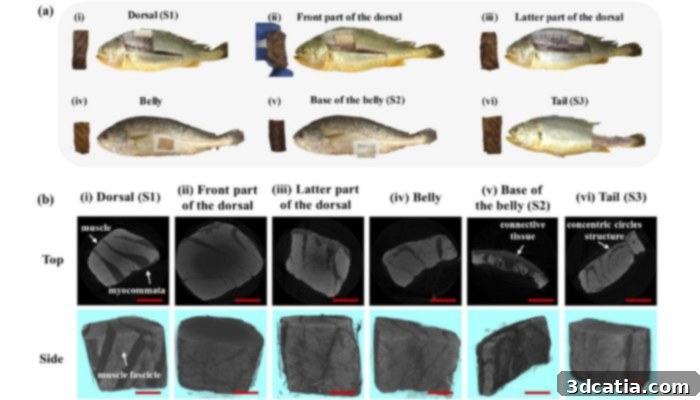
Micro-CT scanning of different parts of yellow croaker fish muscle tissue
The wealth of data obtained from the micro-CT scans, which detailed the exact distribution and orientation of muscle fibers and fat cells, was then utilized to create precise 3D digital models. These models served as the blueprint for the plant-based fish. Leveraging advanced Computer-Aided Design (CAD) software, the researchers meticulously refined these 3D models, enabling them to simulate the composite structure of real yellow croaker meat with remarkable accuracy. This digital simulation phase was critical for translating biological complexity into a printable design, ensuring that the final 3D printed product would closely mimic the natural fish. The precision achieved through this methodology laid a robust foundation for the subsequent printing process, showcasing the power of interdisciplinary research in pushing the boundaries of food technology.
Cutting-Edge 3D Printing: Dual-Nozzle Extrusion and Innovative Inks
The actual printing of the simulated yellow croaker meat was accomplished using a specialized 3D printer equipped with two independent nozzles. This dual-nozzle system was indispensable for replicating the distinct components of natural fish tissue: muscle and fat. Each nozzle was loaded with a unique “ink” formulated to mimic the properties of these respective tissues.
The “muscle ink” was ingeniously composed of a soy protein isolate-xanthan gum-starch complex. Soy protein isolate provides the structural integrity and protein content analogous to muscle, while xanthan gum acts as a thickener and stabilizer, contributing to the desired texture. Starch further aids in structure and consistency. For the “fat ink,” the team developed a nanostarch-carrageenan emulsion gel. Nanostarch offers fine textural properties, and carrageenan, a common gelling agent derived from red seaweed, helps create a stable, fat-like consistency. The careful formulation of these plant-based ingredients was crucial for achieving both structural authenticity and desirable mouthfeel.
For this ambitious project, the researchers utilized a multi-functional extrusion-based 3D bioprinter supplied by China-based Engineering For Life (EFL Tech Co.). This type of bioprinter is particularly well-suited for depositing viscous materials layer by layer, making it ideal for food applications where precise control over material placement is paramount. The study’s lead author, Jie Li, provided insightful details into the meticulous optimization process required for successful printing. Li explained, “We optimized the printing process by controlling the dual-nozzle printing process parameters, including manual calibration of the dual-nozzle offset, layer height, fill rate, printing speed, air pressure, etc.” This level of precise control over numerous variables is what allowed the team to achieve an exceptional degree of accuracy. As a testament to their rigorous optimization, more than 90% of the printed structure’s composite was found to be accurate when compared to the original yellow croaker tissue models. This high fidelity in structural replication is a significant milestone, underpinning the potential for these plant-based alternatives to truly mimic their animal counterparts.
Remarkable Fidelity: Texture, Moisture, and Nutritional Profile
The success of this 3D printed fish project extends far beyond mere structural replication. What makes this advancement truly remarkable is its ability to emulate the sensory and nutritional qualities of real yellow croaker meat. Upon rigorous comparison with natural fish, the plant-based 3D printed version demonstrated striking similarities in several critical aspects, including texture, moisture distribution, and nutrient content. This outcome signifies a “good simulation quality,” indicating that the engineered fish is not just a visual replica but also a functional and palatable alternative.
Achieving comparable texture is particularly challenging for plant-based alternatives, as the fibrous and flaky consistency of fish muscle is difficult to replicate. The precision layering of muscle and fat inks, guided by the micro-CT data, allowed the researchers to create a product that mimics the mouthfeel consumers expect from fish. Similarly, maintaining a realistic moisture distribution is crucial for both cooking performance and sensory experience, preventing the product from being too dry or too watery. From a nutritional standpoint, ensuring that the plant-based fish provides essential nutrients comparable to its animal counterpart is vital for its acceptance as a sustainable and healthy food source. This includes protein content, healthy fats (though plant-based, specific oil additions can address this), and other micronutrients.
The fact that these 3D printed fish exhibited such high fidelity across these critical parameters suggests that the technology is rapidly maturing. With continued development and refinement, it may not be long before these sophisticated 3D printed fish products transition from laboratory curiosities to a common sight on our dinner plates. Such an evolution would offer a viable, environmentally friendly alternative for consumers, reducing pressure on wild fish stocks and offering a consistent, high-quality product.
Navigating Challenges and the Expanding Horizon of 3D Printed Seafood
While the Chinese research study represents a significant leap forward, it also highlights areas for future development. The report notably does not delve into the specific taste profile of their 3D printed fish, nor does it detail whether it can be cooked or prepared in the same versatile ways as real fish. These aspects – taste, aroma, and culinary performance – are crucial for widespread consumer adoption and remain active areas of research for the food tech industry. The complex interplay of flavors released during cooking, and the textural changes that occur, present the next frontier for these advanced food simulations.
However, this Chinese team is not alone in their mission to revolutionize seafood. The global landscape of 3D printed food is dynamic and competitive. In 2023, Steakholder Foods, an Israeli food tech company, made headlines by becoming the first company to 3D print a whole cut of a fish fillet. Steakholder Foods focuses on creating both faux fish and beef products, targeting specialized markets with their innovative offerings. Their work underscores the growing interest and investment in developing cultured meat and plant-based alternatives using additive manufacturing.
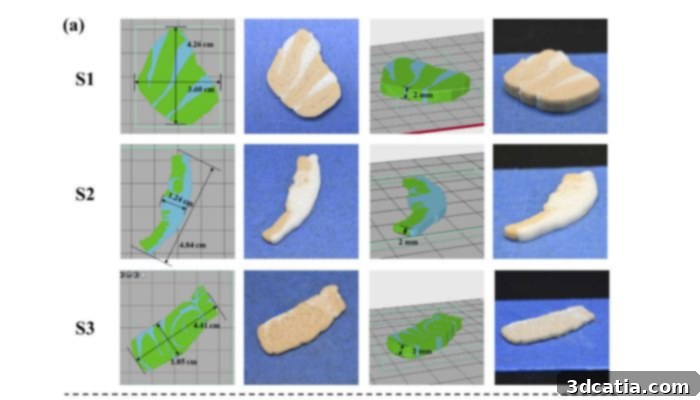
These are the dual-nozzle 3D printings of plant-based fish. S1 is the dorsal flesh, S2 is the base of the belly flesh, and S3 is the tail
Despite these impressive advancements, a persistent challenge highlighted in the Chinese report remains: “simulating the composite structure of real meat tissue remains a challenge.” Replicating the cellular complexity, vascularization, and nuanced textural variations found in natural animal tissue is incredibly difficult. This challenge necessitates ongoing research into material science, bio-ink formulation, and sophisticated printing techniques to achieve even greater levels of authenticity. Nevertheless, the rapid progress seen in this field, particularly with the yellow croaker simulation, suggests that overcoming these hurdles is within reach. This innovation holds immense potential for addressing food security, reducing the environmental footprint of our diets, and offering ethical alternatives to traditional animal products. For those interested in the intricate details of this groundbreaking study, the published research can be accessed here.
The Future of Food: Sustainability and Consumer Acceptance
The advent of 3D printed plant-based fish represents a significant stride towards creating a more sustainable and resilient global food system. As climate change impacts marine environments and traditional fishing stocks dwindle, alternative protein sources become not just desirable, but essential. This technology offers a pathway to decouple seafood production from its current ecological pressures, providing a consistent supply that is free from microplastics, heavy metals, and other contaminants often found in wild-caught fish. Furthermore, the controlled environment of 3D printing allows for precise nutritional adjustments, potentially creating healthier products tailored to specific dietary needs.
Beyond environmental benefits, the economic implications are substantial. As production scales up and costs decrease, 3D printed fish could become a competitive alternative in the market, appealing to a wider range of consumers. The ethical considerations of animal welfare also play a role, as plant-based options provide a cruelty-free choice for those who wish to avoid animal products. However, consumer acceptance remains a key hurdle. Education about the technology, transparency in ingredient sourcing, and continuous improvement in taste and texture will be vital for widespread adoption. As innovative companies like Steakholder Foods and pioneering research teams continue to refine their methods, the vision of a supermarket aisle stocked with high-quality, sustainable, and delicious 3D printed seafood is steadily moving closer to reality.
Have you tried, or would you consider trying, this innovative 3D printed plant-based fish from China or similar products? Do you believe that 3D printed fish holds immense potential to reshape the future of our food supply and contribute to global sustainability? We invite you to share your thoughts and perspectives in the comments section below or connect with us on our LinkedIn, Facebook, and Twitter pages! Don’t miss out on the latest advancements and breaking news in 3D printing by signing up for our free weekly Newsletter here, delivered directly to your inbox! You can also explore all our informative videos and engaging content on our YouTube channel.
*All Photo Credits: Jie Li, Haohao Hu, Ruihao Niu, Qingqing Zhu, Siyu Yao, Jianwei Zhou, Donghong Liu, Enbo Xu. Simulated construction of plant-based fish meat with composite structure via dual-nozzle extrusion 3D printing.