

CECIMO Study Reveals Robust Growth and Strategic Investment in European Additive Manufacturing
CECIMO, the authoritative European Association of the Machine Tool Industries and related Manufacturing Technologies, has recently unveiled the highly anticipated third edition of its comprehensive European study dedicated to the dynamic field of additive manufacturing. This in-depth analysis, meticulously conducted over a six-month period, delves into four critical areas to meticulously identify emerging trends and pivotal shifts within the industry: imports, exports, the array of materials being utilized, and the key target sectors driving innovation. The overarching sentiment conveyed by the study’s results is overwhelmingly positive, underscoring a prevailing confidence among surveyed companies. These businesses express a strong intent to sustain and even escalate their investments in additive manufacturing, driven by a deep conviction in the transformative benefits and strategic advantages this technology offers to the broader manufacturing landscape.
Before immersing ourselves in the detailed findings of this third groundbreaking study, it is pertinent to briefly outline the robust methodology employed by CECIMO. The responses gathered from participating companies are rigorously analyzed, not merely as raw figures, but as the calculated difference between the share of companies reporting demonstrable growth and those indicating a decline in activity. Consequently, positive percentages serve as a clear indicator of expansion and increased vitality within a specific segment, while a negative balance unequivocally signals a contraction or downturn. This nuanced approach provides a clearer, more actionable understanding of market sentiment and directional trends.
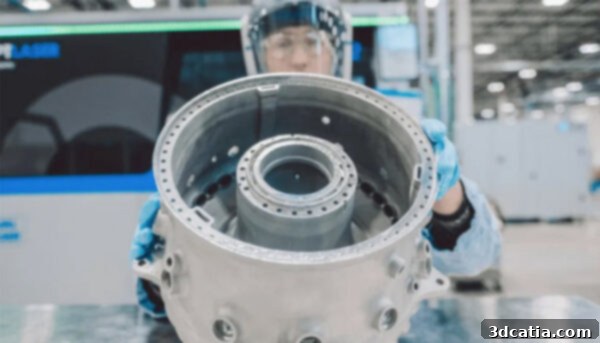
The report highlights the aerospace sector as a significant driver of growth in additive manufacturing over the past six months, reflecting increasing adoption for complex, high-performance parts (photo credits: GE Aviation)
Navigating Global Trade: Trends in Imports and Exports of Additive Manufacturing
The CECIMO report offers an insightful dual perspective, examining both the robust local activities of the surveyed European companies and their intricate engagements with international markets. A primary revelation from the study is the notable uptick in imports across all categories of additive manufacturing offerings, marking a significant increase compared to figures from the previous spring. This growth signals a healthy appetite for foreign expertise and specialized components within the European market. Among these categories, 3D printing services exhibit the highest percentage of growth at an impressive 79%, indicating a strong demand for specialized manufacturing capabilities and outsourced production. Close behind, both 3D printed parts and materials each register substantial growth at 72%. Further underscoring this positive trend, the report reveals that three out of four companies reported a growth scenario within their respective local markets. This widespread domestic expansion is a compelling testament to the fact that additive manufacturing is not just a nascent technology, but is firmly entrenched in a crucial industrialization phase, moving beyond prototyping to become a vital component of mainstream production processes.
Shifting our focus to exports, the study identifies a similarly encouraging trend: a majority of the surveyed companies have reported increased business activities with foreign nations. This surge in international trade can be largely attributed to the global economic recovery, the widespread resumption of cross-border commerce, and the critical reconstruction and strengthening of global supply chains that were severely tested and disrupted during months of widespread confinement. This demonstrates additive manufacturing’s growing role in global value chains. It is noteworthy, however, that despite this export growth, the results for most segments – with the notable exception of the “machinery” segment – indicate even higher growth percentages within the local European market. This particular disparity provides compelling evidence of an increasingly significant trend towards relocation and reshoring among manufacturers. European companies are evidently investing in and leveraging additive manufacturing to build more resilient, localized production capabilities, thereby reducing dependency on distant supply chains and fostering regional economic robustness. This dual growth in both local and international markets underscores the versatility and strategic importance of additive manufacturing in shaping the future of European industry.
Key Insights: Target Materials and Dominant Sectors in Additive Manufacturing
The CECIMO study dedicates a significant portion of its analysis to the most prevalently used materials within the additive manufacturing market, revealing critical shifts and emerging preferences. The most striking conclusion drawn from this third edition is the phenomenal growth observed in the adoption of metals, which surged to 73% compared to just 44% in the previous year. This substantial increase signifies a maturing industry where metal additive manufacturing technologies are increasingly being employed for high-performance, end-use parts across various demanding sectors. The robustness, durability, and intricate design possibilities offered by metal 3D printing are clearly resonating with industrial applications.
Concurrently, polymers continue to maintain a strong presence and widespread usage, offering an expansive array of possibilities for professionals and manufacturers. The versatility of polymers, from flexible elastomers to rigid engineering plastics, allows for a broad spectrum of applications. Interestingly, the study highlights a growing trend where some manufacturers are strategically replacing certain metal parts with advanced plastics, capitalizing on benefits such as lightweighting, corrosion resistance, and often, cost-effectiveness for specific applications. This demonstrates a sophisticated approach to material selection driven by performance and economic considerations. The study also brings attention to the remarkable recovery of ceramics. Previously, this segment had posted a significant negative balance of -41% last spring, reflecting challenges or limited adoption. However, it has now rebounded positively to 9%, indicating renewed interest and investment. Ceramics, while less mainstream in the market, are gaining traction as more players actively seek to democratize their use, recognizing their unique properties such as high-temperature resistance, hardness, and biocompatibility for niche and advanced applications. In contrast to these growth areas, the composites segment experienced a notable decrease, falling to 7% from 42% last year. This could be indicative of a temporary market shift, increased focus on other material types, or perhaps a period of consolidation and refinement within composite additive manufacturing technologies.
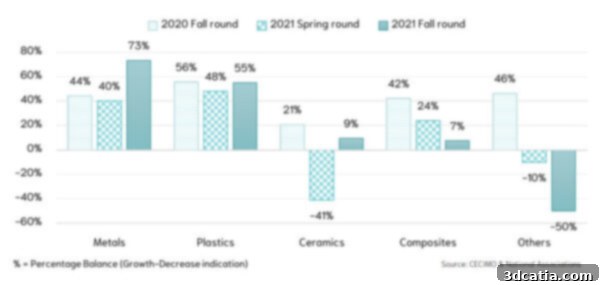
The CECIMO study provides an in-depth analysis of the most commonly utilized materials in the additive manufacturing market, showcasing evolving preferences and technological advancements (photo credits: CECIMO)
The report further extends its analysis by meticulously dissecting which industrial sectors are experiencing the most vigorous activity and adoption of additive manufacturing. The surveyed companies unanimously identified the medical market as exhibiting exceptionally strong growth, recording an impressive balance of 82%. This surge is largely driven by the unique ability of additive manufacturing to produce highly customized implants, prosthetics, surgical guides, and anatomical models with unparalleled precision and patient-specific requirements, revolutionizing healthcare delivery. Following closely is the machinery sector, which also demonstrates robust growth, leveraging 3D printing for specialized tools, complex machine components, and rapid prototyping of industrial equipment.
Perhaps the most significant transformation observed is within the aerospace and automotive industries – two critical verticals that previously faced considerable headwinds. Their balance, which was notably negative in the previous year, has now positively shifted to 24% and 37% respectively. This remarkable recovery can be largely explained by the severe impact of the COVID-19 pandemic, which crippled these sectors for many months, particularly the aerospace industry due to travel restrictions. Now, as these industries rebound, additive manufacturing is poised to play an indispensable and increasingly strategic role. Both aerospace and automotive are currently grappling with pressing environmental challenges, including the imperative to significantly reduce their carbon footprint and the accelerating transition towards electric propulsion systems in the automotive sector. Additive manufacturing offers compelling solutions in these areas, enabling the production of lightweight components that enhance fuel efficiency, optimizing designs for fewer parts and less material waste, and facilitating the rapid development of innovative structures for electric vehicles. This integration of 3D printing is not just about efficiency but also about sustainability and future-proofing these vital European industries.
In its concluding remarks, CECIMO powerfully underscores the ongoing commitment to investments in additive manufacturing, highlighting the industry’s forward-looking perspective. A substantial 57% of the companies surveyed unequivocally state their intention to continue investing in 3D technologies over the forthcoming six months. This sustained commitment reflects a strategic understanding of additive manufacturing’s long-term value and its integral role in modern industrial strategies. Furthermore, within this investing group, a significant 38% specifically indicate that their investments will be higher than in previous periods, signaling an accelerating pace of adoption and expansion. Only a small fraction, 5%, anticipate reducing their investments, suggesting a widespread positive outlook and confidence in the technology’s trajectory. These investment trends are crucial indicators of the robust health and promising future of additive manufacturing across Europe, driving innovation, efficiency, and competitiveness. For those seeking an even deeper dive into these comprehensive findings, the complete CECIMO study is available for review HERE.
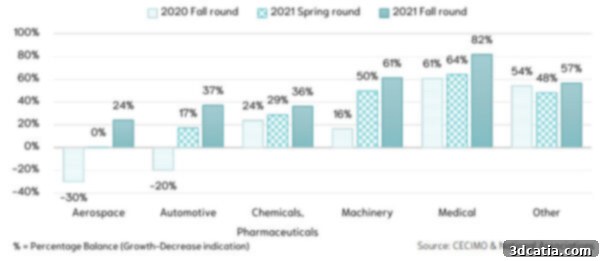
The medical sector consistently registers the highest balance in terms of additive manufacturing adoption and growth, underscoring its pivotal role in healthcare innovation (photo credits: CECIMO)
*Cover Photo Credits : GE Additive
What are your thoughts on the compelling trends identified by the latest CECIMO study? We invite you to share your insights and engage in a discussion by leaving a comment below, or by connecting with us on our Linkedin, Facebook, and Twitter pages! Don’t miss out on the latest advancements and breaking news in the 3D printing world—remember to sign up for our free weekly Newsletter here, delivering the freshest updates straight to your inbox. Additionally, explore our extensive library of videos and in-depth content on our dedicated YouTube channel for more visual insights and expert analyses.