
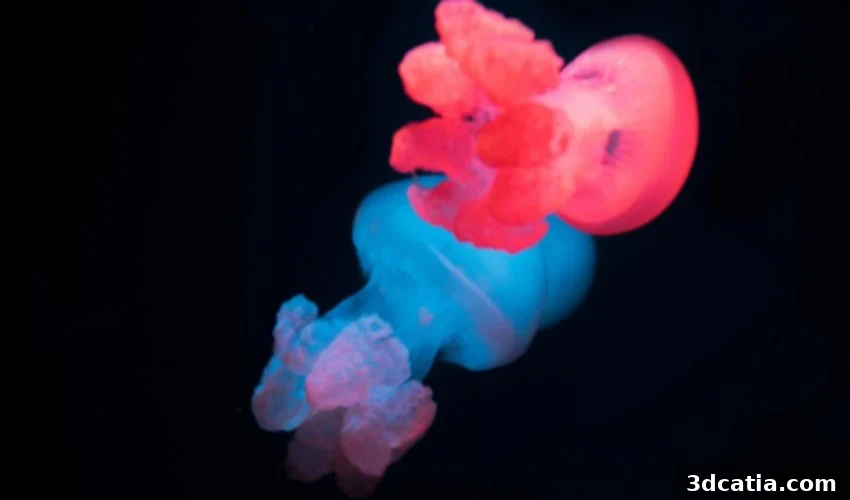
Unlocking Ocean Secrets: How 3D Printing Powers Biohybrid Jellyfish for Deep-Sea Exploration
The vast and mysterious ocean depths have always captivated humanity, representing one of Earth’s last great frontiers. Much like the immense void of space, the ocean remains largely unexplored, holding invaluable data crucial for understanding our planet’s climate, biodiversity, and complex ecosystems. Traditional methods of deep-sea exploration often come with significant limitations, including prohibitive costs, logistical challenges, and the potential to disturb delicate marine environments. Recognizing these hurdles, researchers at Caltech have embarked on a groundbreaking endeavor, merging cutting-edge 3D printing technology with an unexpected biological partner: the jellyfish. This innovative fusion aims to create highly efficient, cost-effective, and minimally invasive tools for navigating the deep ocean and collecting vital scientific information.
At the forefront of this pioneering research is Dr. John Dabiri, the Centennial Professor of Aeronautics and Mechanical Engineering at Caltech. Inspired by the natural elegance, resilience, and adaptability of jellyfish, Dr. Dabiri and his dedicated team are developing what they term “biohybrid jellyfish.” These remarkable creatures are transformed into “cyborg” counterparts by integrating custom-designed, 3D printed enhancements and sophisticated sensors. This revolutionary approach promises to redefine how we interact with and study the marine world, offering a sustainable alternative to conventional, resource-intensive exploration techniques.
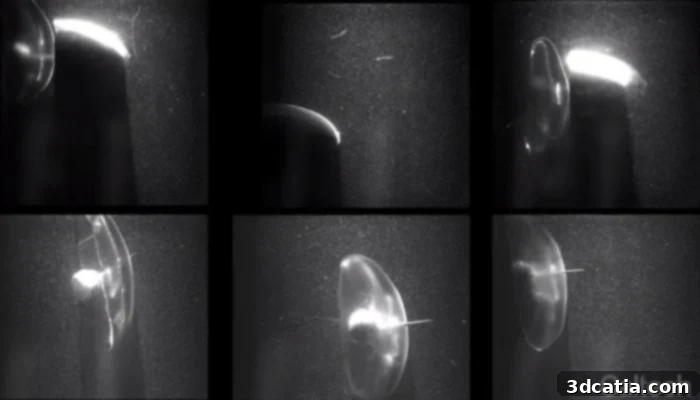
Biohybrid jellyfish with fitted forebodies and sensors (Photo Credits: Caltech)
The Ingenious Design: How 3D Printing Enhances Nature
The success of these biohybrid jellyfish hinges significantly on the capabilities of 3D printing. This additive manufacturing technology allows for the fabrication of custom-designed “forebodies” that are precisely attached to the top of the jellyfish’s bell. These forebodies are not merely decorative; they are engineered with specific geometries to improve buoyancy and drastically reduce hydrodynamic drag, optimizing the jellyfish’s movement through water. The ability of 3D printing to produce intricate, lightweight, and customized components with speed and accuracy is paramount to this project. Researchers can rapidly iterate on designs, testing various shapes and materials to achieve peak performance without the constraints of traditional manufacturing methods. This design flexibility ensures that each enhancement is perfectly tailored, maximizing the efficiency and data-gathering potential of the biohybrid creature.
Beyond mechanical enhancements, Dr. Dabiri’s team has equipped these jellyfish with specialized electronic pacemakers. These minute, biocompatible devices are designed to precisely control the jellyfish’s swimming speed, allowing researchers to dictate their pace and trajectory. The experiments conducted with these pacemakers yielded astonishing results: by encouraging the jellyfish to swim at speeds well beyond their natural leisurely rhythm, they not only adapted but became significantly more proficient. Remarkably, the biohybrid jellyfish could surpass their typical speed by more than four times while utilizing only twice as much energy. This incredible efficiency was observed even while the creatures carried a payload of sensors and other instruments, demonstrating the profound potential of this bio-robotic integration for sustained deep-sea missions. The synergy between nature’s inherent propulsion and human-engineered control opens new avenues for energy-efficient underwater locomotion.
A New Era of Ocean Exploration: Testing the Limits
To rigorously test their biohybrid creations, the Caltech research team constructed a state-of-the-art vertical aquarium. Standing over three stories tall, this unique structure serves as a controlled environment specifically designed for studying the performance of the cyborg jellyfish. It functions as a pioneering “water treadmill,” allowing researchers to test the creatures’ capabilities against flowing vertical currents and simulate the immense pressures of various ocean depths. Within this advanced facility, the 3D printed enhancements proved their worth, enabling the biohybrid jellyfish to showcase significantly improved speed and agility compared to their natural counterparts. They effortlessly navigated the simulated depths and pressures of the tank, demonstrating remarkable efficiency and control, proving the viability of the biohybrid concept for real-world ocean exploration.
Beyond their enhanced performance and natural resilience to deep-sea environments, jellyfish offer a compelling advantage: cost-effectiveness. The economic implications of this technology are revolutionary, especially when contrasted with traditional ocean exploration instruments. A single biohybrid jellyfish costs approximately $20 to create and deploy. This is a stark contrast to the exorbitant operational costs of conventional research vessels, which can easily exceed $50,000 per day. Such a significant reduction in cost could democratize oceanographic research, making deep-sea exploration accessible to more institutions and fostering a greater understanding of our oceans without the colossal financial burden. Furthermore, their small size and energy efficiency contribute to a reduced environmental footprint compared to large, fuel-guzzling ships and remotely operated vehicles (ROVs).
Ethical Considerations and Future Development
The deployment of living organisms augmented with technology naturally raises ethical questions. Dr. Dabiri thoughtfully addresses these concerns, stating, “Jellyfish are the original ocean explorers, reaching its deepest corners and thriving just as well in tropical or polar waters. Since they don’t have a brain or the ability to sense pain, we’ve been able to collaborate with bioethicists to develop this biohybrid robotic application in a way that’s ethically principled.” This fundamental biological characteristic of jellyfish—their simple nervous system and lack of pain perception—was a crucial factor in proceeding with the project, ensuring that the research adheres to robust ethical guidelines. The team’s proactive engagement with bioethicists underscores their commitment to responsible scientific innovation. Dr. Dabiri expresses his excitement about the future, adding, “I’m really excited to see what we can learn by simply observing these parts of the ocean for the very first time.” This highlights the immense potential for unprecedented data collection.
While current biohybrid jellies excel at enhanced straight-line swimming, primarily for deep-sea measurements of parameters like temperature, salinity, and current, Dr. Dabiri envisions even more advanced capabilities. Ongoing research is focused on equipping these creatures with steering mechanisms, enabling not only vertical but also horizontal navigation. This ability to precisely direct their movement would unlock a new level of data collection, allowing for targeted exploration of specific geological features, marine habitats, or even tracking pollution plumes. Imagine swarms of these robotic jellyfish mapping entire sections of the ocean, providing unprecedented resolution of underwater environments. This vision aligns perfectly with the goal of creating a comprehensive, dynamic picture of our ocean’s health and activity.
Beyond Earth’s oceans, the potential applications of this biohybrid technology have sparked fascinating debates regarding extraterrestrial exploration. The concept of deploying similar bio-robotic explorers to investigate the subsurface oceans of distant moons, such as Europa or Enceladus, is gaining traction. These icy worlds are believed to harbor vast liquid water oceans beneath their frozen crusts, representing prime targets in the search for extraterrestrial life. The resilience, adaptability, and low-energy requirements demonstrated by the biohybrid jellyfish make them intriguing candidates for navigating such extreme and alien environments, where traditional probes might struggle. This project truly pushes the boundaries of interdisciplinary science, blending biology, robotics, and advanced manufacturing to tackle some of the greatest mysteries of our universe. You can learn more about this transformative project by clicking here.
The innovative work at Caltech represents a paradigm shift in oceanography and environmental monitoring. By harnessing the power of 3D printing and integrating it with the natural efficiencies of marine life, researchers are developing a sustainable, affordable, and incredibly effective platform for deep-sea exploration. This biohybrid approach not only promises to unlock critical data about our planet’s most enigmatic environments but also establishes a new ethical framework for biological augmentation. As these “cyborg” jellyfish continue to evolve, they will undoubtedly provide us with unprecedented insights into the hidden depths, fostering a deeper appreciation and understanding of Earth’s vital aquatic realms and potentially guiding our search for life beyond our home planet.
What are your thoughts on these revolutionary biohybrid jellyfish and their potential to transform deep-sea exploration? Share your opinions in a comment below or join the conversation on our LinkedIn, Facebook, and Twitter pages! Don’t forget to sign up for our free weekly newsletter here to get the latest 3D printing news delivered straight to your inbox! You can also find all our videos and more exciting content on our YouTube channel.