
BiliScreen: Revolutionizing Early Cancer Detection Through AI, Smartphones, and 3D Printing
The profound impact of early cancer detection on patient outcomes cannot be overstated; it frequently signifies the critical distinction between successful treatment and a life-threatening prognosis for millions across the globe. Among the most aggressive and challenging forms of cancer is pancreatic cancer, a disease notoriously difficult to diagnose in its nascent stages due to its often subtle or absent symptoms until the illness has advanced significantly. This inherent difficulty contributes to its high mortality rate, underscoring an urgent and persistent global need for innovative, accessible, and non-invasive early screening methods. While some regions may report comparatively lower incidence rates, the universal challenge of detecting pancreatic cancer at a treatable stage remains a formidable hurdle in oncology. It is within this crucial landscape that a pioneering application known as BiliScreen has emerged, promising a transformative leap forward in early disease detection. This ingenious solution integrates cutting-edge technology by pairing a specialized, 3D-printed accessory with a user-friendly smartphone application. Together, these components form a powerful new system designed to identify subtle biochemical indicators that could signal the onset of pancreatic cancer or other significant underlying health conditions, offering a beacon of hope for earlier intervention and improved patient survival rates.
The BiliScreen application measures your levels of bilirubin to help detect pancreatic cancer early on, leveraging a non-invasive smartphone photo.
The Science Behind BiliScreen: Unlocking Early Indicators
The BiliScreen system is the brainchild of dedicated researchers at the University of Washington’s Ubiquitous Computing Lab, an institution at the forefront of integrating technology into everyday life to solve complex problems. Their innovation harnesses the power of advanced computer vision and sophisticated machine learning algorithms to achieve a remarkably simple yet profound diagnostic feat: detecting early signs of jaundice through a standard photo of a person’s eye. Specifically, the system focuses on analyzing the sclera, the white outer layer of the eyeball, for subtle changes in coloration. Through this seemingly simple snapshot, the BiliScreen device is meticulously calibrated to measure and identify elevated levels of bilirubin within the white area of the eye. Bilirubin is a yellowish pigment formed as a byproduct when red blood cells break down. While typically processed by the liver and excreted, a buildup of bilirubin in the body, known as hyperbilirubinemia, can manifest as jaundice – a yellowing of the skin and eyes. Critically, significantly elevated bilirubin levels are often an early, yet easily overlooked, indicator of underlying medical conditions, including pancreatic cancer, as well as liver diseases or gallstone issues. Traditionally, medical professionals rely on invasive blood tests to accurately measure bilirubin levels. This conventional method often necessitates multiple visits to a doctor’s office or laboratory, leading to potential delays in diagnosis, increased healthcare costs, and a more cumbersome experience for the patient. BiliScreen’s non-invasive, instant approach offers a compelling alternative, potentially saving valuable time in the diagnostic process where every moment counts.
Seamless Integration: Smartphone Technology Meets 3D Printing Innovation
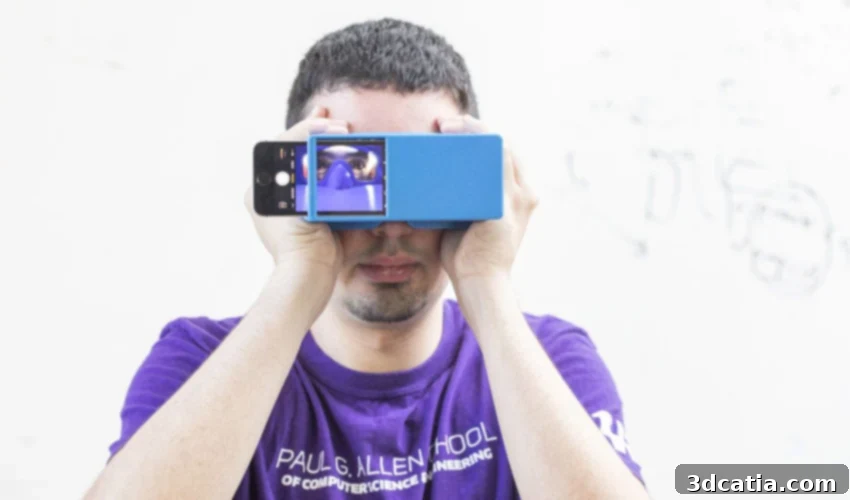
BiliScreen is far more than just a mobile application; it represents a synergistic fusion of digital intelligence and tangible, 3D-printed hardware. Complementing the sophisticated software is a custom-designed, 3D-printed accessory: a meticulously crafted box specifically engineered to control the exposure of light to the eye during the screening process. This innovative accessory plays a crucial role in ensuring the accuracy and reliability of the bilirubin measurement. To utilize the device, a user simply positions their smartphone within this specially designed 3D-printed box. They then wear a pair of distinct, light-controlling glasses, which work in tandem with the box to create an optimally controlled environment. With these preparations complete, the user takes a simple selfie of their face using their smartphone camera. The 3D-printed box effectively blocks ambient light and manages illumination, ensuring that the smartphone camera captures consistent, high-quality images of the sclera under standardized lighting conditions. This careful light control is paramount, as variations in external light sources can significantly impact the color analysis performed by the application’s algorithms. By standardizing the photographic environment, BiliScreen ensures that its computer and machine learning algorithms can operate under optimal conditions, leading to more accurate and dependable detection of bilirubin levels and, consequently, potential early warning signs of disease. This brilliant combination of readily available smartphone technology with precise, custom-manufactured 3D-printed components highlights a new frontier in accessible medical diagnostics, moving sophisticated screening tools closer to the patient.
The innovative 3D printed box and special glasses are essential components of the BiliScreen system, ensuring optimal light conditions for accurate readings.
Promising Results and the Vision for a Healthier Future
The efficacy and potential of the BiliScreen system were rigorously evaluated during an initial study conducted on a cohort of 70 patients. The results were remarkably encouraging, demonstrating BiliScreen’s capability to correctly identify cases of jaundice with an impressive accuracy rate of 89.7%. This figure stands in strong comparison to the diagnostic accuracy achieved through traditional blood tests, which are the current gold standard for detecting bilirubin levels. Such a high level of accuracy in a non-invasive, accessible format represents a significant breakthrough in early diagnostic technology. Alex Mariakakis, a doctoral student at the esteemed Paul G. Allen School of Computer Science & Engineering and lead author of the research, succinctly articulated the profound implications of this innovation: “The problem with pancreatic cancer is that by the time you’re symptomatic, it’s frequently too late.” His statement powerfully underscores the silent and insidious nature of the disease, which often progresses without noticeable signs until it reaches advanced, often untreatable, stages. Mariakakis continued, sharing the overarching hope driving the BiliScreen project: “The hope is that if people can do this simple test once a month—in the privacy of their own homes—some might catch the disease early enough to undergo treatment that could save their lives.” This vision speaks to a future where preventative health screening is seamlessly integrated into daily routines, empowering individuals to take proactive control over their health and potentially avert the devastating consequences of late-stage diagnoses. The BiliScreen’s ability to provide a convenient, home-based screening tool could dramatically shift the paradigm of pancreatic cancer detection, moving from reactive diagnosis to proactive surveillance.
Users simply insert their smartphone into the 3D printed box, which precisely controls ambient light levels to ensure consistent and accurate readings.
Evolving the Technology: The Road Ahead for BiliScreen
The dedicated team behind BiliScreen is not resting on its initial successes. Their forward-thinking approach includes ambitious plans for continuous improvement and expansion of the device’s capabilities. A primary design goal is to refine the hardware, specifically with the objective of eliminating the need for the specialized glasses and the light-controlling box. This streamlined design would make the BiliScreen even more convenient and discreet, further enhancing its appeal as a routine home-based screening tool. Imagine a future where early detection is as simple as taking a regular selfie, without any additional accessories. Furthermore, the researchers are committed to broadening the scope of their testing protocols. They intend to evaluate the BiliScreen app on a significantly larger and more diverse population, particularly focusing on individuals identified as being at risk for jaundice and a wider array of underlying conditions beyond just pancreatic cancer. This includes exploring its potential for detecting liver diseases, hepatitis, and other ailments where bilirubin levels serve as critical biomarkers. By expanding both the device’s user-friendliness and its diagnostic reach, BiliScreen aims to become a versatile, indispensable tool in preventative healthcare, capable of offering widespread, accessible screening for a multitude of conditions. The continuous evolution of BiliScreen underscores its potential to not only revolutionize pancreatic cancer detection but also to significantly contribute to the broader landscape of public health, making early diagnosis more attainable for everyone.
3D Printing: A Catalyst for Medical Innovation
The development of BiliScreen beautifully illustrates the transformative power of 3D printing in the medical sector. Additive manufacturing, or 3D printing, has rapidly emerged as a game-changer in healthcare, enabling the rapid prototyping and production of custom medical devices, intricate surgical guides, and patient-specific anatomical models. For BiliScreen, 3D printing was instrumental in creating the precise, light-controlling accessory that ensures the accuracy and reliability of the smartphone-based detection system. This technology allowed the University of Washington team to quickly iterate on designs, testing various configurations to achieve optimal performance without the significant time and cost associated with traditional manufacturing methods. The ability to produce bespoke components on demand meant that the researchers could tailor the device perfectly to its specific function, integrating seamlessly with existing smartphone technology. This flexibility and efficiency offered by 3D printing are democratizing innovation in medical diagnostics, making advanced tools more accessible and accelerating their journey from concept to clinical application. As BiliScreen continues to evolve, the foundational role of 3D printing in its initial development stands as a testament to how this manufacturing revolution is enabling new possibilities in personalized medicine and accessible healthcare solutions globally.
To gain a deeper understanding of how this groundbreaking device functions and its potential impact, we invite you to watch the insightful video demonstration below:
What are your thoughts on the BiliScreen? Do you believe this innovative blend of AI, smartphone technology, and 3D printing could genuinely revolutionize the early detection of pancreatic cancer and other serious conditions, making healthcare more accessible for all? We eagerly await your insights and opinions! Share your comments below, or engage with our community on our vibrant Facebook page and active Twitter feed. Don’t miss out on the latest advancements and breaking news in the exciting world of 3D printing; make sure to sign up for our free weekly Newsletter, delivered directly to your inbox with all the essential updates you need to stay informed!