
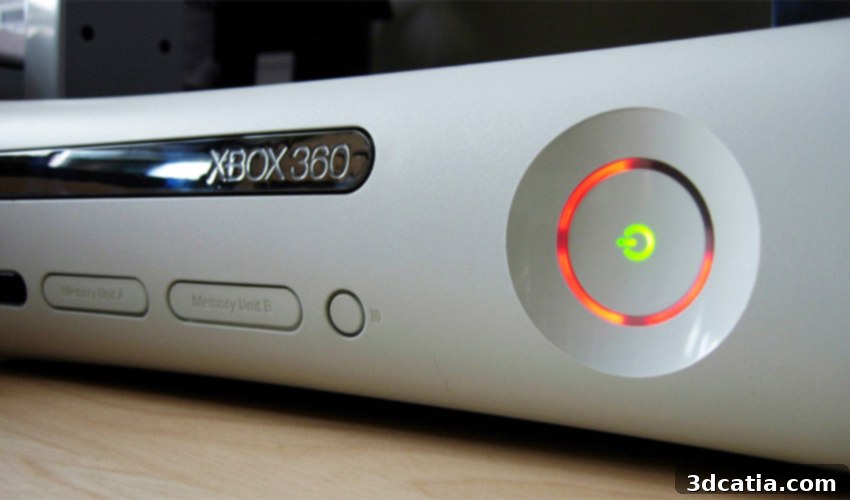
Revolutionizing 3D Printing: How an Xbox 360 Optical Drive Transforms into a Nanoscale SLA Machine for Medical Innovation
Imagine a world where your old video game console isn’t just a relic of gaming history but a cutting-edge tool for scientific advancement. This seemingly audacious concept has become a reality thanks to a visionary team of researchers at the Technical University of Denmark (DTU). They have ingeniously repurposed an Xbox 360, converting its advanced optical sensor into the core component of a high-volume, higher-resolution nanometric 3D printer. Their groundbreaking endeavor aims to dramatically simplify the complex process of stereolithography (SLA), making advanced additive manufacturing more accessible and cost-effective. The primary objective behind this innovative project is to develop a robust system specifically tailored for the medical sector, with a significant focus on enhancing drug administration techniques. This pioneering approach promises to open new frontiers in personalized medicine and biomedical research.
The Xbox 360, a console celebrated worldwide for its impact on video gaming since its 2005 release by Microsoft, holds a secret weapon: its highly sophisticated optical drive. This drive, originally designed for reading and writing data on game discs, is equipped with a laser system that possesses remarkable precision and control. These characteristics – particularly its multiple wavelength laser modes and exacting measurement capabilities – make it an exceptionally suitable component for integration into conventional SLA 3D printing machines. While typical industrial SLA printers rely on expensive, specialized lasers, the Xbox 360’s optical sensor offers a surprisingly powerful and accurate alternative. By integrating these robust and readily available sensors directly into their custom-built machines, the Danish researchers have unlocked a new level of accuracy. They highlight that the system can directly leverage the console’s existing optical components to precisely determine the distance between the laser and the resin-filled platen surface, achieving unparalleled nanoscale resolution. This inherent precision is crucial for fabricating intricate microstructures required for advanced biomedical applications.
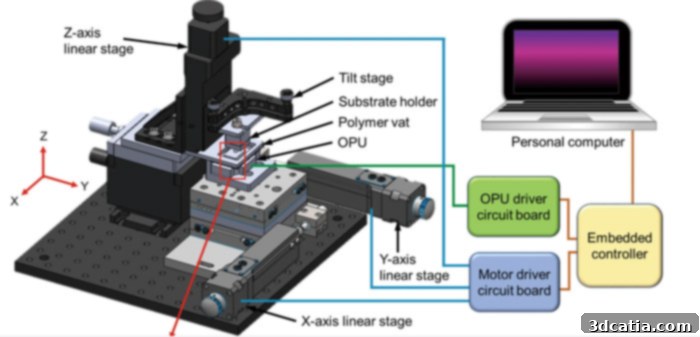
Conceptual diagram illustrating the function of the SLA machine, leveraging the Xbox optical drive (photo credits : DTU)
The conceptualized 3D SLA printer fundamentally rethinks the traditional SLA setup. At its core, the machine utilizes a diode laser emitted by the repurposed Xbox optical sensor, which is directed upwards. This laser operates at a specific wavelength of 405 nanometers – a crucial characteristic for curing many standard photopolymer resins used in SLA. What truly sets this design apart is its connection to a custom-engineered motor. This motor doesn’t just regulate the laser’s intensity; it also precisely controls its wavelength, allowing for optimized curing based on the specific resin being used. Furthermore, this advanced motor is instrumental in governing the different resolutions of the machine’s axes with extraordinary accuracy. This intricate control system enables the researchers at DTU to envision a microscopic-scale resin printing machine that not only boasts superior precision but also offers enhanced ease of use, primarily due to the direct and seamless integration of the Xbox’s sophisticated optical sensors. This clever reuse of consumer electronics significantly reduces the overall cost of the printer, as the optical drive and its integrated laser are far more economical than the specialized, high-power lasers typically employed in industrial 3D resin printers. This cost advantage makes advanced nanoscale 3D printing more accessible to a wider range of research institutions and potentially even small laboratories.
Professor En-Te Hwu, a leading figure in this research at the Technical University of Denmark, articulates the profound implications of their work: “We firmly believe that this innovative technology has the potential to significantly impact various facets of health technology. Our initial motivation for developing this bespoke 3D printer stemmed from a critical need: to be able to print cubic centimeter volumes with micro/nanoscale resolution. This capability is essential for our ongoing development of micro-container based drug delivery systems. After an extensive search, we simply couldn’t find an existing 3D printer system on the market that could meet these specific, demanding requirements. Consequently, the only viable path was to design and construct our own.” This quote highlights the innovative drive born from necessity and the researchers’ commitment to pushing the boundaries of what’s possible in additive manufacturing for medical applications.
The immediate and primary goal for the DTU team is to design and fabricate intricate micro-cubes. These tiny, precisely engineered containers are intended to encapsulate various pharmaceutical drugs, thereby facilitating their oral administration. This method offers several distinct advantages over conventional drug delivery, including controlled release mechanisms, targeted drug delivery to specific areas within the body, and potentially improved patient compliance by simplifying dosing regimens. Beyond this crucial application in drug delivery, the researchers are keenly aware that their innovative Xbox-powered 3D printer holds immense potential for a broader spectrum of biomedical applications. They envision its use in creating sophisticated scaffolds for cell culture, enabling advancements in tissue engineering and regenerative medicine. Furthermore, the machine could prove invaluable in the fabrication of biocompatible micro-devices, such as miniature sensors or intricate components for implantable medical technologies. The ability to achieve nanoscale resolution with such precision and cost-effectiveness unlocks unprecedented opportunities for exploring complex biological interactions and developing novel diagnostic and therapeutic tools. This versatility underscores the transformative power of repurposing everyday technology for high-tech scientific challenges. For more in-depth scientific details, you can find the original research published HERE.
This project exemplifies a growing trend in scientific research: leveraging consumer electronics for advanced scientific purposes, often significantly reducing development costs and increasing accessibility to high-end research tools. The conversion of an Xbox 360 into a functional, nanoscale 3D printer is not merely a clever hack; it represents a paradigm shift in how we approach tool development in fields like medicine and biotechnology. By demonstrating that sophisticated capabilities can be extracted from widely available and affordable hardware, the DTU team challenges the traditional notion that cutting-edge research always requires prohibitively expensive, custom-built equipment. This approach fosters innovation, enabling more researchers, especially in resource-constrained environments, to conduct high-impact studies. The implications for personalized medicine are particularly exciting, as the ability to custom-print micro-devices and drug carriers at an individual patient level could lead to highly tailored treatments, minimizing side effects and maximizing efficacy.
The journey from a gaming console to a medical device printer also highlights the importance of interdisciplinary collaboration, blending expertise from electrical engineering, materials science, and biomedical engineering. This synergy is crucial for overcoming the technical challenges associated with repurposing hardware and ensuring the system meets the rigorous standards required for medical applications. While the initial focus is on developing prototypes and demonstrating feasibility, the long-term vision includes refining the technology for potential commercialization or widespread adoption in research labs. Future developments might involve exploring a wider range of photopolymer resins, enhancing printing speed, and further miniaturizing the system. The success of this project could inspire countless other initiatives to explore the untapped potential within existing technologies, pushing the boundaries of what is possible in fields dependent on precision manufacturing at the micro and nanoscale. This Danish innovation truly stands as a testament to human ingenuity and the boundless possibilities when creativity meets scientific rigor.
What are your thoughts on this incredible fusion of gaming technology and advanced medical 3D printing? Share your comments below or engage with us on our LinkedIn, Facebook and Twitter pages! Stay updated with the latest innovations in additive manufacturing by signing up for our free weekly Newsletter here, delivering the most recent 3D printing news straight to your inbox!